Plenty of people treat curriculum vitae and resume as two words for the same thing, send whichever they have, and wonder why it did not land. Most of the time you can get away with it. Sometimes you cannot, and the cost is an interview you should have had. I have seen it happen to good people, strong candidates whose experience never got a fair reading because they sent the wrong shape of document to the wrong reader. Let me show you the real difference in the content, why it matters more than the label, and the honest mistakes I see people make, so it never happens to you.
This guide is not mainly about geography or dictionaries. Other guides in this series cover which word each country uses and how the two documents compare feature by feature. This one is about consequences. It is about what actually goes wrong when the difference is ignored, and what to do so that the document you send fits the reader who opens it.
The difference in one sentence
A curriculum vitae is a full record of your working life, while a resume is a short, edited pitch for one particular job. Same person, same career, but one document keeps everything and the other keeps only what fits. Hold that single sentence in your head and most of the confusion falls away, because almost every practical difference, in length, in content, in how often you change it, flows straight out of that one idea.
What goes in, and what stays out
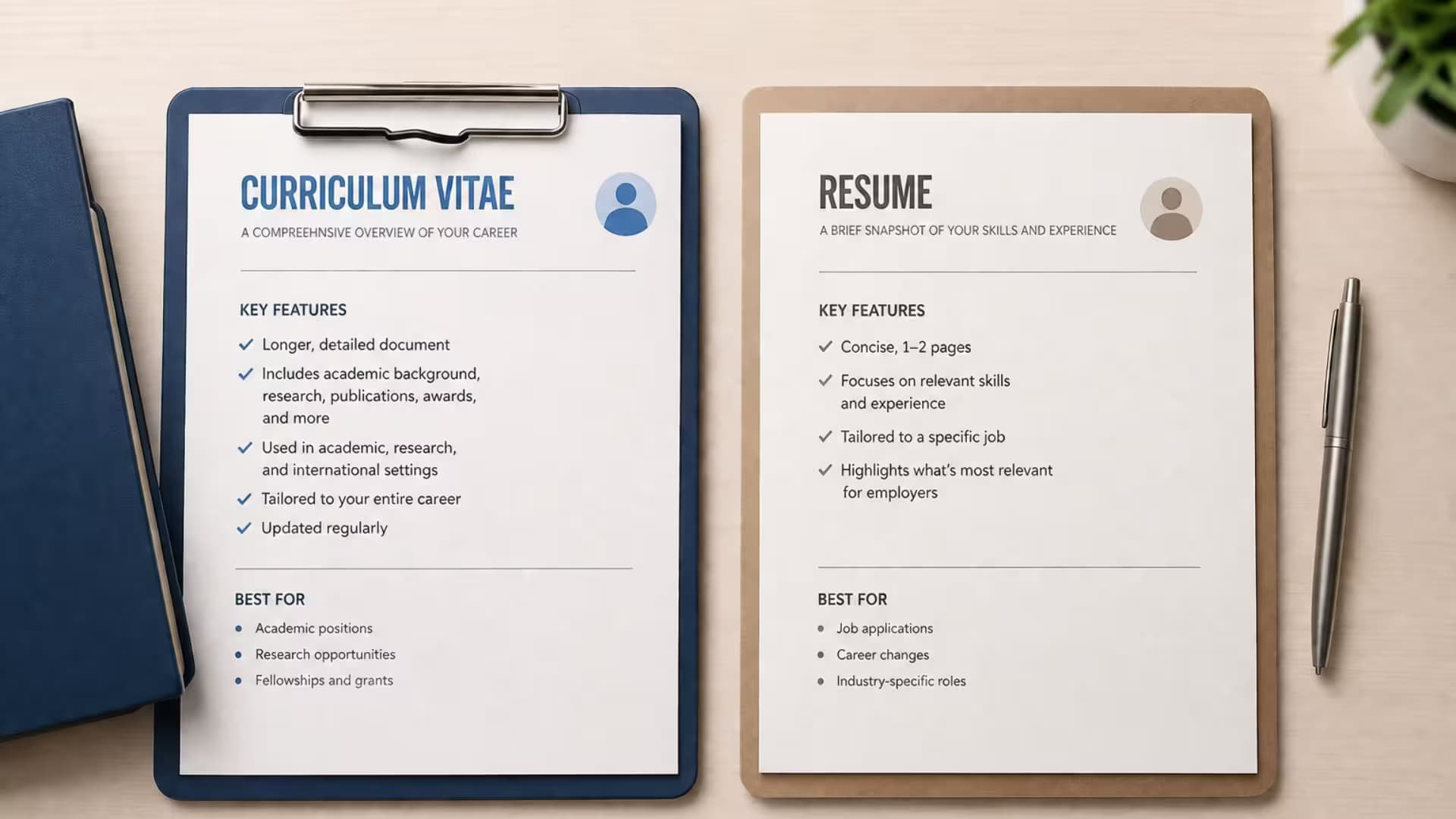
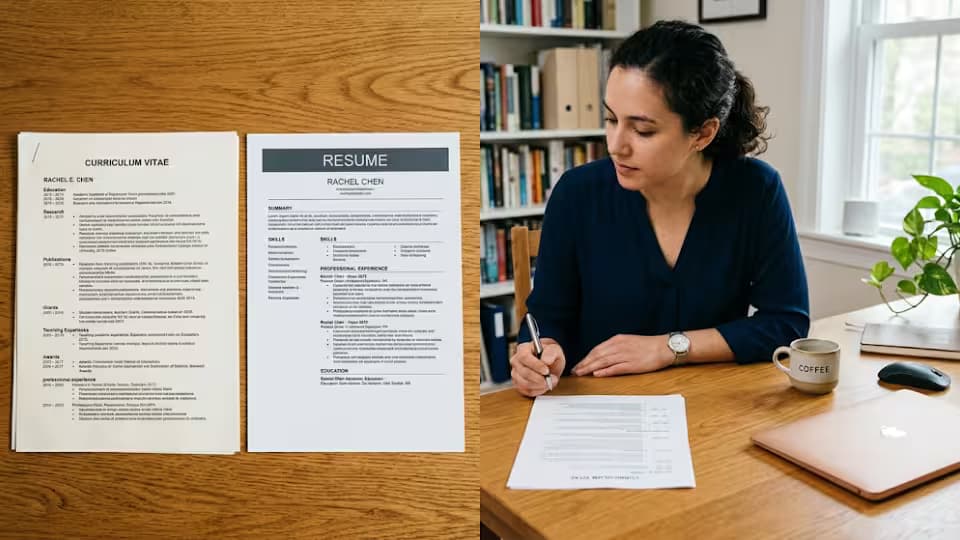
The clearest way to feel the difference is to look at what each document chooses to include and what it deliberately leaves out. The picture below sets them side by side.

A curriculum vitae keeps everything, a resume keeps only what fits the job
A curriculum vitae carries your full work history, your publications, your grants, your talks and your teaching, and it grows over the years into a complete record. A resume takes that same raw material and cuts it hard, keeping only the roles, skills and one or two achievements that speak to the job you are chasing right now. It leaves out long lists, older jobs that no longer matter, and it refuses to pad itself just to reach a certain length. The CV says here is everything I have done. The resume says here is exactly why I fit this.
The difference in length, and why it bites
Length is where the difference first shows itself, and where it first causes trouble. A resume is usually one page, sometimes two, because the reader wants to see your fit fast. A curriculum vitae is at least two pages and often many more, because its reader wants the whole record. This is not a matter of taste. Send a reader the wrong length and you hand them an experience they were not expecting. A quick scanner faced with six pages feels the weight and moves on. A careful academic panel faced with a single thin page wonders what you are hiding. The length itself sends a message before a word is read.
The difference in how you tailor them
There is a difference in habit as well as in content, and it trips people up quietly. A resume is meant to be rewritten for almost every job, sharpened each time to match the advert. A curriculum vitae changes far less often. You build it once as a complete record and update it now and then as your career grows. The mistake here is treating a resume like a CV, writing one version and firing it at every job unchanged, so it fits none of them well. A resume that is not tailored is a resume working at half strength, because its whole purpose is to argue for one specific role.
The mistake of sending a long CV where a resume is wanted
The most common error I see is a candidate sending a long, complete curriculum vitae to an employer who wanted a short resume, usually for a normal job in the United States or Canada. The hiring manager opens a document that runs to several pages, cannot find the point quickly, and moves on to the next applicant before your best material is ever reached. Your experience may be excellent. It simply arrived in a shape the reader did not have the time or the expectation for. In a market where a resume is the norm, a long CV does not look thorough. It looks like someone who did not understand what was being asked.
The mistake of sending a thin resume where a CV is wanted
The opposite mistake hurts just as much. Send a bare one page resume to an academic, medical or research panel that expected a full curriculum vitae, and you look as though you have nothing to show. In that setting the reader is actively searching for your publications, your funding and your teaching, because those are how they judge you. Leaving them out to keep the document short reads as an empty record, even when yours is full. Here, brevity is not a virtue. It is a failure to give the reader what they came for, and it can end a strong candidacy before it starts.
How to tell which one a job wants
Fortunately, the signals are usually easy to read once you know what to look for. Look first at the kind of role. Academic, medical and research posts want a full CV anywhere in the world. Normal jobs want a resume in the United States and Canada, and a CV, meaning the everyday document, in most other places. Look next at the word the advert uses and the country it is in. Look at any length or format instructions the advert gives, because employers often tell you exactly what they want if you read carefully. Put those signals together and the right document is almost always obvious.
A worked scenario
Imagine you are a nurse. You see two openings. The first is a staff nurse role at a hospital in a country where the everyday document is called a CV. You send a clean two page CV that leads with your clinical experience and your key achievements, and you keep it tight. The second is a research fellowship studying patient care. For that one you send a full curriculum vitae that lists your research, any publications, your presentations and your teaching in detail, several pages long, because that panel wants the complete record. Same nurse, same career, two documents shaped to two readers. Get the shape right and each reader gets exactly what they were looking for.
How to avoid getting it wrong
A little preparation makes this almost automatic. Keep both a full master record and a short tailored version ready, so you are never forced to send the wrong shape under time pressure.
1. Check the word the advert uses and the country the job is in.
2. Decide the kind of role, since academic, medical and research posts always want a full CV.
3. For a normal job in the United States or Canada, send a short resume built for that role.
4. For most other countries, and for any research or academic post, send a CV of the right depth.
5. Match any length or format instruction the advert gives, because that is the reader telling you what they want.
6. Keep a full master and a short tailored version, so you can send the right shape in minutes.
Why the difference exists at all
It helps to understand where this split came from, because the history explains the habits. The curriculum vitae is the older idea, a complete record of a person's learning and work, used for centuries by scholars, doctors and researchers who needed to set out everything they had studied and published so their standing could be judged. The resume is the younger, more commercial idea, born of a faster hiring world that could not spare the time to read a full record for every ordinary job. So one document was built to be complete and the other was built to be quick. When you send the wrong one, you are really giving the reader a document built for a different purpose than the one they have in mind, and that mismatch is what quietly sinks applications.
The difference a recruiter actually feels
From my side of the desk, the difference is not an abstract rule. It is a feeling I get in the first few seconds. When I open a resume for a normal job and find a tight, well ordered page that shows me the fit at once, I feel that this person understands what I need and respects my time. When I open a document for the same job and find a sprawling multi page record, I feel a small sinking, because now I have to hunt for the point, and I have forty other applicants waiting. That feeling, repeated across many recruiters and many applications, is the real cost of getting the difference wrong. It is rarely a dramatic rejection. It is a quiet loss of goodwill at the exact moment you needed to earn it.
Turning your CV into a resume without losing your best
Many people resist cutting their curriculum vitae down into a resume because it feels like throwing away good material. It is not. Nothing is lost, because your full CV keeps the master record safe. Cutting a resume from it is simply choosing, for this one job, the few pieces that make the strongest case, and setting the rest aside for another day. The achievement you drop from a resume for a sales job may be the very one you lead with on a resume for a training job. You are not deleting your history. You are selecting from it, on purpose, for one reader at a time. Once you see cutting as selecting rather than losing, tailoring a resume stops feeling like a sacrifice and starts feeling like a strength.
Common mistakes people make
Beyond the two big errors, a few smaller ones cost interviews. People send the same document to every job regardless of country or role. They pad a resume with filler to reach a length, weakening it. They cut an academic CV so short that the very things the reader wanted are gone. They ignore clear length instructions in the advert. And they spend their worry on the label rather than the shape, forgetting that the reader is reacting to the length and content in front of them, not to whether the heading says CV or resume. Fix the shape for the reader and the label mostly takes care of itself.
Questions job seekers ask
Is the difference just the name?
No. The name changes by country, but the real difference is in length, content and how often you tailor the document. A CV is a full record, a resume is a short pitch, and confusing the two can cost you the reader.
What happens if I send the wrong one?
Usually your application is quietly passed over. A long CV can lose a quick scanner, and a thin resume can disappoint a panel that wanted the full record. Neither gets you a fair reading.
Can one document work for both?
A clean master CV can be cut down into a resume in minutes, so in that sense one source serves both. But you should send the shape the reader expects, not the same document to everyone.
How do I know which a specific employer wants?
Read the role, the country and the advert. Academic and research posts want a CV. Normal jobs want a resume in North America and a CV elsewhere. Any length instruction in the advert is a strong clue.
Does the difference matter early in my career?
Yes. Even a first job usually calls for a short resume, while staying in academia calls for the start of a CV. Sending the wrong shape can hurt you just as much at the beginning as later on.
A quick self test before you send
Before any application leaves your hands, put it through one honest test that takes half a minute. Picture the person who will open it. Are they a busy manager filling a normal job, or a panel weighing a research or academic record? Now look at what you are about to send. If it is a manager and your document runs to five pages, you are about to send the wrong shape, and you should cut it to a sharp one or two page resume. If it is a panel and your document is a single thin page, you are about to sell yourself short, and you should send the full record instead. This one test, applied every time, catches almost every version of the mistake this guide warns about, and it costs you nothing but a moment of imagining the reader on the other side.
The habit behind the test is simple but powerful. Always write for the specific person who will read the document, not for a general rule you half remember. Rules are useful, but readers are real, and it is a real reader who decides whether you get the interview. Give that reader the shape they expect, filled with your honest results, and the difference between a curriculum vitae and a resume will always work in your favor rather than against you.
A final word
The name on the document matters less than the shape underneath it. A curriculum vitae is a complete record, a resume is a sharp pitch, and the harm comes not from choosing the wrong word but from sending the wrong shape to the reader. Match the shape to the reader every time, keep both a full record and a short tailored version ready, and the difference between a curriculum vitae and a resume stops being a trap that costs you interviews and becomes a tool you use to win them.
Recruiter tip: If an advert is silent on length and you cannot tell the local habit, send a focused two page document. It is long enough to prove you can do the job and short enough to respect the reader's time.
Sources
• TopCV, resume versus CV differences by country