You can read advice about curriculum vitae writing all day and still stare at a blank page. What helps far more is seeing a finished CV and understanding why it works, line by line. So here are three complete examples I built for people at different stages of their careers, a graduate, an experienced professional and an academic. Study them, then borrow the thinking, not the words. By the end you will not just have seen a good CV. You will know what makes it good, which is the part you can carry into your own.
Before we look at the examples, one warning. Do not copy any of these word for word. A recruiter can tell in a moment when a CV has been lifted from a sample, because the achievements sound generic and none of the numbers belong to the person in front of them. The value of an example is in the pattern it shows you, the way it opens, the way it turns a job into a result, the way it orders its sections. Take the pattern and fill it with your own true life.
How to read a CV the way a recruiter does
To learn from these examples, look at them the way I would. Start at the top third of the first page and ask, do I know within seconds who this person is and what they are good at? Then run your eye down the left edge, where the job titles and dates sit, and see whether the story is easy to follow. Then look at the lines under each job and ask whether they show results or just list duties. A strong CV passes all three tests without effort. As you read each example below, try these three questions yourself, and you will start to see the craft underneath the tidy page.
Example one: a graduate curriculum vitae
Amara is a recent marketing graduate with little paid experience. Her challenge is the one most new graduates face, which is how to look employable when you have not yet held a full time job. Notice how she makes the most of what she has rather than apologizing for what she lacks.

A graduate CV that leads with a clear profile and real results
This CV works because it does not shrink from being early in a career. It opens with a short, confident profile that names what she can do rather than begging for a chance. It turns a volunteer role into a genuine achievement by showing a number, growing a page from four hundred to two thousand one hundred followers, which is the kind of concrete result a reader remembers. It lists coursework, a final year project with a grade, and a certificate, all of which fill out a thin work history with real evidence of ability. And it stays on one page, which is exactly right for someone at this stage, because a graduate who stretches to three pages is padding rather than proving.
Look also at what she leaves out. There is no long list of every part time job unrelated to marketing, no paragraph about hobbies at the top, no vague claim to be a hard working team player. Every line earns its place by pointing at the job she wants. That discipline is what lifts a graduate CV above the pile of others that all say the same empty things.
Example two: an experienced professional curriculum vitae
Mateo has nine years behind him, so his CV has a very different job to do. It has to sort a large amount of experience into something a reader can absorb quickly, without losing the weight of what he has achieved. The danger at this stage is not too little to say but too much, so the skill is selection and order.

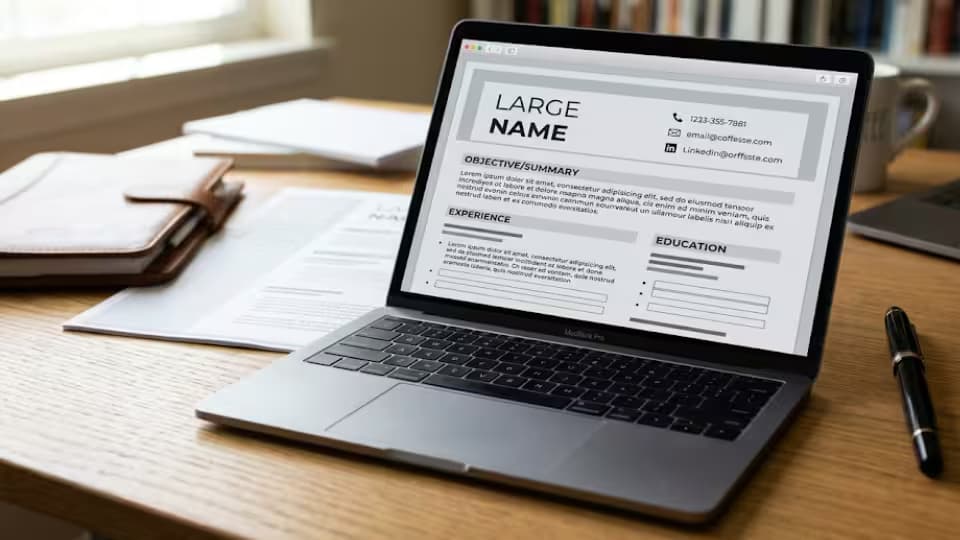
A mid career CV that uses a side column to keep skills easy to scan
This one works because it leads with results, not duties. Every role shows an outcome, such as cutting warehouse time by twenty two percent or managing a budget of two and a half million euros, so a reader learns not just what he was responsible for but what changed because he was there. The side column keeps skills, tools, certifications and languages within easy reach without crowding the main story, which lets the experience breathe. The most recent and most senior role sits at the top, where the reader looks first, and the older roles shrink as they go down, because they matter less to today's decision.
Notice the restraint in the numbers. He does not claim a result for every single line, which would strain belief. He picks the strongest one or two outcomes under each role and lets them carry it. A CV full of suspiciously round achievements reads as invention. A CV with a few real, specific numbers reads as truth, and truth is what earns the interview and survives the questions that follow.
Example three: an academic curriculum vitae
Priya is a researcher, and her CV follows completely different rules from the other two. Here, more really is more, because the reader is a panel weighing the depth of a body of work rather than a manager scanning for quick fit. What would be padding on a normal CV is exactly what this reader wants.

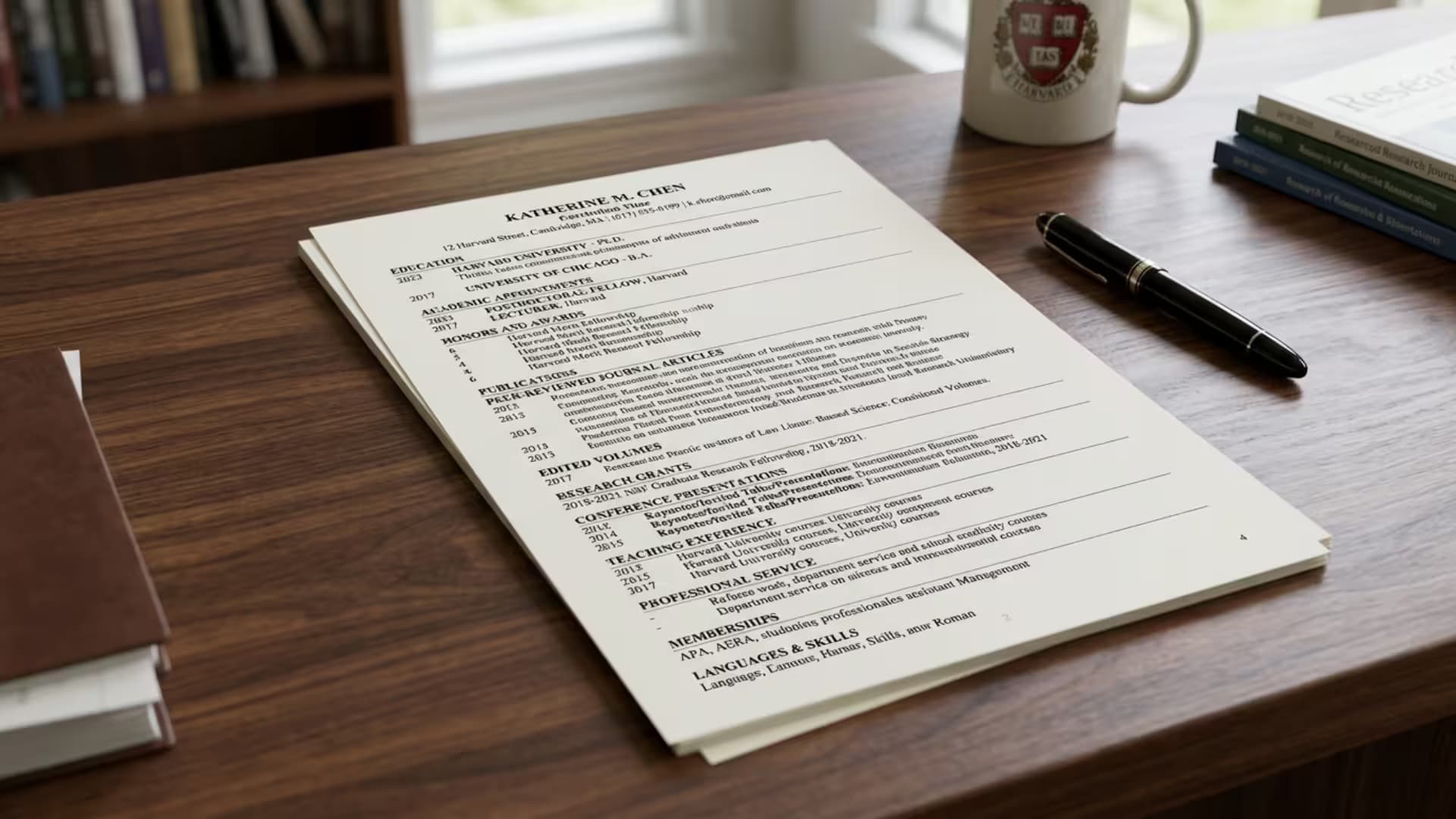
An academic CV lists publications, grants and talks in full, and runs to several pages
This CV works because it does what academic readers expect. It lists publications, grants, teaching and conference talks in full, because in that world these are the measures of standing, and leaving them out would be like hiding your best work. It would be a real mistake to squeeze this onto one page, because the panel is reading for completeness and would wonder what was missing. What you are seeing here is only the first page of a longer document, and that length is a strength, not a fault, so long as everything on it is real and relevant.
The lesson from Priya's CV is that context sets the rules. The same person, applying for a job outside academia, would cut this down to a two page resume in a heartbeat. The document is long here not because long is good, but because this particular reader wants the full record. Always write for the reader in front of you, not for a rule you half remember.
What the three examples share
Different as they are, the three CVs share the same good habits, and these are the habits to carry into your own. Each one opens with the most important information, so the reader is rewarded in the first few seconds. Each uses plain, specific language rather than vague claims. Each shows results with numbers wherever it honestly can. Each is ordered so the strongest material sits highest. And each is built for its particular reader, whether that reader is a hiring manager skimming for fit or an academic panel checking a full record. Master those five habits and you can write a strong CV at any stage of any career.
Turning a weak line into a strong one
The single biggest change you can make to your own CV is to turn duties into results, so it is worth seeing a few side by side. Weak: responsible for managing the store's stock. Strong: managed stock for a busy store and cut shortages by a third in six months. Weak: helped with the company's social media. Strong: ran the company's social media and grew followers from two thousand to nine thousand in a year. Weak: dealt with customer queries. Strong: resolved customer queries and lifted our satisfaction score from three stars to four and a half. In each case the strong version names what changed and puts a number to it. That is the whole trick, and you can apply it to almost every line you write.
How to adapt an example to you
Here is the honest way to use these examples. Pick the one closest to your own stage and open it beside a blank document. Copy the shape, the order of the sections, the way each job leads with a result, the length. Then throw away every word of the content and replace it with your own real history. Where Amara grew a page to two thousand followers, you write the true number from your own life. Where Mateo cut warehouse time by a fifth, you write the real result you delivered. The example gives you the frame and the rhythm. Your career fills it with truth, and truth is the one thing no example can give you.
Common mistakes when learning from examples
A few traps catch people who work from examples. Some copy the sample achievements word for word, so their CV claims results that are not theirs, which falls apart the moment an interviewer asks about them. Some keep the example's job titles or industries even when they do not match their own, creating a document that does not add up. Some copy a graduate example when they are experienced, or an academic example when they are applying for a normal job, so the shape fights their stage. And some polish the design of the example while ignoring the thing that actually made it work, which was the specific, honest results. Avoid these, take the pattern rather than the words, and an example becomes a teacher rather than a trap.
Questions job seekers ask about CV examples
Can I copy an example CV and just change the details?
Change far more than the details. Keep the structure and the way each job leads with a result, but write every line about your own real work. A recruiter can spot a lifted example, and the generic achievements let you down in the interview.
Which example should I follow?
Follow the one closest to your stage. A graduate should learn from the graduate example, an experienced worker from the professional one, and someone applying for research or teaching from the academic one. Matching the example to your stage matters more than the design.
My results are not as impressive as the examples. What do I do?
Use your real numbers, whatever they are. A small, true result beats a large, invented one every time, because the true one holds up when you are asked about it and the invented one collapses.
How long should my CV be, based on these examples?
One page for a graduate, two pages for an experienced professional, and several pages only for academic or research roles. Let your stage and your reader set the length, exactly as the three examples do.
Do these examples work for any country?
The habits do, but adjust the details for local custom, such as whether to include a photo or a date of birth. The way of showing results and ordering sections travels well almost everywhere.
A final word
A good example is one of the fastest teachers a job seeker has, as long as you learn the right lesson from it. Do not copy the words. Copy the thinking, the clear opening, the results with numbers, the order that puts your best first, the length that fits your stage and your reader. Fill that frame with your own true history, and you will end up with a CV that looks like the strong examples here and reads unmistakably like you.
Recruiter tip: Pick the example closest to your own stage and write your CV beside it on the screen. Match the structure section by section, but replace every claim with something real from your life. You will finish faster and sound like yourself.
Sources
• Indeed, CV examples and templates
• Harvard, resume and CV guidance