People throw these two words around as if they are the same, and often they are. But when they are not the same, the gap between them is wide, and knowing it saves you from sending a document that feels wrong for the job. Here is the honest comparison, laid out plainly, so you understand not just which is which but why the difference exists and what it means for the document you send. I have read both kinds for years, and the candidates who understand the difference send sharper applications than those who do not.
I will start with the single idea behind both documents, then set them side by side in a table, then take each real difference in turn, one section at a time. Along the way I will show you two worked examples of the same person building each document, because seeing it is worth more than being told. By the end you will be able to look at any advert and know at once which document it is really asking for, and how to shape it.
Two words for a similar job
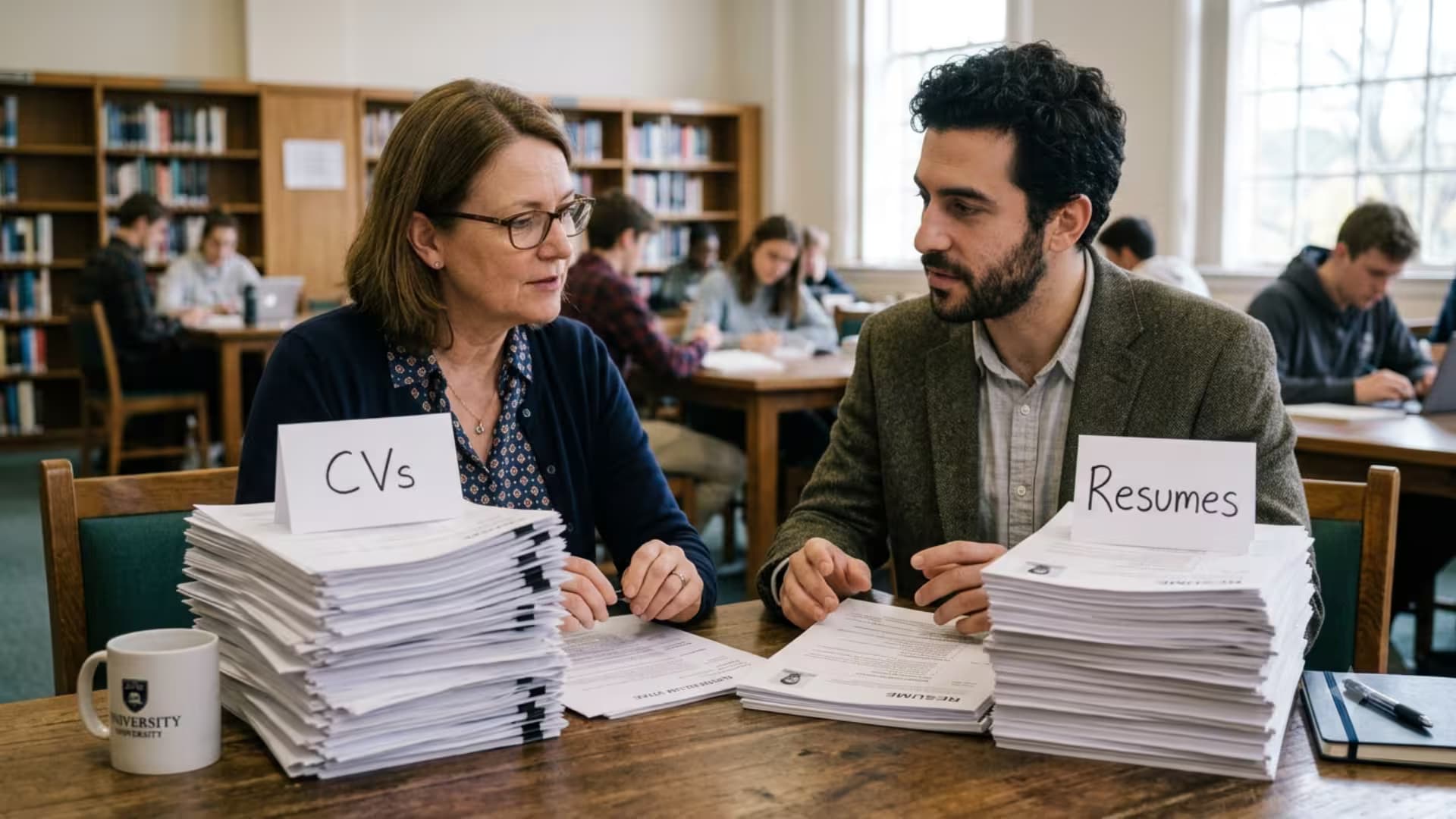
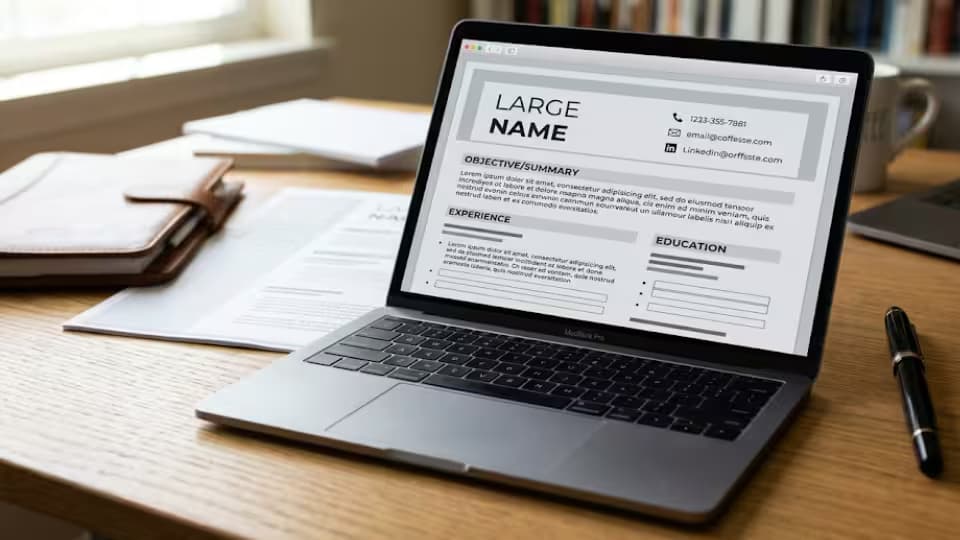
Both a curriculum vitae and a resume exist to do the same basic thing, which is to summarize your working life and win you an interview. Neither is your full life story, and neither is an application form to be filled to the brim. Both are marketing documents that put your best and most relevant material in front of a busy reader who has many others to get through. The difference between them is in how much they carry, how long they run, and how often you change them. The picture below shows the idea at a glance, and the sections that follow break it down.

A curriculum vitae is long and complete, a resume is short and targeted
The comparison at a glance
Feature | Curriculum vitae | Resume |
Length | Two pages, or many more for academic roles | One page, sometimes two |
Purpose | A full record of your career and study | A quick pitch for one particular job |
Detail | Comprehensive, leaves little out | Selective, only what fits the role |
Publications | Listed in full for academic work | Rarely included |
Tailoring | Changed rarely, grows over time | Rewritten for almost every job |
Where it is standard | United Kingdom, Europe, and academia worldwide | United States and Canada for most jobs |
Where the two documents come from
It helps to know why these two documents grew apart, because the history explains the habits. The curriculum vitae is the older idea, a complete record of a person's learning and work, used for centuries by scholars, physicians and researchers who needed to set out everything they had studied and published. The resume is the younger and more commercial idea, born of a faster hiring world that did not have time to read a full record for every ordinary job. So one document was built to be complete and the other was built to be quick. Almost every difference between them flows from that single split in purpose, and once you see it, the rest makes sense.
The difference in length
The curriculum vitae is the longer of the two because it is meant to be complete. In academic and research work, the reader actually wants the full list of your papers, your funding, your talks and your teaching, because that is precisely how your standing in the field is judged. A resume is the opposite. It is short on purpose, usually one page and rarely more than two, because a hiring manager for a normal job wants to see, fast, that you fit this one role and nothing more. Length is not a sign of effort or seriousness. In a resume, shorter is stronger, and a candidate who can make the case in one clean page often looks sharper and more confident than one who spreads it thinly across three.
The difference in purpose
A curriculum vitae is a record. Its job is to document your whole career and study in one place, and it grows steadily as you do. A resume is a pitch. Its job is to argue, quickly and persuasively, that you are right for one particular opening. This difference in purpose quietly explains everything else about them. A record aims to be complete, so it keeps things in, even small talks and older roles. A pitch aims to persuade, so it leaves things out that do not serve the argument. When you understand that one document is a record and the other is a pitch, you know instinctively what belongs in each, without needing a rule for every line.
The difference in content
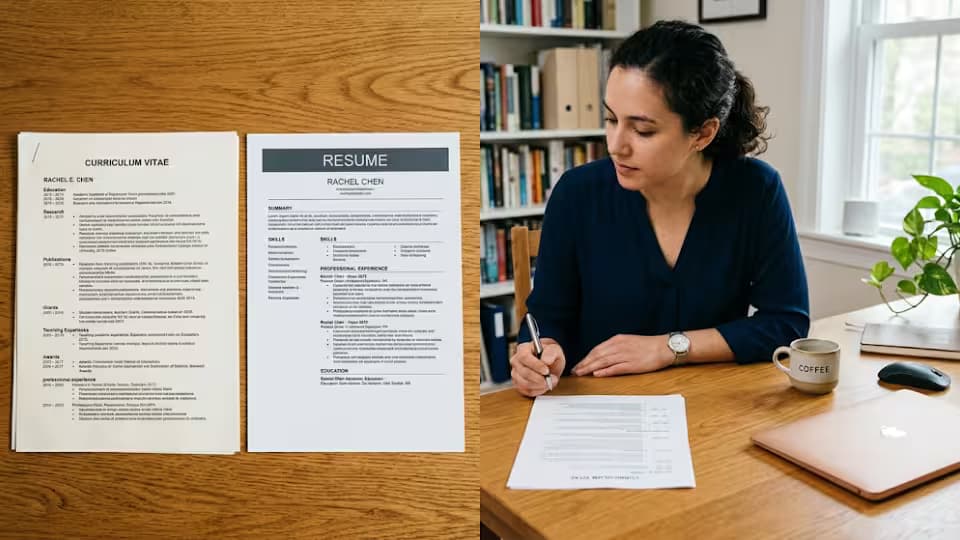
A curriculum vitae aims to show the whole picture, so it carries your full history in order, along with publications, grants, talks and teaching wherever they apply. A resume is edited down hard to what matters for the job in front of you, which means you may leave out older roles, trim your education to a line or two, and drop anything that does not help your case for this specific opening. The same person can and should keep both, and use whichever the situation calls for. The clearest way to picture it is that the resume is a sharp selection cut from the fuller record of the CV, keeping only the pieces that speak to one reader.
The difference in tailoring
There is a difference in habit as well as in content, and it is one many people miss. A resume is meant to be rewritten for almost every job, sharpened each time to match the advert, with the most relevant experience moved to the top and the language matched to the words the employer used. A curriculum vitae changes far less often. You build it once as a complete record and update it now and then as your career grows, adding a new role or a new publication. If you find yourself heavily rewriting a full CV for every single application, you are probably doing resume work under the wrong name, and you would be far better served keeping a master CV and cutting fresh, tailored resumes from it each time.
The difference in how a recruiter reads them
The two documents are also read differently, because the reader wants different things. When I read a resume for a normal job, I am scanning quickly for fit, looking to see in seconds whether this person can do this role, so a short, sharp, well ordered page is a gift. When a panel reads an academic curriculum vitae, they are studying it, checking the depth and quality of a body of work, so length and completeness are exactly what they are looking for. Sending the wrong document means giving the reader an experience they were not expecting, either a wall of detail to a quick scanner or a thin page to a careful studier, and both feel wrong to the person on the other side.
A worked example: the same teacher, two documents
Picture the same person, a teacher, applying for two very different things. For a normal teaching job at a school, she sends a two page resume that leads with her classroom results, the subjects she teaches, one or two standout achievements such as lifting a class's pass rate, and a short skills section, and she leaves out the small conference talk she once gave. For a university research post, she sends a full curriculum vitae that lists every publication, every talk, every grant and all her teaching in careful detail, running to several pages, because that panel wants to weigh the whole body of work. Same person, same career, two documents shaped by two very different readers. That is the difference in action, and it is why one document could never simply be sent in place of the other.
A second worked example: the graduate
Now picture a new graduate. For a first job at a company, he builds a one page resume that opens with a short profile, then shows his degree, an internship with a real result, and the skills the advert asked for, and nothing else, because he wants the reader to see his fit in one glance. If that same graduate were applying to stay in academia for a research degree, he would begin building a curriculum vitae instead, starting to list his dissertation, any conference poster, and his teaching assistance, knowing that this document will grow over the years into a full record. Even at the very start of a career, the choice between a pitch and a record shapes what you write.
The difference in geography
Where you are decides a great deal, and it is the source of most of the confusion around these two words. In the United Kingdom, most of Europe and much of the world, people use the word CV for the short everyday document and treat resume as a foreign word for the same thing, so the two are effectively the same there. In the United States and Canada, the two are genuinely different, with the resume being the short document for normal jobs and the curriculum vitae being a long academic record. Calling a short one page pitch a curriculum vitae in the United States would raise an eyebrow and suggest you did not know the market. Indeed and TopCV both set out this geographic split in detail. Know your reader, and the choice becomes obvious rather than confusing.
So which should you use?
Let the job and the place decide, in that order. For any academic, medical or research role anywhere in the world, use a full curriculum vitae, because completeness is what those readers want. For a normal job in the United States or Canada, use a short resume. For most normal jobs elsewhere in the world, use a CV, and understand that in those places the word simply means the everyday document rather than a long academic one. When the advert names a single word, match it. When it names both, send a clean two page document and you have answered the request without having to guess.
How to build a resume from your CV, step by step
If you already have a full curriculum vitae, turning it into a resume is a matter of cutting, not writing from scratch, which is the easiest way to work.
1. Copy your full CV so you never cut into the master version by accident.
2. Read the job advert and underline the skills and requirements it names.
3. Keep only the roles and achievements that speak to those requirements, and delete the rest.
4. Move your strongest, most relevant experience to the top of the first page.
5. Trim your education and older jobs to a line each, and cut anything that does not earn its place.
6. Stop when it fits one page, or two at most, and reads sharply from top to bottom.
What you are left with is a resume, cut cleanly from the fuller record of your CV. Because you started from a complete master, nothing true was lost. It is simply waiting in the master version for the next job that needs it.
How a CV grows over a career
The curriculum vitae works the other way. You do not rewrite it for each job. You let it grow. Each time you finish a project worth remembering, publish something, earn a qualification or take on a new role, you add it to the master while the details are fresh. Over the years this becomes a complete and accurate record of everything you have done, which is exactly what an academic or research reader wants to see, and exactly what you cut your sharp resumes from. Tending your CV a little at a time is far easier than trying to rebuild your whole history from memory when a big opportunity suddenly appears.
Common mistakes people make
The errors are predictable once you understand the difference. People pad a resume to reach a length, when shorter and sharper would have been stronger. They cram an academic CV onto one page, hiding the very publications the reader was looking for. They send the same document everywhere without shaping it to the job or the country. They confuse the two words in the United States, sending a long CV where a short resume was wanted. And they spend their energy on the label rather than the content, forgetting that a reader is persuaded by results, not by whether the heading says CV or resume. Each of these mistakes comes from not seeing that one document is a record and the other is a pitch.
Questions job seekers ask
Is a CV longer than a resume?
Usually yes. A resume is one or two pages. A curriculum vitae is at least two pages and can run to many more for academic and research roles, where completeness is expected and rewarded.
Can I just use my CV as a resume?
Not directly. Cut your CV down to the roles, skills and achievements that fit the specific job, and keep it to one or two pages. That shorter, sharper version is your resume, and it will always beat sending the full record where a pitch was wanted.
Which one do employers prefer?
It depends entirely on where they are and the kind of job they are filling. There is no universal preference. Match the document to the reader, and you will always be sending exactly what they prefer.
Do I include publications on a resume?
Rarely. Publications belong on an academic curriculum vitae. On a resume for a normal job, they usually just take up space the reader would rather see spent on your results and skills.
Should both documents look the same?
They can share the same clean design, which keeps your applications consistent, but the content differs. The CV is complete, the resume is selective. Same frame, different amount of detail inside it.
I am early in my career. Does the difference still matter?
Yes. Even a first job usually calls for a short resume, while staying in academia calls for the beginnings of a CV. The choice between a pitch and a record shapes your document from the very start.
A final word
The truthful answer to curriculum vitae versus resume is that it depends where you stand and what you are applying for. One is a complete record, the other a sharp pitch, and each is right for its own reader. Keep a full master version of your career, cut tailored versions from it, and match the document to the reader every time. Do that, and the difference between the two stops being a source of worry and becomes a tool you reach for on purpose, sending exactly the document each job deserves.
Recruiter tip: Keep a master document that holds everything you have ever done. It is your long curriculum vitae. When a specific job appears, copy from it and cut it down into a sharp resume. Building down from a full record is far easier than trying to remember your history from scratch each time.
Sources
• TopCV, resume versus CV differences by country