This is one of those small worries that can hold you up for far too long. You are about to name a document or write a sentence, and suddenly you are not sure whether it is curriculum vita or curriculum vitae. You stare at the screen, second guess yourself, and lose ten minutes to a question that should take ten seconds. Let me settle it for you quickly, then explain where the confusion comes from, so you never have to pause on it again.
I am a recruiter, not a Latin teacher, and I will treat this the way a busy job seeker needs it treated. The short version comes first. Then, if you want to understand why, the rest of the guide explains the roots, the plural, the spelling, the worldwide usage and the pronunciation, and it ends with the only part that truly affects your job hunt.
The short answer
When you mean the document you send to employers, the correct term is curriculum vitae, and you shorten it to CV. That is the form used across most of the world and the one you should use. Curriculum vita, without the final letter, exists too, but it belongs mainly to American academic life, and for everyday job hunting it can look like a slip. If you remember one thing from this guide, remember this. Use curriculum vitae, and spell it the same way every time. The picture below shows why the phrase is built the way it is.

Curriculum vitae is a Latin phrase meaning the course of your life
What the Latin actually means
Curriculum vitae is a Latin phrase. Curriculum means a course, or a running, the path you have travelled. Vitae means of life. The word for life on its own is vita. When you change the ending and make it vitae, it becomes of life. So curriculum vitae means the course of your life, which is a rather graceful way to describe a job document. You can see the roots explained at Merriam-Webster. Once you picture it as the course of your life, the two words stop feeling like a spelling trap and start making sense.
A quick history of the phrase
The phrase has been in English use for a long time, borrowed from Latin the way many learned terms were. For centuries the document itself was mainly the tool of scholars, doctors and men of letters, who used it to record their studies and their published work. That is why, to this day, the fullest version of a CV belongs to academic and research life. The everyday job hunting CV, the short two page summary most of us send, is a much later and more practical descendant of that older scholarly record. Wikipedia traces the story if you are curious. Knowing the history helps one thing make sense, which is why the same word can mean a two page summary in one setting and a ten page academic record in another.
Vita and vitae, and why it is not a plural
Here is the point that trips up even careful writers. Many people assume vitae is the plural of vita, in the way that adding a letter often makes a plural in Latin. In this phrase it is not. Vitae here is not a plural at all. It is the form that means of life. So curriculum vitae does not mean courses of life. It means the course of one life, yours. Knowing this saves you from the mistake of thinking you have already made the phrase plural, which leads people astray when they try to talk about more than one.
Where curriculum vita comes from
You are not imagining things when you see curriculum vita without the second letter e, or simply the word vita on its own. Some universities, mainly in the United States, use curriculum vita, or shorten the whole thing to a vita, when they mean an academic record. In that world it is accepted and understood. So if you are applying inside American academia and you see the word vita, do not be alarmed. It is the same idea. For everyday job hunting outside that world, though, curriculum vitae is the safer and more widely understood choice, so that is what I would tell you to use.
How the word is used around the world
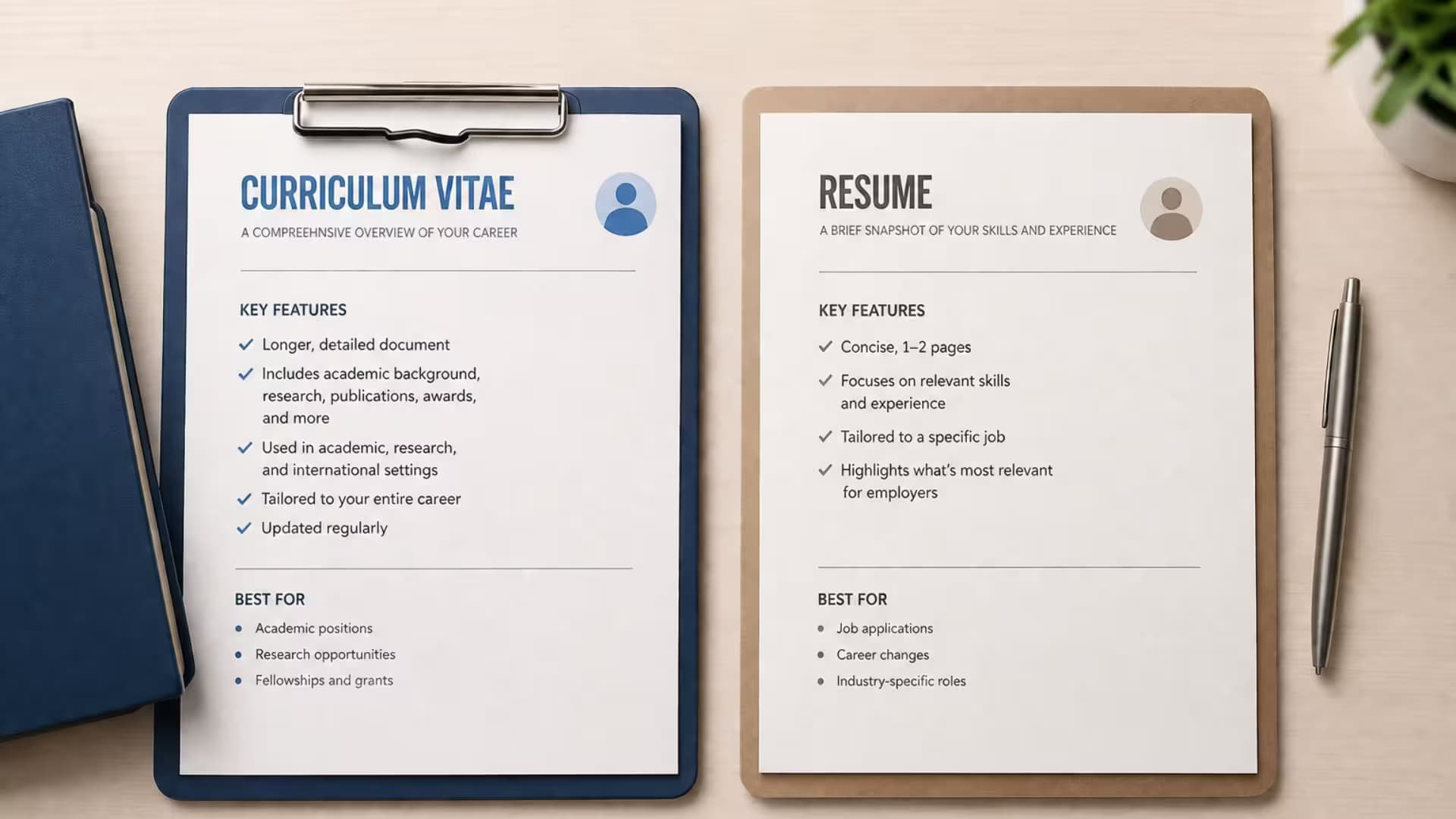
Part of the confusion comes from the fact that the same words travel differently in different places. In the United Kingdom, most of Europe, and much of Africa and Asia, people say CV for the ordinary document they send to get a job, and they use it for almost every role. In the United States and Canada, the word curriculum vitae is reserved for the long academic and research record, and the everyday document is called a resume instead. So when an American job advert asks for a CV, it usually means a research post, while a British advert asking for a CV just means a normal two page summary. Same two words, different expectations, and knowing which world you are in saves you from sending the wrong kind of document.
Curriculum vitae, resume, and bio data
There is a third word you may meet, especially in parts of South Asia and Africa, which is bio data. A bio data sheet is an older style of personal document that often leads with personal details such as date of birth, marital status and sometimes a photograph, followed by education and work. In modern hiring, a curriculum vitae or a resume is almost always the better choice, because it leads with what you can do rather than who you are on paper. If an employer specifically asks for bio data, give them what they ask for, but for most applications today, a clean CV serves you far better. There are separate guides in this series that compare a curriculum vitae with a resume in full.
How do you write the plural?
If you ever need to talk about more than one, the Latin plural is curricula vitae. Notice that it is the first word that changes, from curriculum to curricula, because that is the word being counted. It looks unusual because English does not form plurals that way, and almost nobody says it in normal speech. In real life you will rarely need it, and there is no shame in simply writing CVs instead, which everyone understands. Wikipedia has more on the grammar if you enjoy that sort of thing.
How do you say it out loud?
People pronounce it in a few different ways, and all of them are accepted. Some say vee-tie, some say vee-tay, some say vy-tee. You will hear different versions in different countries and even in different offices in the same city. None of these will mark you out as wrong in an interview, so say it the way that feels natural where you live and move on. If it helps, most people in an interview will simply say CV anyway, which sidesteps the question entirely.
CV, C.V., and writing it in full
You will see the short form written as CV and, less often, as C.V. with periods. Both are understood, and the plainer CV without periods is the more common choice today. When you first mention it in a formal document, it can read well to write curriculum vitae in full and then use CV afterward, in the same way you might introduce any term before shortening it. On the document itself, a simple heading of Curriculum Vitae, or even just your name, is all you need. You do not have to label it at all, since the reader already knows what they are looking at.
Capital letters and italics
Two small style questions come up often. Do you capitalize curriculum vitae, and do you put it in italics? In ordinary writing, you do not need capital letters unless it begins a sentence or sits as a heading. As a heading on the document, capital letters look neat, as in Curriculum Vitae. As for italics, some style guides treat it as a foreign phrase and italicize it, while most now treat it as an ordinary English term and leave it upright. For a CV you are sending to an employer, plain upright text is perfectly correct and the safest choice. Do not lose a moment over it.
How to title and name your document
Here is the practical version of everything above. At the top of the document, you can write Curriculum Vitae as a heading, or you can simply put your name in large letters, which many modern CVs do and which reads cleanly. When you save the file, name it with your own name and the letters CV, for example Amara_Okafor_CV.pdf, and keep that spelling consistent with whatever you wrote in the heading. That way the heading, the file name and the content all agree, and nothing on the document contradicts anything else. It is a small discipline that quietly signals care.
Common spelling and usage mistakes
A handful of small errors turn up again and again. People write vitae when they mean the plural and think the job is done, when the plural is actually curricula vitae. They mix spellings within a single document, writing vitae in the heading and vita in the file name, which a careful reader notices at once. They add an apostrophe where none belongs. And they agonize over the Latin while letting a real spelling mistake slip through elsewhere on the page. The lesson is simple. Pick one correct form, use it everywhere, and spend your attention on the content, where it actually counts.
Does any of this matter to a recruiter?
Here is the honest truth from my side of the desk. When I read your application, I am not grading your Latin. I care about what you have done and whether you can do the job. I have never once rejected a candidate for saying vee-tay instead of vee-tie, and no reasonable recruiter would. What does matter, and matters a great deal, is that the words actually printed on your CV are spelled correctly and used consistently. A spelling mistake in your own document tells me you did not check your work, and that is a far bigger problem than choosing vita or vitae.
So the practical order of things is this. Choose curriculum vitae. Spell it the same way every time, in the heading and in the file name. Then forget about it and pour your energy into the parts of the CV that decide whether you get the interview, which are your experience, your results and your clarity. The Latin is a footnote. Your record is the story.
Curriculum and curricula, the other meaning
One more thread adds to the muddle, and it is worth untangling. The word curriculum on its own has a second everyday meaning, which is the course of study a school or college teaches. In that sense, the plural you will hear is curricula, as in the curricula of several universities. This is the same Latin root, the idea of a course, applied to learning rather than to a life. It is why the word can feel slippery. When you are talking about your job document, you want curriculum vitae, the course of your life. When you are talking about what a school teaches, you want curriculum on its own, and curricula for more than one. Keeping these two uses separate in your mind stops the words from tangling.
The bigger question behind this one
Often, when people ask whether it is vita or vitae, the real question underneath is a larger one, which is whether they should be sending a curriculum vitae at all, or a resume, or something else. That is a more important question than the spelling, and it depends on where you live and the kind of job you want. If that is what is really on your mind, the spelling is the easy part, settled here, and you can turn to the separate guides in this series that compare a curriculum vitae with a resume and help you choose which to send. Get the choice right first, then simply spell whichever you choose correctly and consistently.
Questions job seekers ask about the words
Is it CV or C.V.?
Both are understood, and CV without periods is the more common and cleaner choice today. Pick one and use it consistently.
Do I capitalize curriculum vitae?
Only when it begins a sentence or serves as a heading. In the middle of a sentence, small letters are fine. As a title on the document, Curriculum Vitae in capitals looks neat.
Should it be in italics?
You do not need italics. Most writers now treat it as an ordinary English term and leave it upright, which is perfectly correct for a job document.
Is curriculum vita simply wrong?
Not wrong, but narrow. It is used mainly in American academic settings. For general job hunting, curriculum vitae is the safer and more widely understood form.
What is the plural of curriculum vitae?
The Latin plural is curricula vitae. In everyday writing, most people simply say CVs, which everyone understands and nobody will question.
Is a CV the same as bio data?
Not quite. Bio data is an older style that leads with personal details. A CV leads with your skills and experience, which is what most employers want to see today. Send bio data only if it is specifically requested.
When the employer uses a word you do not expect
Sometimes an advert will use a word that throws you, asking for a personal profile, a professional summary, an application document, or one of the terms we have looked at. Do not overthink it. In almost every case they want the same thing, a clear summary of who you are and what you have done, well presented and easy to read. Send your curriculum vitae, and if the advert used a particular word, echo that word in your covering message so the reader sees that you paid attention. The name on the request matters far less than whether the document underneath answers it. A strong, well ordered CV answers almost every version of this request.
A simple rule to keep it straight
If you take nothing else from this guide, take this small rule and you will never stumble on the words again. For the document you send to get a job, write curriculum vitae, shorten it to CV, and keep that exact spelling in your heading and your file name. Reserve the word curriculum on its own for a course of study, and use curricula only when you mean more than one such course. Do not worry about italics, do not fret about the plural you will almost never need, and do not let any of it distract you from the work that decides the outcome, which is making your experience clear and your results plain. Spell it right once, then let it go.
A final word
Do not lose sleep over vita or vitae. It is a small question with a simple answer. Use curriculum vitae, shorten it to CV, keep your spelling consistent, and then turn your full attention to the content that actually earns you interviews. The Latin is a pleasant piece of history. Your results are what get you hired.
Recruiter tip: Whatever you name the file, keep it consistent. If your heading says Curriculum Vitae and your file name says vita, that small mismatch is exactly the kind of thing a careful reader notices, and it plants a needless doubt about your attention to detail.
Sources
• Merriam-Webster, definition of curriculum vitae
• Chicago Manual of Style, curriculum vitae usage