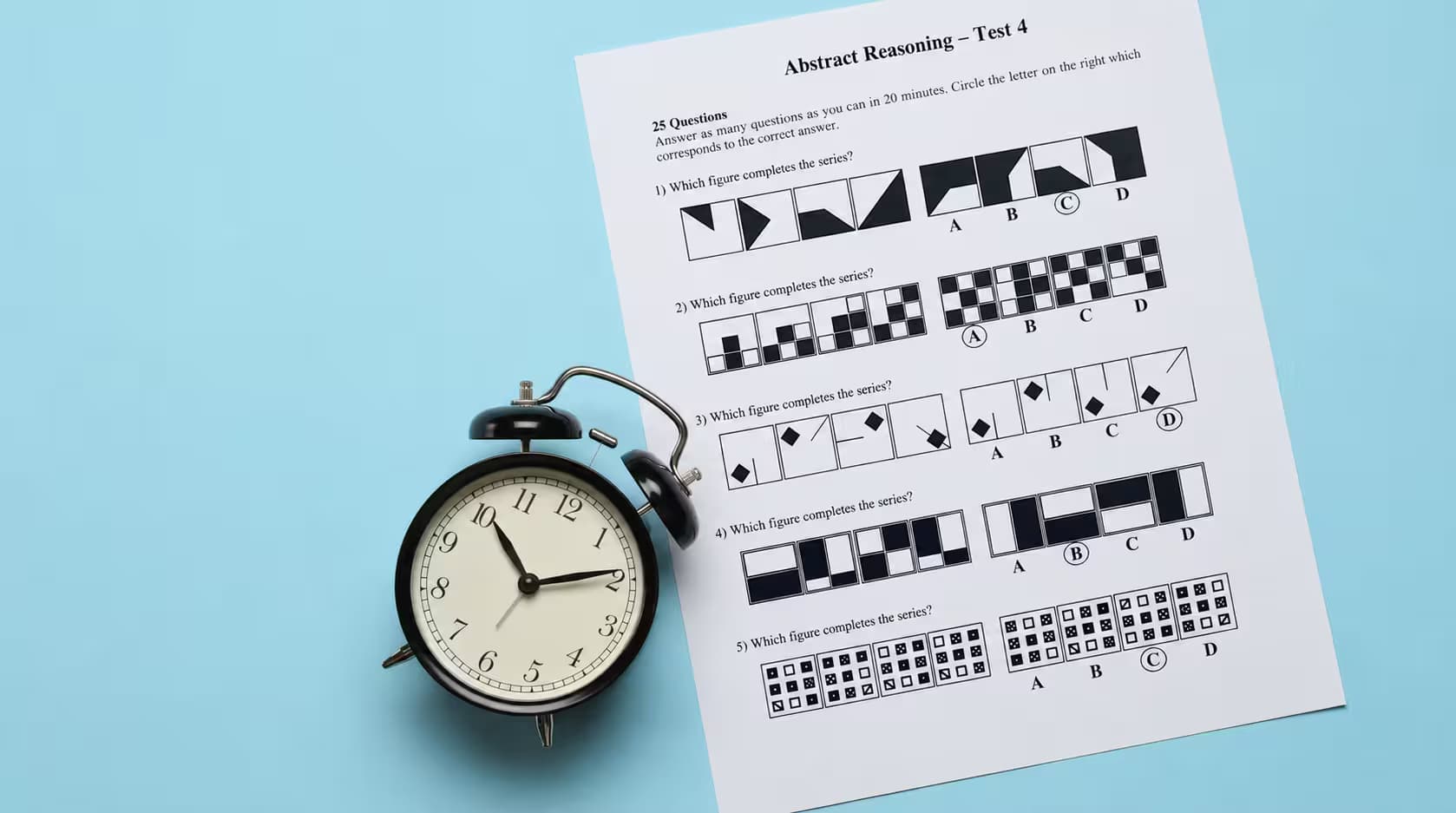
Abstract reasoning examples are best understood by the kind of rule each one hides. Most questions use a small family of rules: rotation, counting, shading, movement, size, and the adding or removing of elements. Once you can name these rule types, the examples stop looking like random puzzles and start looking like variations on a few familiar themes.
This article is a gallery of worked examples, each describing a figure in words, giving the answer, and naming the rule. Because the rules are the same whether you are screened for a frontline job or assessed for a senior post, these examples serve any reader. Read each one actively. Try to name the rule yourself before you read the answer, since recognizing the rule type is the skill that transfers to the real test. The method for working through a question and full practice are covered in separate articles.
Related: Psychometric Practice Tests
What are the common rule types in abstract reasoning examples?
Almost every abstract reasoning item is built from a short list of rule types. The most common are rotation, where a figure turns; counting, where a number of elements changes; shading, where fill or color changes; movement, where an element shifts position; size, where figures grow or shrink; and construction, where elements are added or removed.
Knowing this list matters, because research on how people solve these items found that item difficulty rises with the number of elements and transformations involved. In other words, hard items are not a different species. They are simple rules stacked together. So the examples below start with single clean rules and build toward two rules at once, which is exactly how difficulty is created on a real test.
Related: Abstract Reasoning Examples-The Common Rule Types, Worked One by One
How does a rotation rule work?
A rotation rule turns a figure by a fixed amount at each step. Your job is to find the angle and direction of the turn.
Example: A row shows an arrow pointing up, then an arrow pointing right, then an arrow pointing down. Which arrow continues the row?
Answer: An arrow pointing left.
Rule: The arrow rotates ninety degrees clockwise at each step. Up, right, down, then left. The move is to fix the direction of turn from the first two figures, then continue it. Watch for the opposite trap, where a figure rotates counterclockwise instead.
How does a counting rule work?
A counting rule changes the number of elements by a fixed amount. Your job is to find the step in the count.
Example: A sequence shows a box containing two dots, then a box containing four dots, then a box containing six dots. Which box comes next?
Answer: A box containing eight dots.
Rule: The number of dots increases by two at each step. Two, four, six, then eight. The move is to count the elements in each figure and find the difference. Counting rules can also multiply or follow a repeating cycle, so check whether the count grows by addition or by some other pattern.
Related: Abstract Reasoning Sample: How to Use Sample Tests and What They Can and Cannot Do
How do shading and movement rules work?
Shading rules change the fill of a figure, and movement rules change where an element sits. Both are common, and both are easy to miss if you fixate on the shape and ignore everything else.
Shading example: A row shows a square shaded on its left half, then shaded on its top half, then shaded on its right half. Which comes next?
Answer: A square shaded on its bottom half.
Rule: The shaded half rotates clockwise around the square. Left, top, right, then bottom.
Movement example: A single dot sits in the top left corner of a box, then the top right corner, then the bottom right corner. Where is the dot next?
Answer: The bottom left corner.
Rule: The dot moves one corner clockwise at each step. The move for both rule types is to ask not only what the shape is, but how it is filled and where its parts sit.
How do you handle two rules at once?
The harder examples run two rules in parallel. Nothing about them is new. They simply stack two of the simple rules above, and the difficulty is in tracking both without losing one.
Example: A sequence shows a small white triangle, then a larger gray triangle, then a still larger black triangle. Which figure comes next?
Answer: A larger triangle that is white again.
Rule: Two rules run together. The triangle grows at each step, which is a size rule, and the shading cycles white, gray, black, then back to white, which is a shading rule. The move is to track each rule separately, one at a time, then combine them. Most lost marks on hard items come from finding one rule, feeling satisfied, and missing the second.
Notice the pattern across all of these examples. Each is one or two rules from the same short family. Build the habit of scanning for each rule type in turn, and the hardest items become a checklist rather than a mystery.
Related: Numerical Questions-How to Approach Them and the Traps That Cost Marks
Key takeaways
1. Almost every abstract reasoning example is built from a short list of rule types: rotation, counting, shading, movement, size, and construction.
2. Hard items are not a different species. They stack simple rules together, and difficulty rises with the number of elements and transformations.
3. A rotation rule turns a figure by a fixed angle and direction at each step.
4. A counting rule changes the number of elements by a fixed amount, by addition, multiplication, or a repeating cycle.
5. Shading and movement rules change the fill of a figure or where its parts sit, and are easy to miss if you fixate on shape.
6. The hardest items run two rules at once. Track each rule separately, then combine, because most lost marks come from missing the second rule.
What this means for you
Use these examples to build a mental checklist of rule types. When you meet a new item, run down the list: is something rotating, counting, changing shade, moving, resizing, or being added and removed? Naming the rule family is most of the battle, because once you know which kind of rule is in play, the answer usually follows.
The value is in the pattern, not the particular puzzle. The real test will use different figures, but the same small family of rules. That is why a candidate who knows the rule types reasons faster and more calmly, which is part of approaching any selection assessment at your best.
Related reading on The Human Capital Hub
To place these examples within a full selection process, read our psychometric tests guide. For the wider context on why reasoning ability is studied so closely, our article on cognitive ability and broader social outcomes offers useful background.