You have applied for a job, and the email says your next step is an online abstract reasoning test. You have never done one, and you want to know one thing: how do I pass an abstract reasoning test?
The truth is that you cannot cram for these tests the way you cram for an exam, because there are no facts to learn. But you can get a lot better at them in a short time. Most people perform poorly because they encounter an unfamiliar format for the first time, panic, and that affects their performance.
What Is an Abstract Reasoning Test?
An abstract reasoning test is a puzzle like test made of shapes. There are no words to read and no sums to do. Each question shows you a pattern, and you have to work out the rule behind it. It's called a non-verbal reasoning test because it has no written material to digest.
The most common type is a sequence. You see four or five boxes in a row. Each box holds shapes, such as circles, squares, arrows, or dots. Something changes from one box to the next. You pick which box comes next from four or five choices.
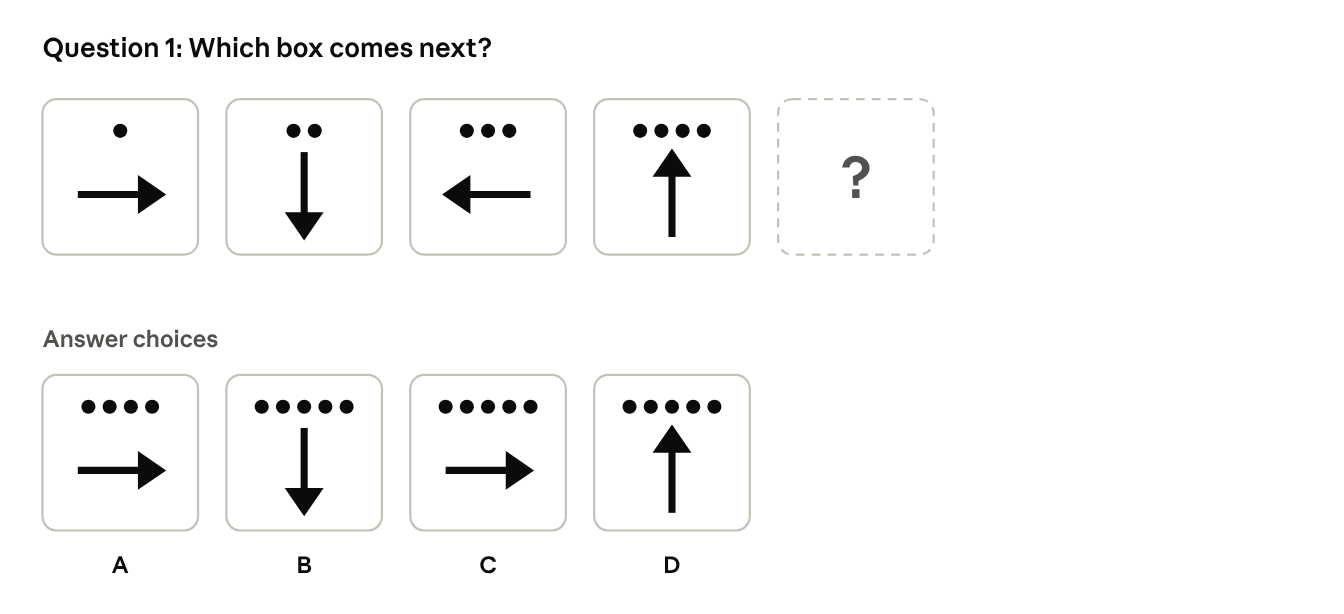
Answer: C. Two rules run at once. The arrow turns a quarter to the right each time, so after pointing up it points right again. One dot is added each time, so the next box has five dots. Choice B has five dots, but the arrow points the wrong way, which is the trap.
The second common type is a grid. You see a square made of nine boxes, three across and three down. The bottom right box is empty. You pick the shape that fills it.
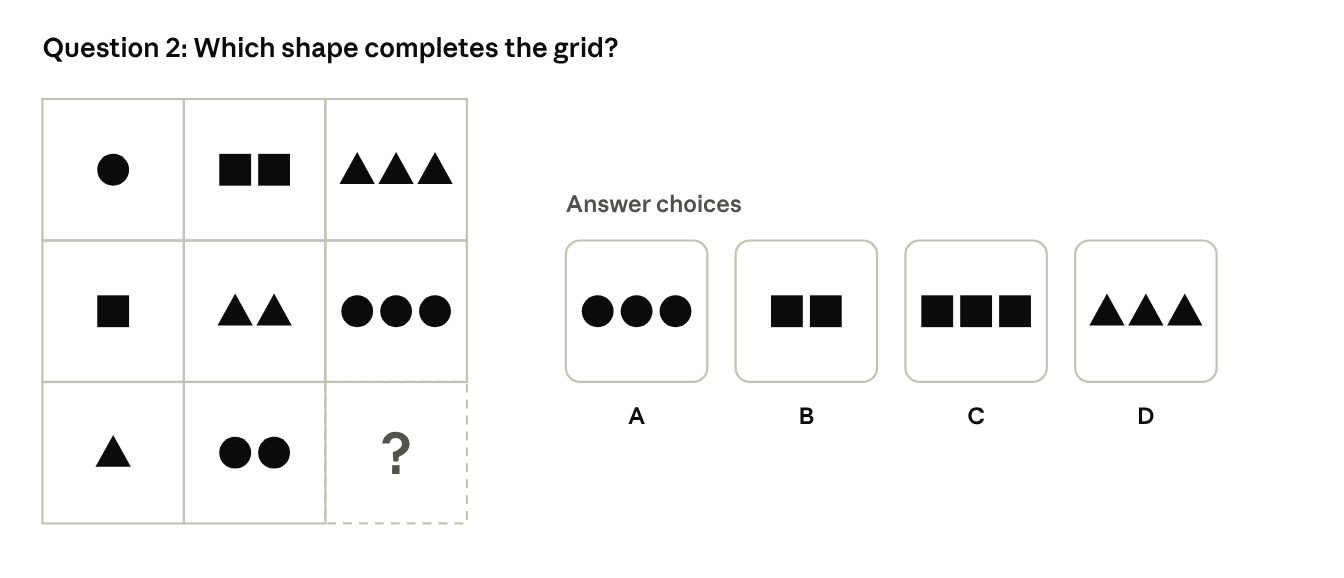
Answer: C. Each row holds one circle, one square and one triangle, and each column holds one, two, then three shapes. The bottom row is missing its square, and the third column always holds three shapes, so the answer is three squares.
You may also see "odd one out" questions, where you spot the shape that breaks the rule, and "which group" questions, where you decide whether a new shape belongs to set A or set B. Employers call these tests by many titles: inductive reasoning, diagrammatic reasoning, nonverbal reasoning, or logical reasoning. The job is the same every time. Find the rule. Use the rule.
These tests are timed, and the clock is tight on purpose. Many people do not reach the last question. Check the instructions for how many questions there are and how long you have, then work out roughly how much time each question gets.
If you want to see what these questions look like before the real thing, The Human Capital Hub has free psychometric practice tests you can try.
Abstract reasoning is often paired with a spatial reasoning test, which also uses shapes but asks you to turn and fold them in your head. If you face both, read our spatial reasoning test guide too.
Is Abstract Reasoning Related to IQ?
Yes, but less than most people fear. IQ stands for intelligence quotient, the score from a full intelligence test. People who do well on one kind of reasoning test tend to do fairly well on others, so abstract reasoning scores and IQ scores do go together.
But an abstract reasoning score is not the same thing as IQ. A large analysis found that a classic pattern test shares only about half of what it measures with general intelligence. The rest comes from narrower skills and from the test itself.
Why does this matter to you? Because it means an abstract reasoning score is not a verdict on how clever you are. It is a score on one kind of task, on one day, and it can move. The rest of this guide is about making it move in your favor.
How Do I Pass an Abstract Reasoning Test? Use This Five Step Method
The biggest mistake people make is looking at the answer choices too early. It feels quicker. It is not. When researchers tracked where people's eyes went during a pattern test, those who spent more time studying the problem and less time flicking between answers scored higher. In a later experiment with 250 people, simply telling everyone to work out the answer before looking at the choices closed much of the gap between stronger and weaker performers. That is a method you can learn to use.
Step one: cover the answers. Put your hand over the choices, or scroll them off the screen if you can. Look only at the pattern.
Step two: check one feature at a time. Most questions are built from a short list of changes. Shapes turn, move, grow, shrink, change color or shading, appear or disappear, or change in number. Go through them in order. Is the number of shapes changing? Is anything turning? Is the shading moving? Name each rule in plain words as you find it, such as "the arrow turns a quarter to the right each time."
Step three: expect more than one rule. Hard questions are hard because they stack two or three rules at once, not because the rules are strange. A well known study of how people solve these puzzles found that the toughest items were the ones that made people hold several rules in mind at the same time. So when you find one rule, keep looking for a second.
Step four: picture the answer, then look. Before you uncover the choices, say to yourself what the missing box should contain. Then find the choice that matches.
Step five: cross out, then move on. If nothing matches exactly, rule out every choice that breaks a rule you are sure of. Pick from what is left. If you are still stuck after your time for that question, guess and move on, unless the instructions say wrong answers lose points.
Here is how it works on a real style of question. You see four boxes. Box one has one black circle in the top left corner. Box two has two circles in the top right. Box three has three circles in the bottom right. Box four is the question mark. Checking one feature at a time, you notice the number of circles goes up by one each time, so box four needs four circles. Then you notice the position moves clockwise around the corners, so box four's circles sit in the bottom left. Only now do you look at the choices, and you pick the one with four circles in the bottom left. A choice with four circles in the wrong corner is exactly the kind of trap that catches people who look at the answers first.
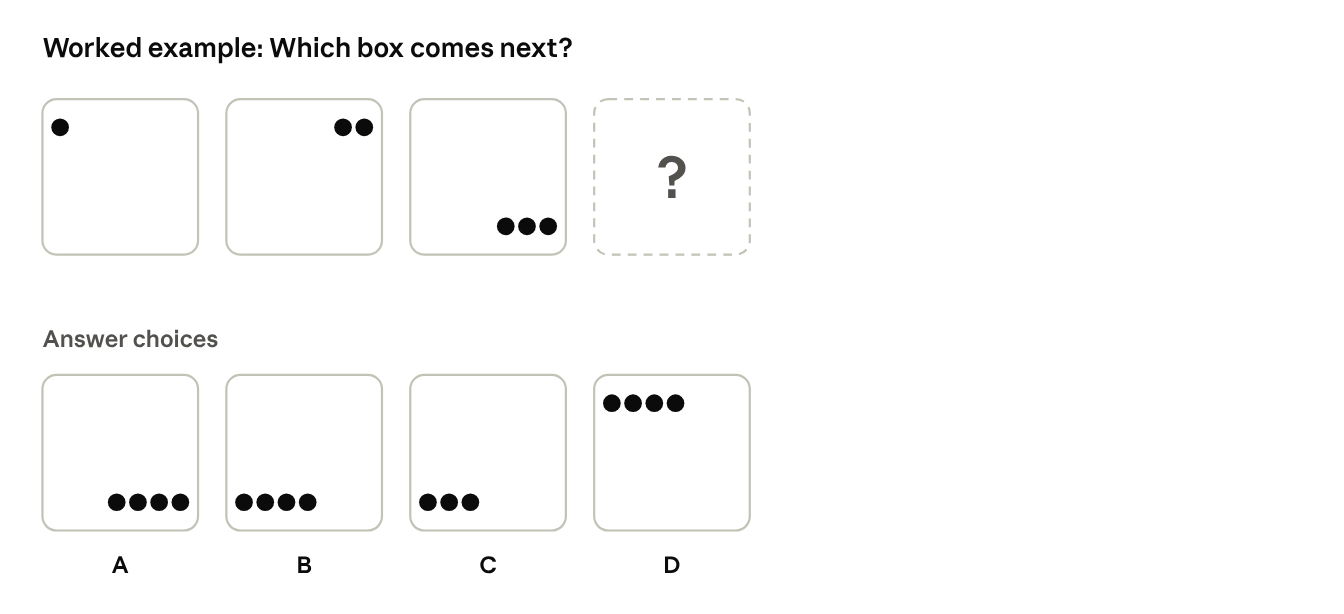
Answer: B. The count rises by one and the circles move clockwise around the corners, so the next box holds four circles in the bottom left. Choice A has the right count in the wrong corner.
How Much Should You Practice for an Abstract Reasoning Test?
Less than you think. Practice clearly helps. A review of 40 studies found that taking practice tests raised people's scores, and a larger review of more than 134,000 people who took ability tests more than once found a modest but real rise the second time around, with bigger gains when practice came with coaching.
But the gains stop quickly. The largest review to date, covering 122 studies and more than 153,000 people, found that scores rose only up to the third attempt. After the third try, extra practice added nothing. What practice gives you is familiarity with the format, the timing, and the usual tricks. Once you have that, doing another 500 questions will not help much. One study that tracked people's eye movements found that about a third of their improvement came from a better test strategy, not from becoming smarter. That is fine. Strategy is exactly what you want to improve.
Skip the brain training apps. A review of memory training programs found they made people better at the games they practiced, but gave no lasting boost to reasoning on tests they had not seen. Practice on questions that look like your real test instead.
Here is a simple one week plan for an abstract reasoning test. On day one, read the employer's instructions and find out exactly which type of test you face. On day two, do one full timed practice test cold, then check every wrong answer and name the rule you missed. On days three and four, practice the five step method on 15 to 20 questions each day, with no timer, so the method becomes a habit. On day five, do a second full timed test. On day six, do a third full timed test and practice your pacing. On day seven, rest. If you also face a spatial test, add 15 minutes of hands on spatial practice each day, and start it earlier if you can.
The Day Before and the Day of the Test
Calm your nerves with familiarity. A review of 238 studies found that test anxiety is linked to lower scores, and that anxiety runs higher when the test feels high stakes or hard. The best cure is having seen the format before. That is one more reason to do your timed practice tests. On the day, if you freeze on a question, take one slow breath, skip it, and come back later.
Sleep, do not cram. A review of 70 studies on lost sleep found that missing a night hits your attention hardest. Reasoning itself held up better, but these tests need 20 or 30 minutes of steady focus against a clock. Tired people drift, lose time and make careless slips. A normal night's sleep is worth more than two extra hours of late practice.
Set up your space. If your test is online, use a laptop or desktop rather than a phone if you can, because small screens make shapes harder to see. Charge the device, close other tabs, silence your phone, and keep scrap paper and a pen next to you for sketching patterns.
Read the instructions twice. Check how many questions there are, how long you have, whether you can go back, and whether wrong answers cost points. If wrong answers do not cost points, never leave a question blank.
Watch the clock, not the question. Divide the total time by the number of questions to get your time per question. Check the clock every five questions or so. If one question eats double its time, guess and move on. An easy question later is worth exactly the same as the hard one you are stuck on.
Key Takeaways
- An abstract reasoning test asks you to find the rule in a pattern of shapes.
- Your score is not a fixed measure of how clever you are, and it can go up with the right preparation.
- Work out the answer before you look at the choices, and check one feature at a time.
- Two or three timed practice tests are enough for abstract reasoning; beyond that, extra practice adds very little.
- Sleep, a quiet setup and a clear pacing plan protect the score you have earned in practice.
Implications for Practice: What to Do If You Do Not Pass
First, do not read too much into one result. Studies of hiring show that ability test scores are useful but less powerful than claimed for years. A test is one piece of the picture, and employers look at your experience, knowledge, and interview too.
Second, find out whether you can retake the test and how long you must wait. Retakes usually go better. A study of people applying to medical school found that those who retook the ability test scored noticeably higher the second time. Use the wait to fix what went wrong. If you ran out of time, practice pacing. If you rushed and fell for traps, practice the five step method until covering the answers feels natural.
Third, apply elsewhere while you prepare. Many employers use similar tests, so every one you take is practice for the next. And every test you take makes the format more familiar, which is where most of the early gains come from.
If you want to understand what employers are looking for when they use these tests, The Human Capital Hub explains the pre employment testing practices good organizations follow.