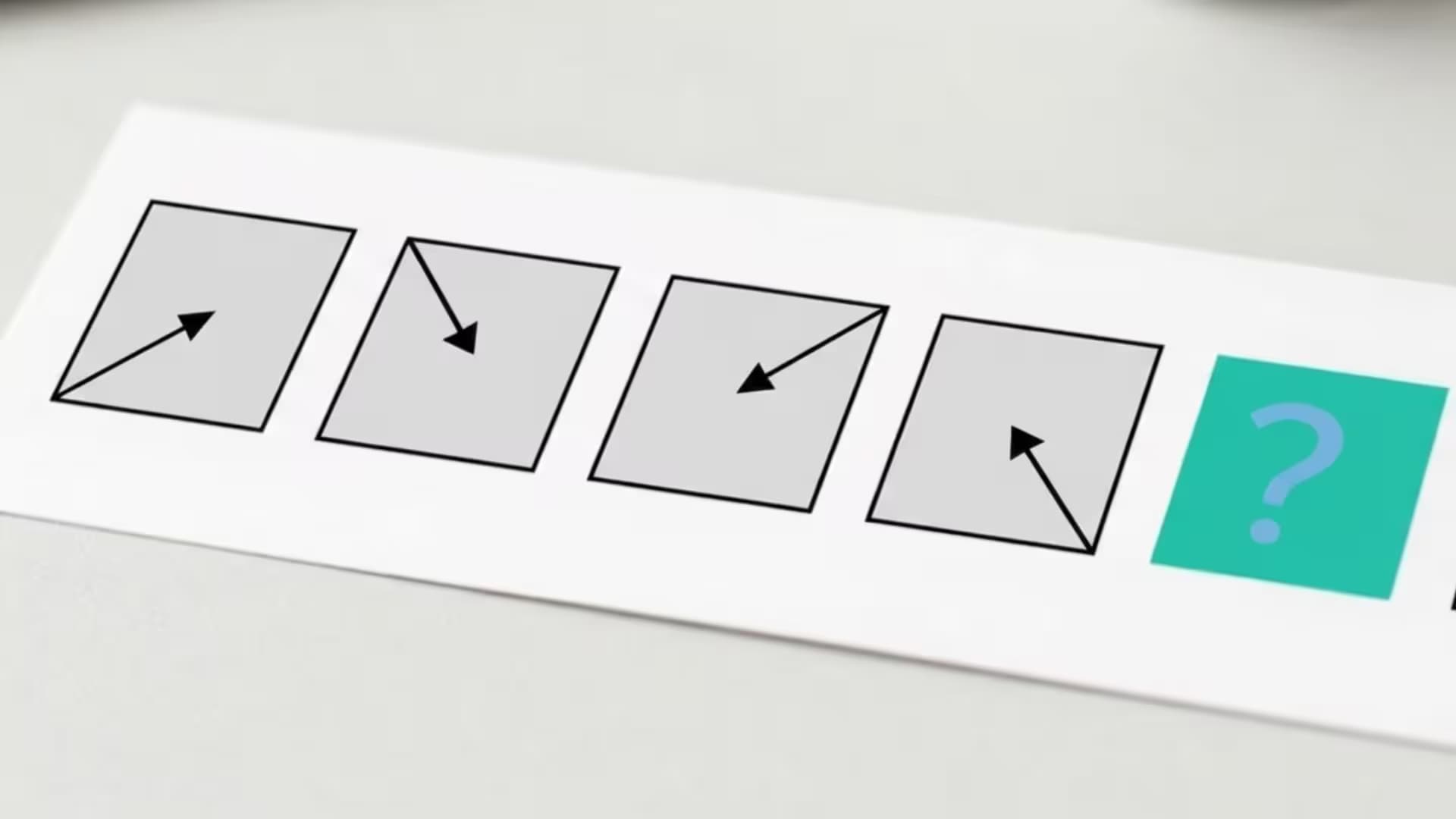
Abstract reasoning is the cognitive ability to identify the relationships and rules that connect unfamiliar items, then apply them to reach a conclusion. It is the clearest everyday expression of fluid reasoning, works mainly through induction, and is largely independent of language and learned knowledge. That is what sets it apart from related kinds of reasoning.
The word abstract trips people up, and the many overlapping labels that test publishers use make it worse. Whether you are a job applicant trying to understand a test or simply someone who likes terms used precisely, this article pins down the definition and then places it next to its neighbors. You will see what abstract reasoning is, what it is not, and why so many names point at roughly the same ability. The test formats, examples, and preparation live in separate articles. This one is about meaning.
What is the definition of abstract reasoning?
The definition of abstract reasoning is the ability to perceive relationships among unfamiliar elements, infer the rule that governs them, and apply that rule to reach a correct conclusion. Each of those three steps matters, and a useful definition keeps all three.
Break it into its parts. First, you perceive a relationship, noticing how elements connect rather than what they are. Research on how the mind handles relational structure describes this as mapping the underlying structure of a situation while setting aside its surface features, which is the engine of abstract thought. Second, you induce a rule, forming a general principle from the particular cases in front of you. Third, you apply that rule to produce or recognize the answer. The word abstract refers to this stepping away from surface detail to the relationship beneath. It does not mean vague. It means general.
What is the difference between abstract reasoning and fluid intelligence?
Abstract reasoning and fluid intelligence are closely related but not identical. Fluid intelligence is the broad ability to solve novel problems through reasoning. Abstract reasoning is the most direct way that broad ability shows itself on a test.
The widely used map of cognitive abilities helps here. In the standard model of abilities, fluid reasoning is a broad capacity for solving unfamiliar problems, and inductive and deductive reasoning are named as its hallmark indicators. Abstract reasoning tasks, which ask you to induce a rule from figures, are about the purest measure of that capacity available, because they carry so little learned content. So abstract reasoning is not a different thing from fluid reasoning. It is fluid reasoning made visible in a form that can be scored.
Is abstract reasoning the same as IQ?
No. An IQ score is a broad summary that combines several abilities, including verbal knowledge and memory, not only reasoning. Abstract reasoning is one component of that wider picture, and one of the most strongly linked to general mental ability. Doing well on an abstract reasoning test suggests strong reasoning, but it is not the same as a full intelligence measure, and a single reasoning score should never be read as an IQ.
Is abstract reasoning inductive or deductive reasoning?
Abstract reasoning is mostly inductive, with a deductive step at the end. Induction means working from particular cases to a general rule. Deduction means working from a given rule to a specific case. An abstract reasoning item asks you to do the first, then the second.
A clear account of inductive reasoning defines it as detecting regularities and irregularities by comparing attributes and relationships across a set of items. That is exactly the main work of an abstract reasoning question. You compare the figures, find the regularity, and form the rule, which is induction. Then you apply that rule to choose the answer, which is a small piece of deduction. Calling abstract reasoning inductive captures where the real effort lies, in discovering the rule rather than applying it.
How is abstract reasoning different from verbal, numerical, and spatial reasoning?
The difference is in the content, not the underlying act. Verbal reasoning works with words and meaning, numerical reasoning with numbers and data, spatial reasoning with the physical arrangement and manipulation of objects in space. Abstract reasoning works with relationships between figures that carry no words, numbers, or real world meaning at all.
Because it strips away that content, abstract reasoning isolates the relational thinking that the others also use but mix with knowledge. Verbal reasoning leans on vocabulary you have learned. Numerical reasoning leans on comfort with figures. Spatial reasoning leans on visualizing shapes in space, which is related to abstract reasoning but distinct, since spatial tasks are about manipulating form while abstract tasks are about inferring rules. Abstract reasoning is the one that comes closest to pure pattern and rule, with the least to learn beforehand. That content independence is its defining property and the reason it is often presented as the fairest of the reasoning measures.
Why do the terms abstract, non verbal, inductive, and diagrammatic overlap?
These terms overlap because they describe the same ability from different angles, and different test publishers favor different names. That is a real source of confusion for test takers, so it is worth untangling.
Abstract reasoning names the content, that the material is abstract figures. Non verbal reasoning names what is absent, that there are no words. Inductive reasoning names the mental process, the inferring of a rule. Diagrammatic or logical reasoning sometimes names a close cousin that adds operators or flow logic. In practice these labels point at heavily overlapping ground. A test called any of these names will ask you to do the same core thing: find the rule that links the figures and apply it. If you meet a test under an unfamiliar one of these names, you can treat it as abstract reasoning by another title.
Key takeaways
1. Abstract reasoning is the ability to perceive relationships among unfamiliar elements, infer the governing rule, and apply it to reach a conclusion.
2. Abstract means stepping away from surface detail to the general relationship beneath. It does not mean vague.
3. It is the clearest measurable expression of fluid reasoning, the broad ability to solve novel problems.
4. It is not the same as IQ, which combines several abilities. It is one strong component of general mental ability.
5. It is mostly inductive, inferring a rule from cases, with a small deductive step to apply the rule.
6. It differs from verbal, numerical, and spatial reasoning by content. It carries no words, numbers, or real world meaning.
7. Abstract, non verbal, inductive, and diagrammatic reasoning are overlapping names for much the same ability.
What this means for you
If you have been confused by the many names, let the confusion go. Once you understand that abstract reasoning means finding and applying the rule that links unfamiliar figures, the various labels stop mattering. A test called abstract, non verbal, inductive, or diagrammatic reasoning is asking you to do the same thing.
Knowing the definition also tells you how to prepare. Since the ability is about relational thinking with little learned content, there is no subject to revise. What helps is familiarity with the format, which is part of the wider craft of approaching employee selection with a clear head. The reasoning itself is something you already use whenever you make sense of a new situation.
Related reading on The Human Capital Hub
For the wider story of why reasoning ability is studied so closely and what it relates to, see our article on cognitive ability and broader social outcomes. For how this assessment sits among the others, our psychometric tests guide is a useful companion.