Verbal reasoning tests assess how well you understand words and use them to solve problems. A question might ask you to complete a word analogy, identify an opposite, find the word that does not belong, or work out a relationship from a few statements.
The format matters. Preparing for analogies means practicing relationships between pairs of words. Preparing for vocabulary questions means learning to distinguish between word meanings. Knowing which questions your assessment contains is the starting point for useful preparation.
What is the verbal reasoning test?
A verbal reasoning test is a cognitive ability assessment that uses language to examine understanding and reasoning. Depending on its design, it can draw on vocabulary, verbal knowledge, the ability to recognize relationships, and reasoning from written information. Research on the measurement of cognitive ability includes verbal questions covering vocabulary, knowledge and verbal reasoning, illustrating why the content of the particular test matters.
The word “verbal” refers to language. It does not mean that you must give spoken answers. In the examples below, you select an answer from several options.
Psychologists distinguish between fluid intelligence and crystallized intelligence. Fluid intelligence involves reasoning through unfamiliar problems. Crystallized intelligence refers to knowledge acquired through learning and experience, including word meanings. Verbal questions can draw on both. An analogy requires you to recognize a relationship, but you need to understand the words before you can compare them.
Verbal reasoning test examples with answers
These practice examples cover word analogies, classification, vocabulary and verbal logic. They illustrate the question types; they are not a standardized test and cannot produce a valid assessment score.
Word analogies: matching relationships
A word analogy gives you a relationship to reproduce. The form “A is to B as C is to D” means that the relationship between the first two words should match that between the second pair. Research on analogical reasoning examines the mental processes involved in identifying and applying these relationships.
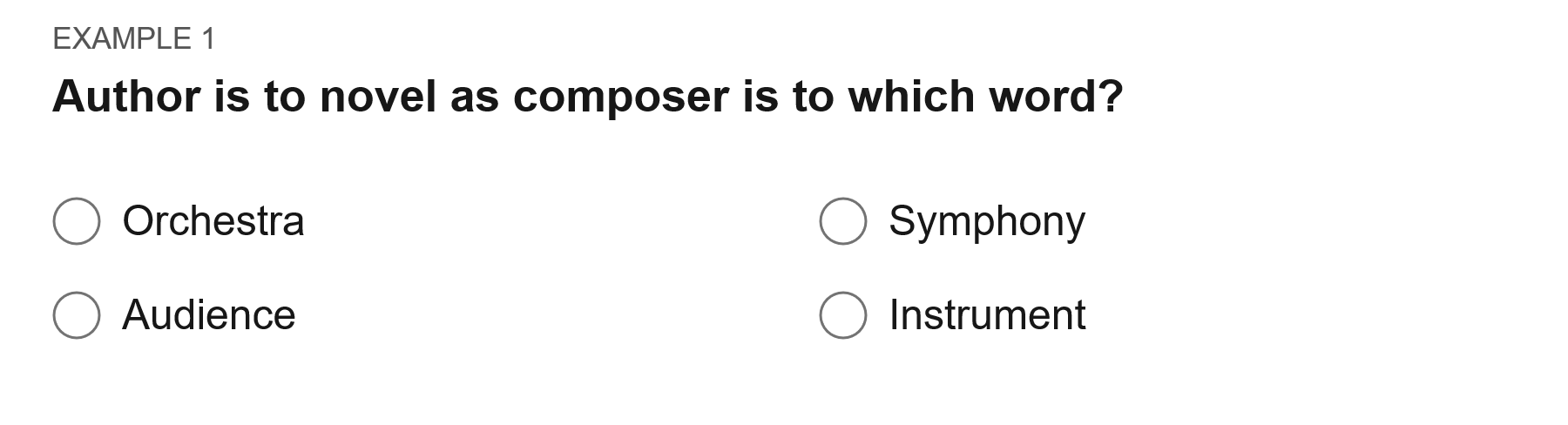
Answer: Symphony. An author creates a novel, and a composer creates a symphony. The relationship is creator to creation. An orchestra may perform the music, but it does not fit the same relationship.
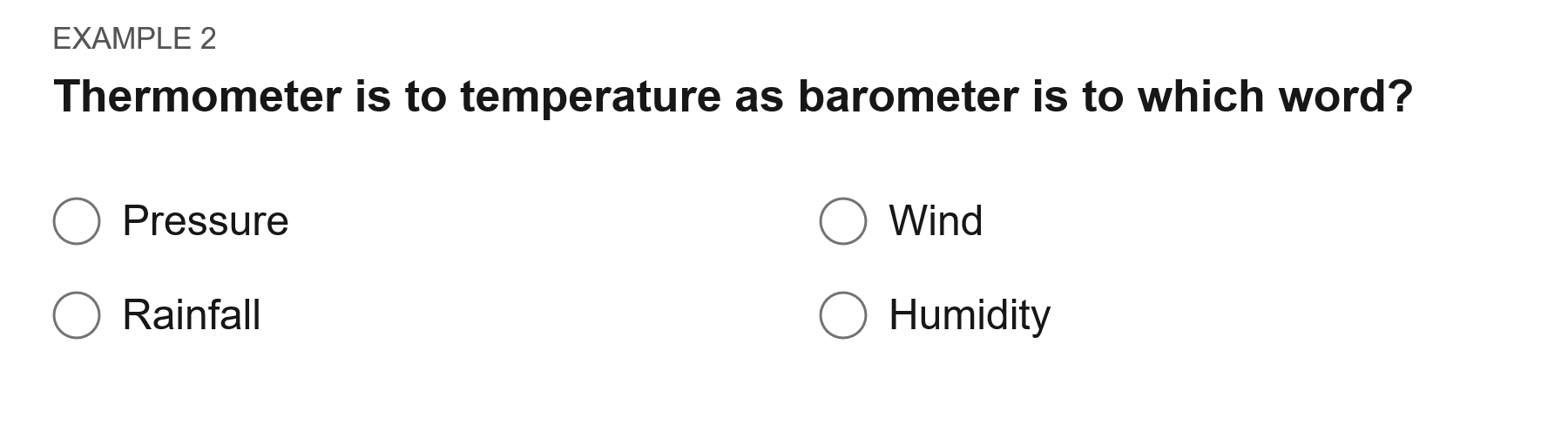
Answer: Pressure. A thermometer measures temperature, and a barometer measures atmospheric pressure. Both pairs follow the relationship of instrument to what it measures.
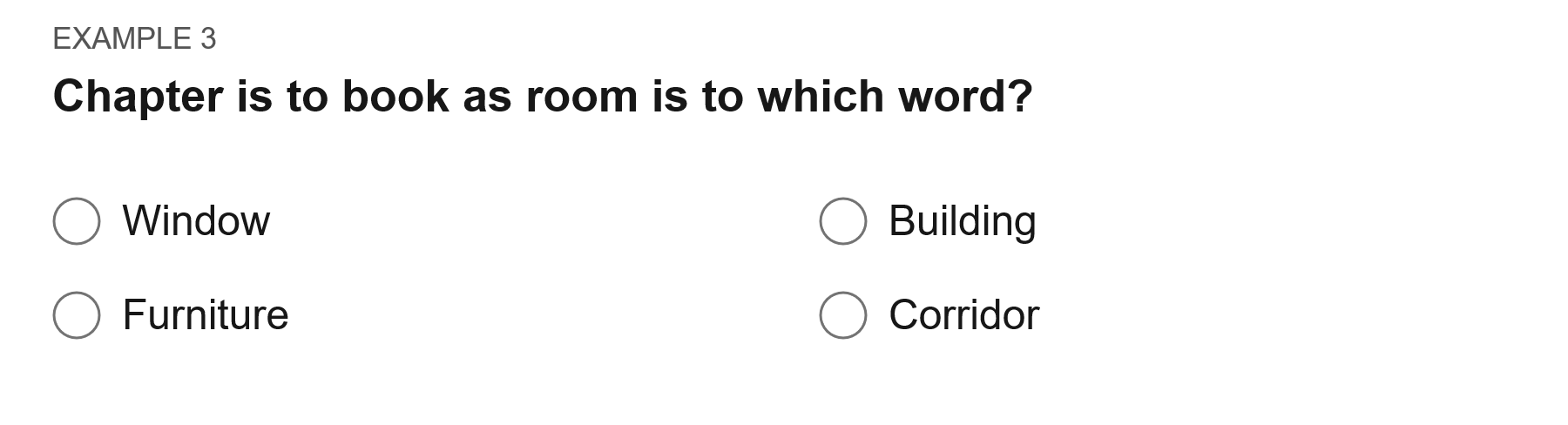
Answer: Building. A chapter is part of a book, and a room is part of a building. The direction matters: the first word names a part, and the second names the whole.
Put the relationship into a short sentence before looking for the answer. “Creates,” “measures” and “is part of” are more precise than saying that two words are connected.
Classification: finding the odd word out
Classification questions ask you to identify a shared category and select the word outside it.
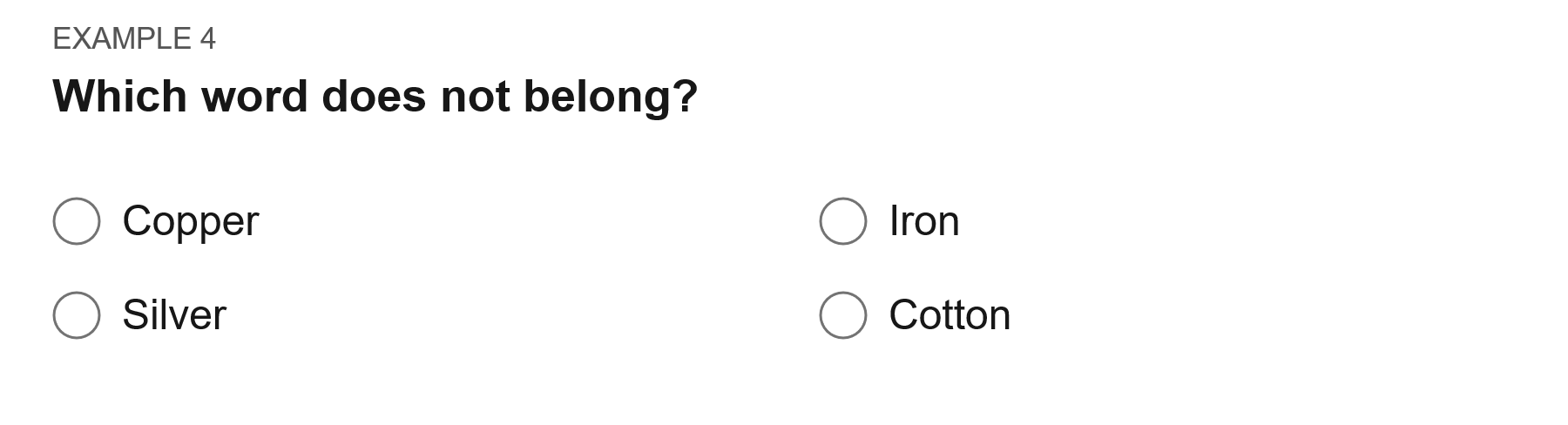
Answer: Cotton. Copper, iron and silver are metals. Cotton is a plant fibre. The relevant category is the type of material.
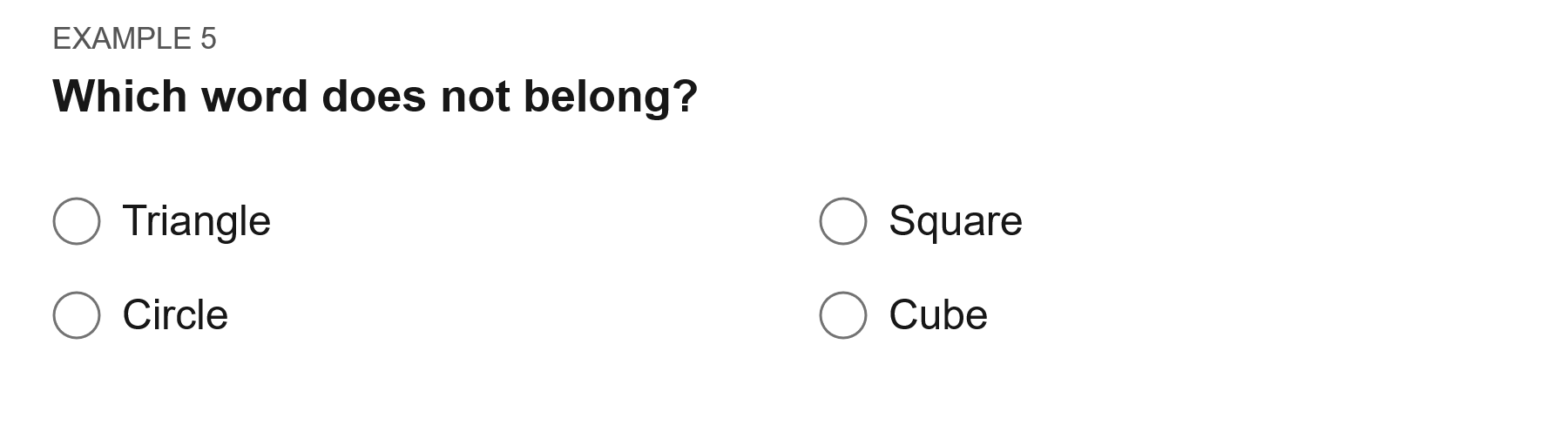
Answer: Cube. A triangle, square and circle are flat shapes. A cube is a solid with three dimensions.
Choose the category that clearly accounts for the other options. In the second question, “things found in mathematics” would include every option and would not distinguish the answer.
Synonyms: recognising similar meanings
A synonym question asks you to choose the word closest in meaning to the target word.
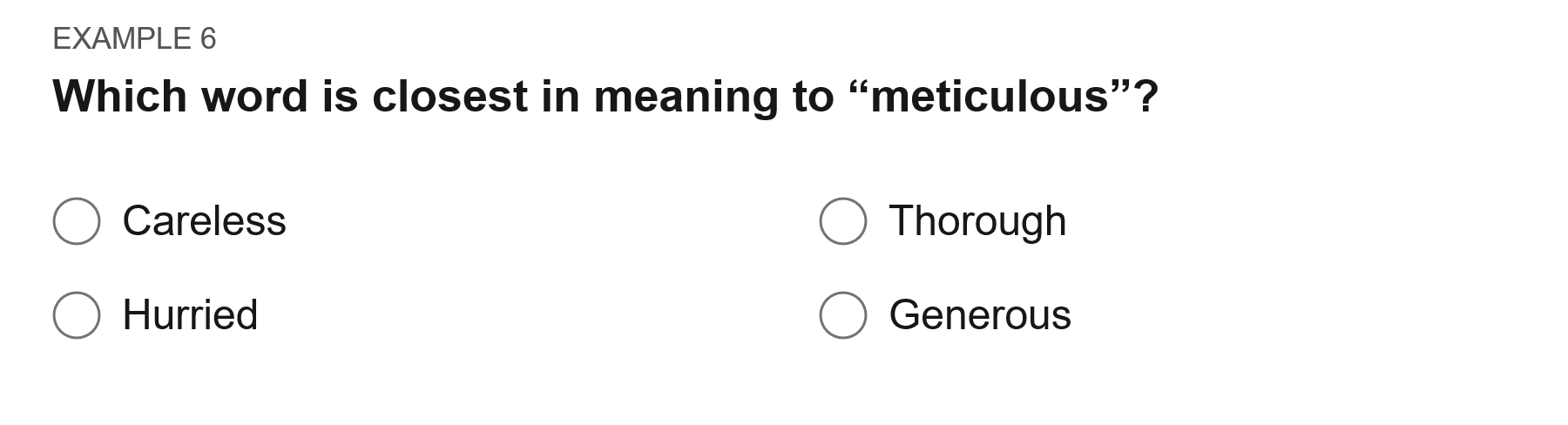
Answer: Thorough. A meticulous person pays careful attention to detail. Generosity describes a different quality, while carelessness and haste do not convey the target meaning.
Read the instruction carefully. Choosing an opposite would be wrong even if you understood the target word perfectly.
Antonyms: recognising opposite meanings
An antonym question asks for the word most nearly opposite in meaning.
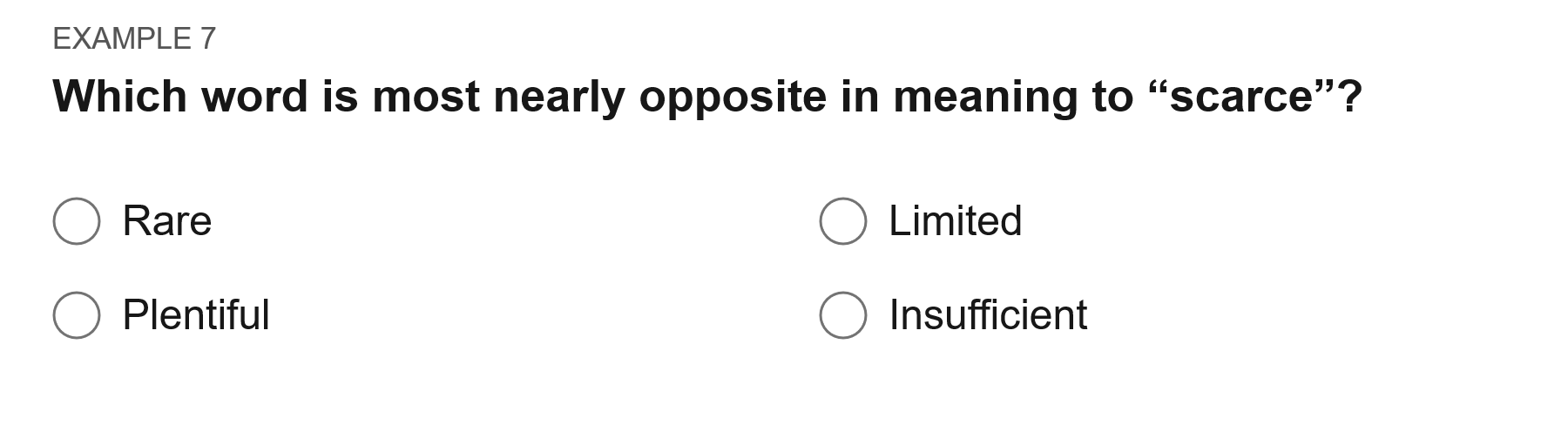
Answer: Plentiful. Something scarce is in short supply; something plentiful is available in abundance. The remaining options all suggest a shortage or limited availability.
Vocabulary questions depend on precise meanings. A word that sounds familiar or belongs to the same topic is not necessarily a synonym or an antonym.
Verbal logic: following stated relationships
Verbal logic questions can present a short ordering problem and ask you to work out a relationship.
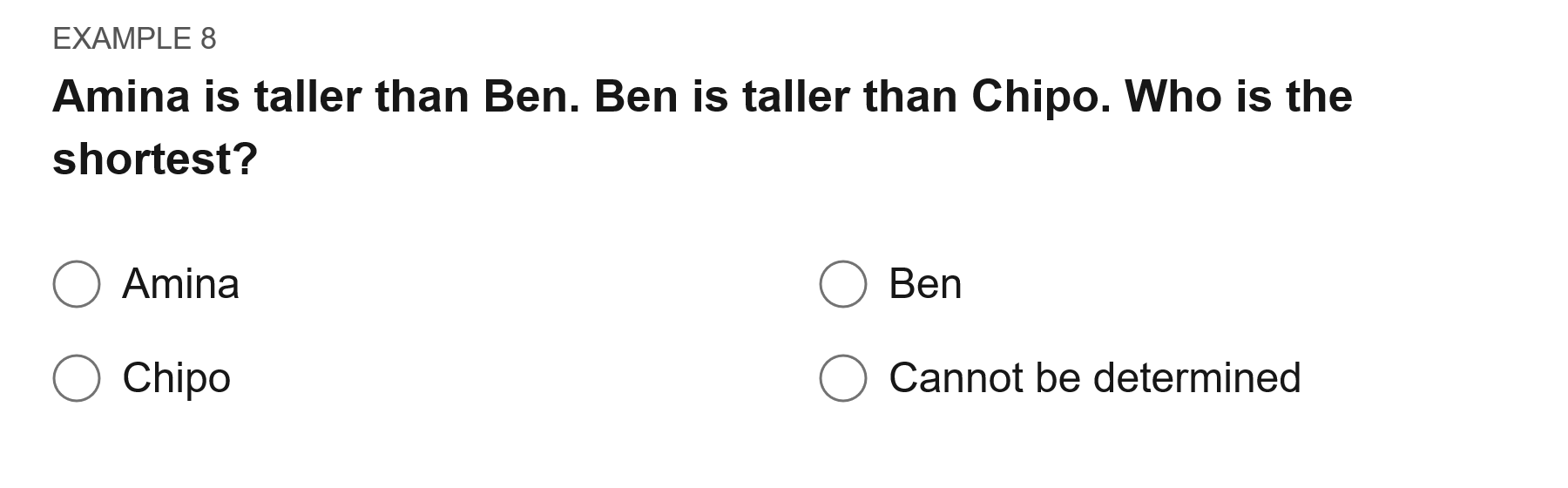
Answer: Chipo. The order from tallest to shortest is Amina, Ben, Chipo.
This uses deductive reasoning: the conclusion follows from the information given. In more complex verbal logic questions, distinguish what follows from the statements from what seems believable. Research on belief bias shows that beliefs can influence judgments about whether a conclusion follows logically.
How to pass a verbal reasoning test?
Begin with the actual assessment instructions and sample questions. Check which question types appear, how much time you have, whether you can return to earlier questions, and how incorrect answers are treated. Use those details to guide your preparation.
Practice the question types you will face
If the test includes analogies, practice explaining the relationship between each pair. For classification, name the category before choosing the odd word out. For vocabulary, check whether you must select a synonym or an antonym. For verbal logic, write down the order or relationship if notes are allowed.
Practice can improve cognitive test performance. A meta-analysis of practice effects by Hausknecht and colleagues found score improvements with repeated testing, with larger gains associated with coaching and identical test forms. That supports becoming familiar with the task, but it does not guarantee a particular score.
Use fresh questions as well as ones you have already answered. A meta-analysis of retest effects by Scharfen and colleagues found that gains varied with factors such as the test form and the interval between assessments. Remembering an answer is different from solving a new question using the same principle.
Review the reason for each mistake
After each practice session, explain why your answer was wrong. In an analogy, did you match a general association instead of the exact relationship? In an antonym question, did you choose a synonym? In classification, did your category fail to include one of the other words?
Keep a short record of recurring errors. “I reverse the order in part and whole analogies” gives you something specific to correct. “I am bad at verbal reasoning” does not.
Learn vocabulary in context
When you meet an unfamiliar word, check its meaning and use it in a sentence. Where appropriate, add a synonym and an antonym. For example, connect “scarce” with “limited” and contrast it with “plentiful.”
Research on reading comprehension identifies vocabulary and background knowledge as important contributors to understanding text. Reading can provide useful material for vocabulary study, but do not assume that reading alone will prepare you for every question format.
Test yourself on the meanings later instead of repeatedly looking at the definitions. A review of effective learning techniques found strong support for practice testing and distributed practice, which means spreading learning across separate sessions. Apply these methods to your vocabulary study and revisit words you have forgotten.
Add timing once you understand the questions
Start with enough time to work out the correct method. Then practise under the conditions given for your assessment. Check whether errors appear because you do not understand a word, misunderstand the relationship, or rush past the instruction.
If returning to questions is permitted, decide when to leave a difficult item and come back to it. If wrong answers carry a penalty, follow the scoring rules when deciding whether to guess. There is no guessing strategy that suits every test.
Be realistic about preparation
Focus on vocabulary, question familiarity and accurate methods. Be cautious about claims that a short brain training programme will produce broad improvements in verbal ability. A meta-analytic review of working memory training found no convincing evidence of broad transfer to verbal ability and other outcomes when compared with suitable active control groups.
Preparing well means improving how you approach the assessment. It does not mean that anyone can obtain any score through practice alone.
What is a good verbal reasoning test score?
A score needs to be interpreted using the assessment's scoring system and comparison group. Where a percentile is reported, it describes your position relative to that group. A score around the 75th percentile means performing as well as or better than roughly three-quarters of the comparison group. It does not mean answering 75% of the questions correctly.
Ask what standard the employer or institution uses. Do not assume that a percentage described as a pass mark on a practice website applies to your assessment.
In recruitment, a verbal reasoning result should also be interpreted in the context of the role and the wider selection process. Research reviewing the predictive validity of selection methods shows why claims about how well assessments predict job performance require care. Evidence about cognitive ability tests generally should not be treated as proof that every verbal reasoning test is equally useful for every job.
For your own preparation, concentrate on the questions you will actually face. Learn the word meanings, state the relationship clearly, check the instruction, and practise applying the method to unfamiliar examples.