You have applied for a job, and the email says your next step is an online spatial reasoning test. You have never done one, and you want to know one thing: how do I pass a spatial reasoning test?
The truth is that you cannot cram for these tests the way you cram for an exam, because there are no facts to learn. But you can get a lot better at them in a short time. Most people perform poorly because they encounter an unfamiliar format for the first time, panic, and that affects their performance.
What Is a Spatial Reasoning Test?
A spatial reasoning test checks how well you can picture objects in your head and move them around. It looks a bit like an abstract reasoning test because both use shapes, but the task is different. In an abstract test, the shapes carry a rule. In a spatial test, the shape itself is the puzzle.
The most common question is mental rotation. You see a three dimensional shape built from small cubes. Then you see four more shapes, and you pick the one that is the same object turned around. The trap is that some of the wrong answers are mirror images, which look the same until you check closely.
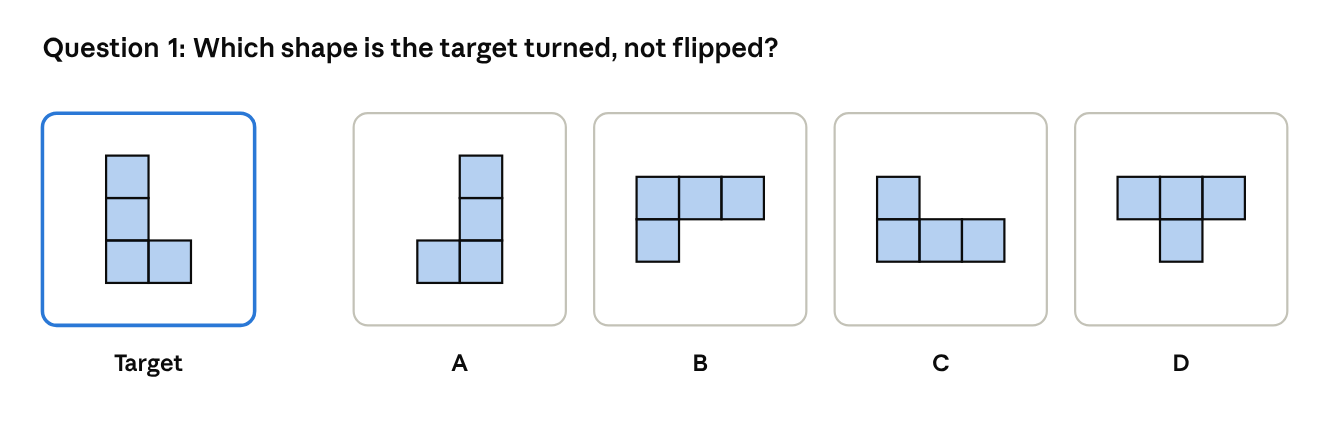
Answer: B. Follow the short foot of the target. Turn the whole shape a quarter to the right and the long bar lies flat along the top, with the foot hanging down from its left end. Choice A is the mirror image, the classic trap, and choice C is the mirror image turned. Real tests often use three dimensional cube shapes, but the skill is the same.
Other spatial questions ask you to fold a flat paper pattern into a box in your mind and say which box it makes, to picture what a shape looks like from above or from the side, or to fit loose pieces together into a whole shape.
You are most likely to meet a spatial test if you apply for technical, engineering, design, trade, or flying jobs. There is a good reason for that. A study that followed around 400,000 high school students for more than 11 years found that spatial ability predicted who went on to work in science, technology, engineering and mathematics, even after their math and verbal scores were taken into account. Employers in those fields use the test because the skill shows up in the work.
If you want to see what these questions look like before the real thing, The Human Capital Hub has free psychometric practice tests you can try.
Is Spatial Reasoning Related to IQ?
Yes, but less than most people fear. IQ stands for intelligence quotient, the score from a full intelligence test. People who do well on one kind of reasoning test tend to do fairly well on others, so spatial scores and IQ scores do go together.
But spatial skill is also its own thing. A study of 436 adults who took 42 different mental tests found that turning shapes in your head formed a separate ability, not just a slice of general intelligence.
Why does this matter to you? Because it means a spatial reasoning score is not a verdict on how clever you are. It is a score on one kind of task, on one day, and it can move. The rest of this guide is about making it move in your favor.
Spatial Reasoning Test Tips That Work
Here is the good news about spatial tests. Spatial skill is one of the easiest thinking skills to improve with practice. A review that pulled together 217 studies found that people who practiced spatial tasks improved by a clear margin, that the gains lasted over time, and that they carried over to spatial tasks they had never practiced. So, if you think you are "just bad at this," you probably have not practiced it much yet.
Start early. Because spatial skill really does grow with practice, a few weeks of short daily sessions will do more than one long session the night before. Aim for 15 to 20 minutes a day.
Use your hands, not just a screen. A 2022 review of 29 studies found that practice with real objects, such as blocks you can hold and turn, was more effective than practice on a computer alone. Build shapes from building blocks. Cut out paper box patterns and fold them. Turn a mug or a phone in your hand and notice how it looks from each side. It feels like play, but it trains the exact skill the test measures.
Follow one corner. When you compare two shapes in a rotation question, do not try to spin the whole thing at once. Pick one clear feature, such as the end with three cubes, and track where it goes. Then check a second feature. If both land where they should, you have your match.
Always check for a mirror image. After you think you have found the answer, ask one more question: Is this shape turned or flipped? Mirror images are a favorite trap in rotation questions.
For folding questions, find the neighbors. On a flat box pattern, pick one face and ask which faces will sit next to it once folded. Faces that are opposite each other can never touch. That one check rules out many wrong answers quickly.
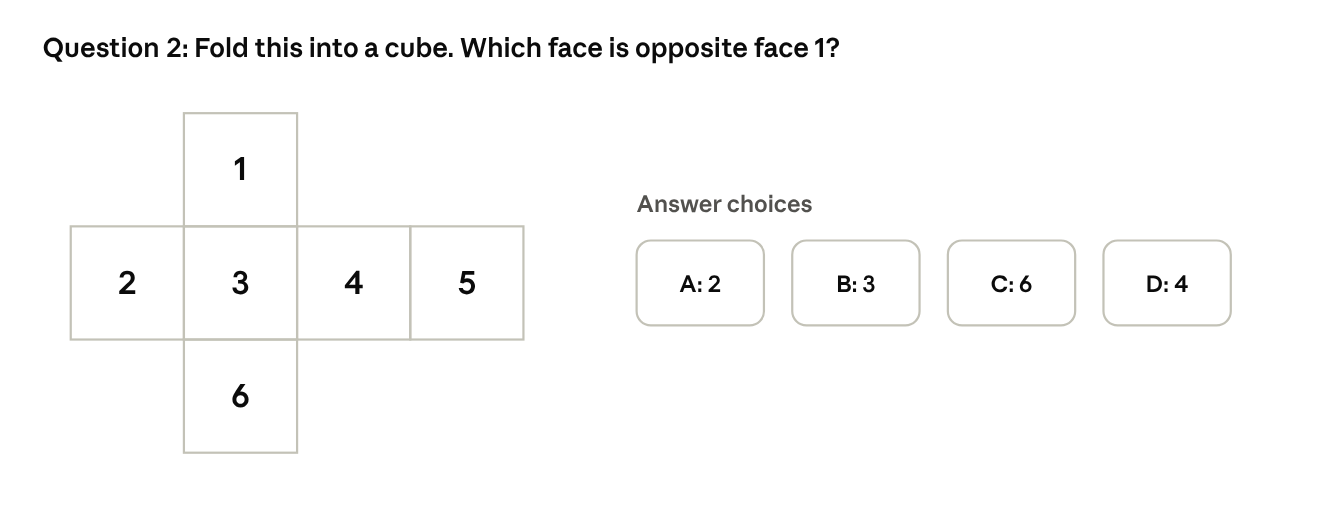
Answer: C. Look at the straight column of three squares: 1, 3 and 6. When you fold a straight line of three squares, the two end squares always finish opposite each other, so face 1 sits opposite face 6.
How Much Should You Practice for a Spatial Reasoning Test?
Two kinds of practice help. The first is the short daily hands on practice described above, which builds the skill itself. The second is timed practice on the test format. A review of more than 134,000 people who took ability tests more than once found a modest but real rise the second time around, with bigger gains when practice came with coaching. What format practice gives you is familiarity with the format, the timing, and the usual tricks.
Skip the brain training apps. A review of memory training programs found they made people better at the games they practiced, but gave no lasting boost to reasoning on tests they had not seen. Practice on questions that look like your real test instead.
Here is a simple plan. Start 15 to 20 minutes of hands on practice each day as early as you can. In the final week, read the employer's instructions and find out exactly which type of spatial questions you face, do one full timed practice test, check every wrong answer and name the trap you fell for, then do a second timed test a few days later. Rest the day before the test.
The Day Before and the Day of the Test
Calm your nerves with familiarity. A review of 238 studies found that test anxiety is linked to lower scores, and that anxiety runs higher when the test feels high stakes or hard. The best cure is having seen the format before. That is one more reason to do your timed practice tests. On the day, if you freeze on a question, take one slow breath, skip it, and come back later.
Sleep, do not cram. A review of 70 studies on lost sleep found that missing a night hits your attention hardest. Reasoning itself held up better, but these tests need 20 or 30 minutes of steady focus against a clock. Tired people drift, lose time and make careless slips. A normal night's sleep is worth more than two extra hours of late practice.
Set up your space. If your test is online, use a laptop or desktop rather than a phone if you can, because small screens make shapes harder to see. Charge the device, close other tabs, silence your phone, and keep scrap paper and a pen next to you for sketching shapes.
Read the instructions twice. Check how many questions there are, how long you have, whether you can go back, and whether wrong answers cost points. If wrong answers do not cost points, never leave a question blank.
Watch the clock, not the question. Divide the total time by the number of questions to get your time per question. Check the clock every five questions or so. If one question eats double its time, guess and move on. An easy question later is worth exactly the same as the hard one you are stuck on.
Key Takeaways
- A spatial reasoning test asks you to picture shapes turning, folding and fitting together.
- Your score is not a fixed measure of how clever you are, and it can go up with the right preparation.
- Follow one feature at a time, and always check whether a shape is turned or flipped.
- Spatial skill grows with regular practice, especially with real objects you can hold and turn.
- Sleep, a quiet setup and a clear pacing plan protect the score you have earned in practice.
Implications for Practice: What to Do If You Do Not Pass
First, do not read too much into one result. Studies of hiring show that ability test scores are useful but less powerful than claimed for years. A test is one piece of the picture, and employers look at your experience, knowledge, and interview too.
Second, find out whether you can retake the test and how long you must wait. Retakes usually go better. A study of people applying to medical school found that those who retook the ability test scored noticeably higher the second time. Use the wait to fix what went wrong. If you ran out of time, practice pacing. If you fell for mirror image traps, check for them on every rotation question until it becomes a habit. Start daily hands on practice straight away, because that skill keeps improving with time.
Third, apply elsewhere while you prepare. Many employers use similar tests, so every one you take is practice for the next. And every test you take makes the format more familiar, which is where most of the early gains come from.
If you want to understand what employers are looking for when they use these tests, The Human Capital Hub explains the pre employment testing practices good organizations follow.