You have applied for a job as a technician, an apprentice, an operator or an engineer, and the next step is a mechanical aptitude assessment test. You may not have looked at a pulley since school. You want to know what is on the test and how to pass it.
Here is the good news. Unlike many ability tests, a mechanical reasoning test rewards knowledge you can learn in a couple of weeks. Many questions are built on a small set of simple principles: how gears turn, how levers balance, how pulleys share a load, how belts pass on motion, and how liquids and weight behave. Learn those principles, practice spotting them in pictures, and your score will rise.
This guide shows you what the questions look like, the five principles behind many of them, and a simple method for working through each one.
What Is a Mechanical Reasoning Test?
A mechanical reasoning test checks whether you understand how everyday machines and physical forces work. Each question shows a simple drawing, such as two gears, a seesaw, a rope over a pulley, or a tank of water, and asks what will happen. Which way will this wheel turn? Which side will go down? Which rope needs the least pulling? You pick from three or four answers.
You do not need to do heavy math. Many questions can be answered by picturing the machine moving in your head. Researchers who watched people solve pulley problems found that they animate the machine in small steps, following the chain from the part that moves first to the part that moves last. People found it much harder to reason backward against that chain. That gives you your first practical tip: always start at the part that is being pushed or turned, and follow the motion forward.
The test also has a trap built in. Our gut feelings about physics are often wrong. In a classic study, more than half of university students, including many who had taken physics classes, drew the wrong path for a moving object. So a mechanical reasoning test is partly a test of whether you trust the principle or your gut. This guide teaches you the principles so that you can trust them.
You will see this test called a mechanical aptitude test, a mechanical comprehension test or a technical reasoning test. The name changes; the content hardly does. Typical topics are gears, levers, pulleys, belts and wheels, springs, simple electrical circuits, liquids and pressure, and objects falling or sliding.
Why Employers Use a Mechanical Aptitude Assessment Test
Employers use these tests because the results tend to show up on the job. In a study of 193 manufacturing workers who built electro mechanical parts, a mechanical comprehension test was the best single predictor of how supervisors rated their work. Adding a general intelligence test on top of it did not improve the prediction.
The test also draws on your ability to picture things in your head. A 2025 study of 282 adults found that people who were better at picturing shapes and viewpoints, such as imagining a piece of paper being folded or a scene seen from another angle, did better on mechanical reasoning questions. An earlier set of experiments found that people with weaker spatial skills made more errors as machines grew longer, because each extra part is one more thing to animate in their heads.
That is useful to know, because it tells you where the difficulty lies. A long chain of gears is not harder because the physics is harder. It is harder because there are more steps to track. Break it into steps, and it becomes easy.
How to Pass a Mechanical Reasoning Test: Learn These Five Principles
Many questions on a mechanical reasoning test are the same few ideas dressed up in different pictures. Learn these five, and you will be ready for a large share of what you meet. Each one comes with a sample question drawn the way you will see it on a test, and the answer is underneath.
Principle one: gears that touch turn in opposite directions
When two gears mesh, one turning clockwise makes the next turn counterclockwise. In a line of gears, the direction flips at every gear. So, count them: the first, third, and fifth gears turn the same way; the second and fourth turn the other way. Size matters for speed, not direction. A small gear driven by a big one spins faster, and a big gear driven by a small one spins more slowly but with greater torque.
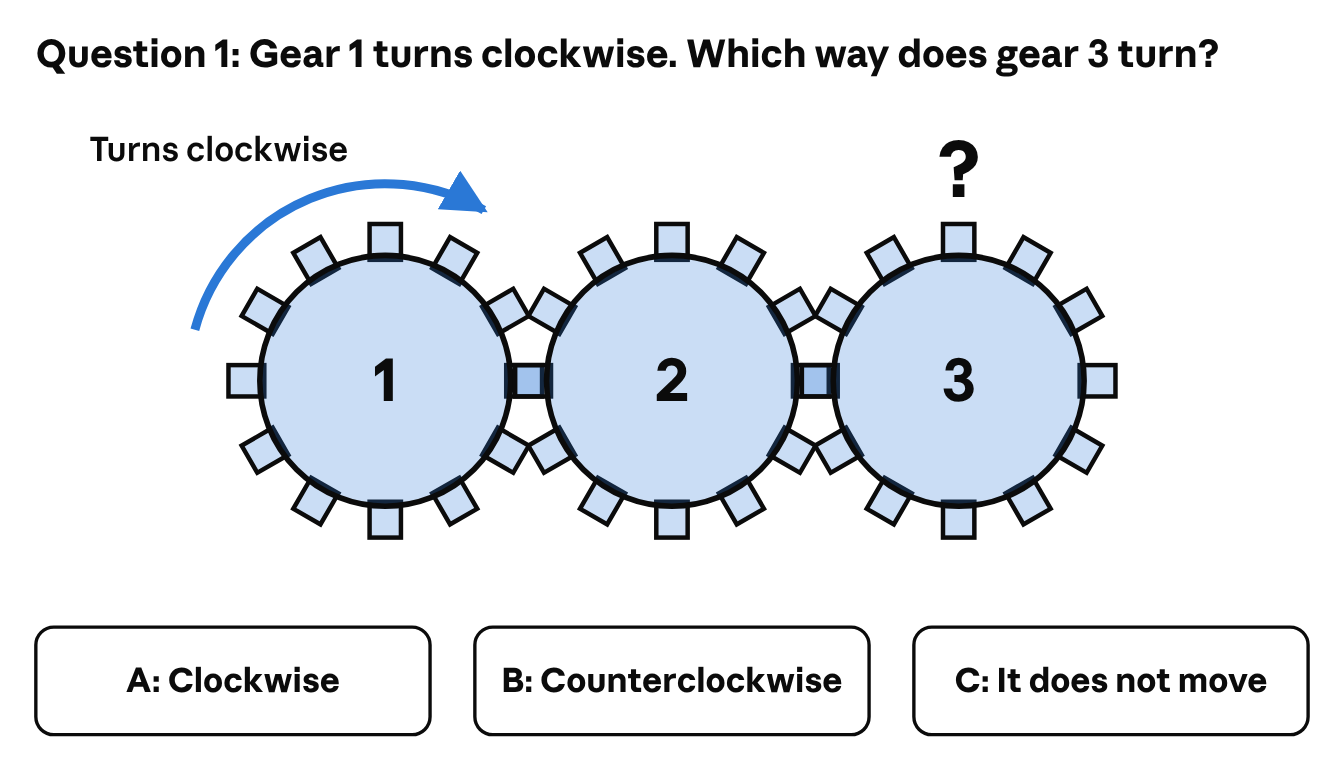
Answer: A. The direction flips at every gear: gear 1 turns clockwise, gear 2 turns counterclockwise, and gear 3 turns clockwise again. In a line with an odd number of gears, the last gear always turns the same way as the first.
Principle two: a lever balances when weight times distance is equal on both sides
A seesaw, a crowbar, and a wheelbarrow are all levers. The pivot point is called the fulcrum. A light weight far from the fulcrum can balance a heavy weight close to it. The rule is simple: multiply each weight by its distance from the fulcrum. When the two answers match, the lever balances. If one side's answer is bigger, that side goes down. This is why a long crowbar makes a heavy rock feel light.
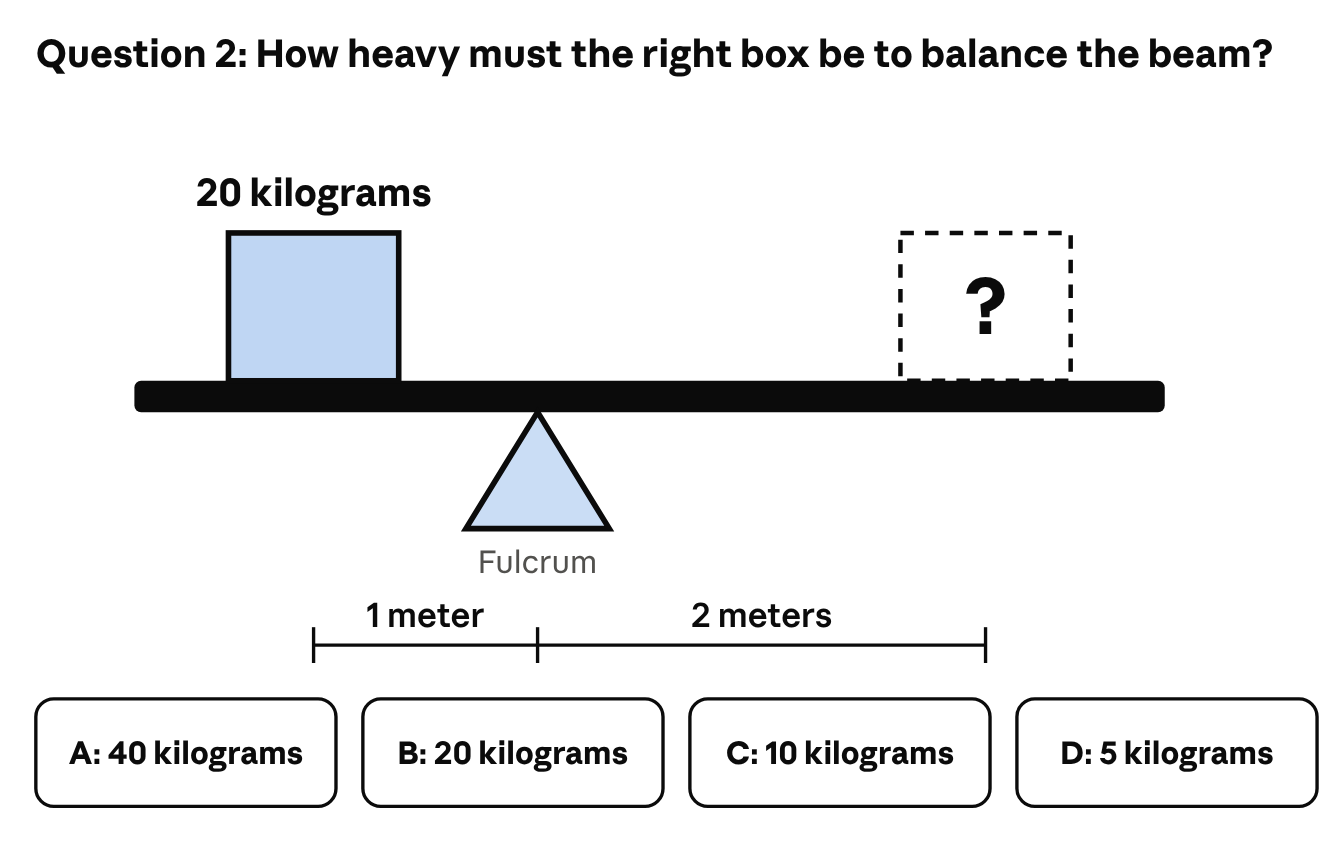
Answer: C. On the left, 20 kilograms times 1 meter gives 20. On the right, the box sits 2 meters out, so it needs a weight that gives 20 when multiplied by 2. That is 10 kilograms.
Principle three: the more rope sections hold the load, the less you pull
A single fixed pulley at the top of a beam only changes the direction of your pull. You still pull the full weight. But when a pulley is attached to the load itself, two sections of rope share the weight, so you pull about half as hard. The trade off is distance: you pull twice as much rope. On the test, count the rope sections holding up the load. Divide the weight by that number to get the pulling force.
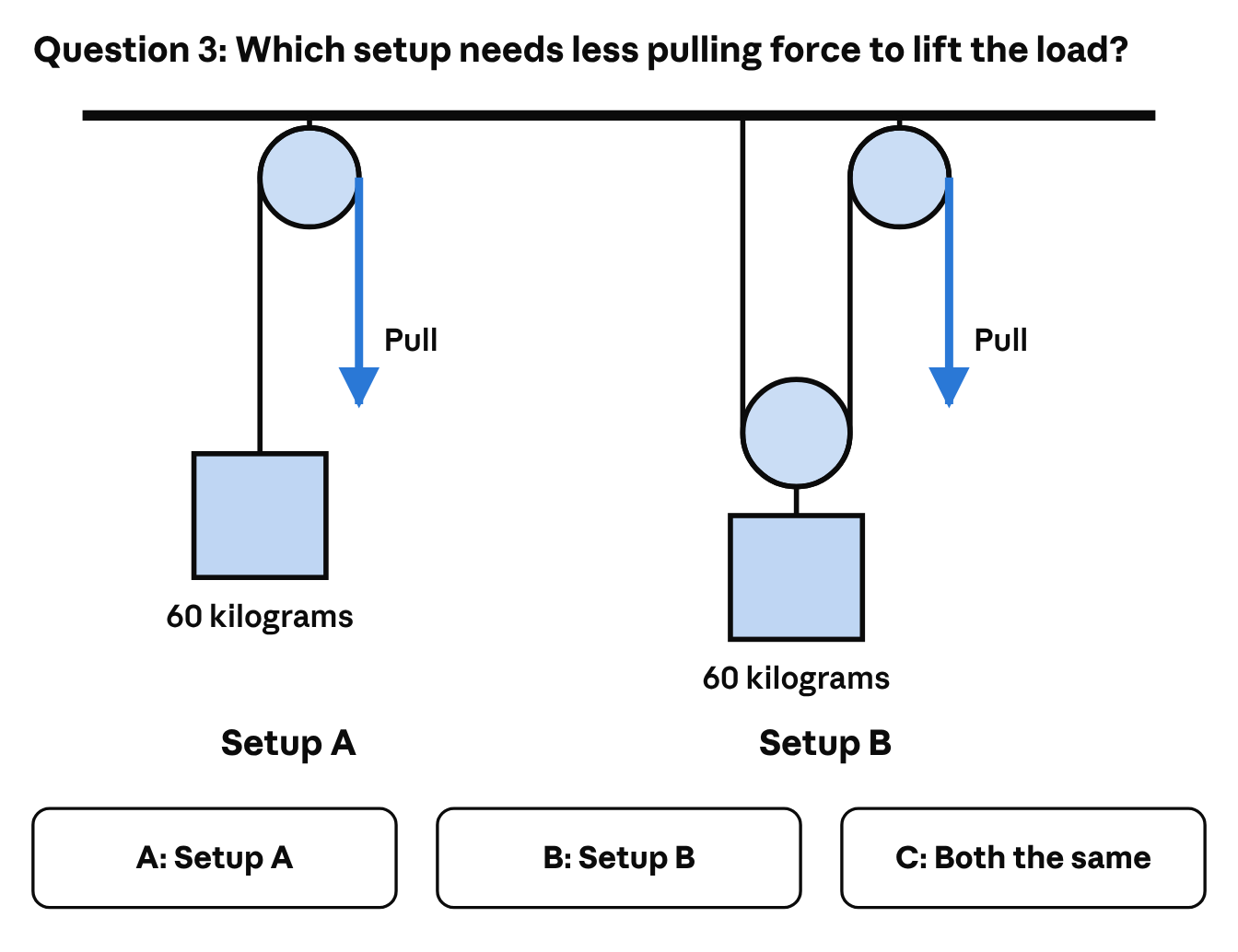
Answer: B. In setup A, one rope section holds the load and the pulley only changes the direction of your pull, so you pull the full 60 kilograms. In setup B, two rope sections hold the load, so you pull about half as hard.
Principle four: an open belt keeps direction, a crossed belt reverses it
When a belt loops straight around two wheels, both wheels turn the same way. When the belt crosses over itself in the middle, making a figure eight, the second wheel turns the opposite way. As with gears, a small wheel on the belt spins faster than a big one.
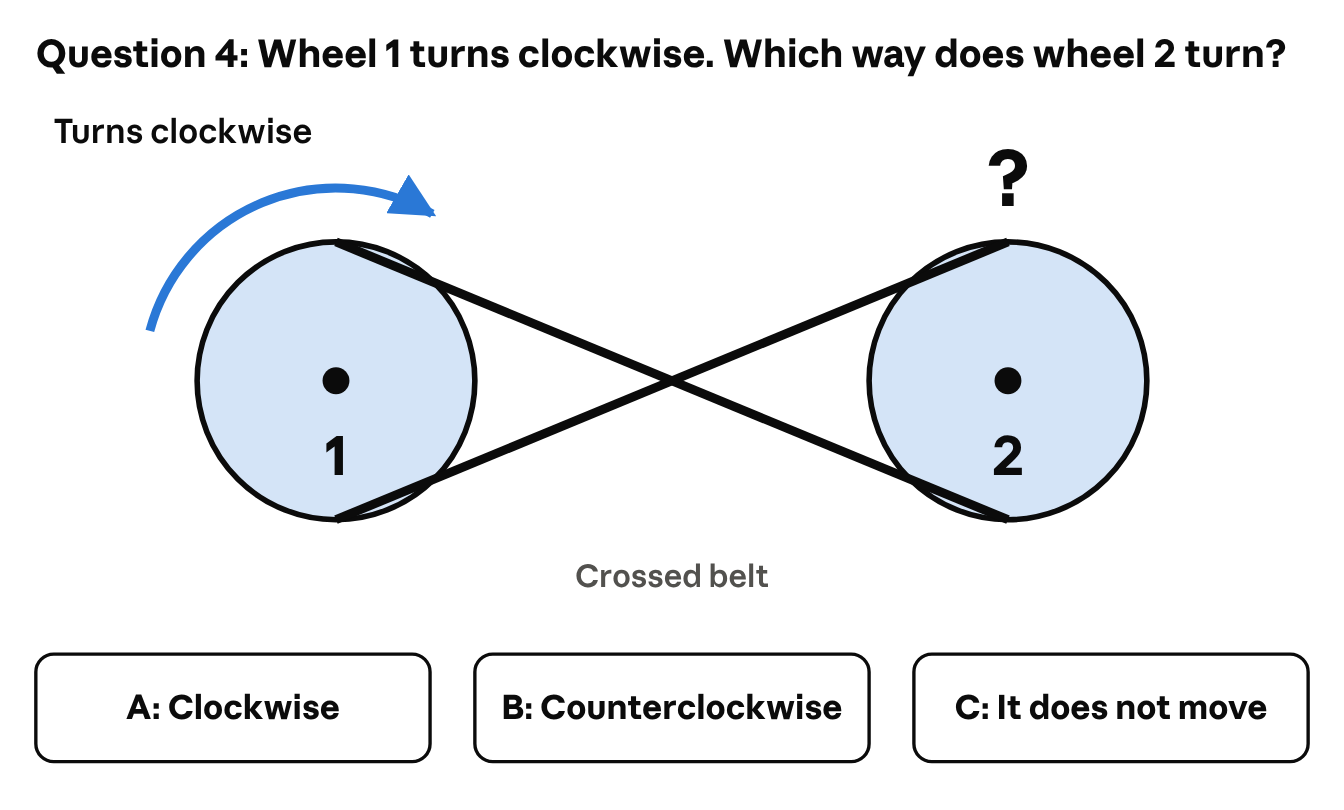
Answer: B. The belt crosses over itself, so it reverses the direction. Wheel 1 turns clockwise and wheel 2 turns counterclockwise.
Principle five: liquid pushes harder the deeper you go
Water pressure rises with depth, because the water lower down carries the weight of all the water above it. That is why the bottom of a dam is thicker than the top. On the test, a hole low in a tank squirts water out faster than a hole near the top. Pressure also depends on depth, not on the shape or width of the container.
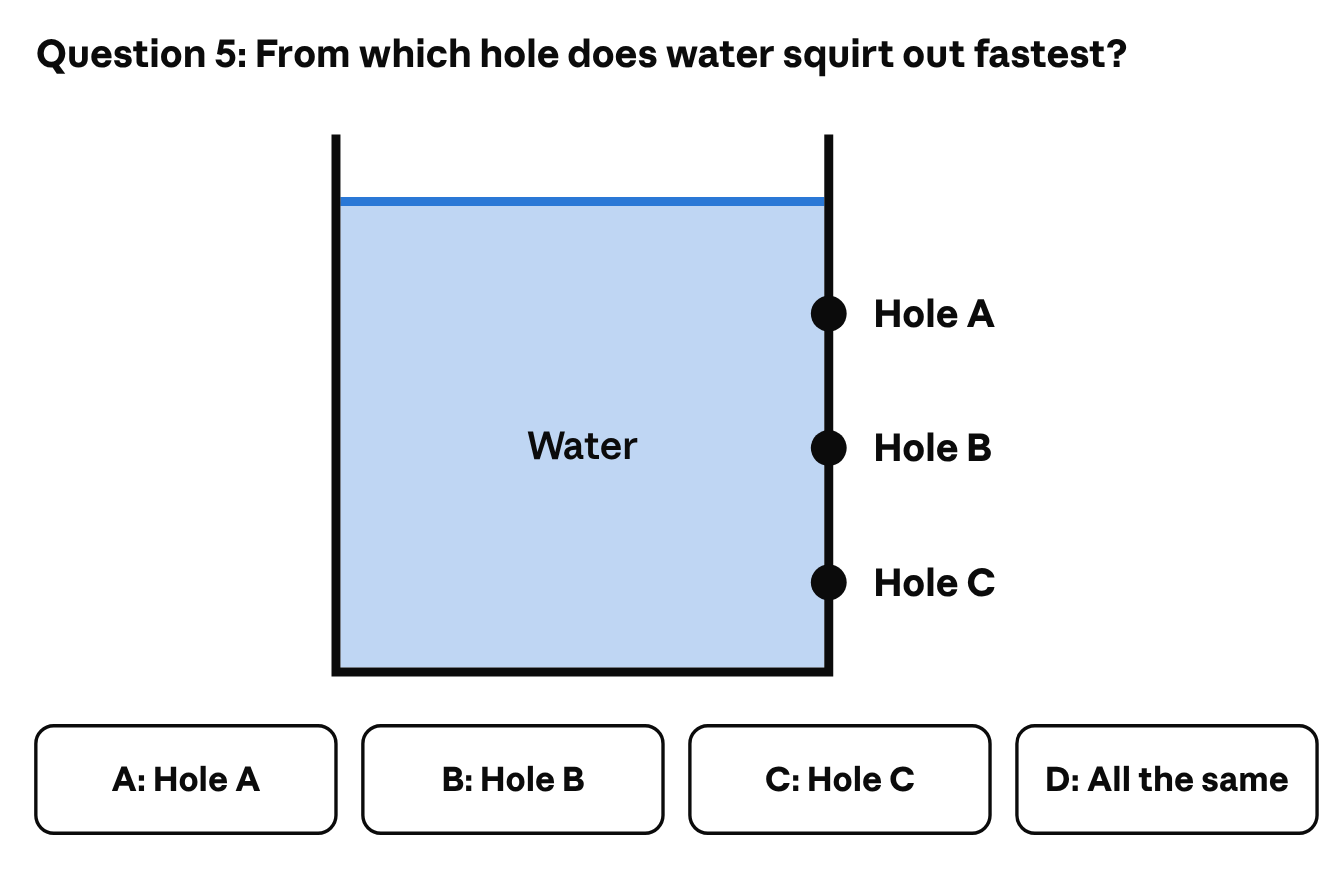
Answer: C. Hole C is the deepest, so it has the most water pressing down above it. Higher pressure pushes the water out fastest.
A Simple Method for Every Question
A review of how people solve these puzzles found that they do not picture the whole machine at once. They build the picture in stages and combine it with rules they already know. So give your brain both: a clear order to work in, and the rules above. Use these five steps on every question.
Step one: name the principle. Before anything else, ask what kind of question it is. Gears, lever, pulley, belt, liquid, spring or circuit? Naming it tells you which rule to use.
Step two: find the starting point. Put your finger on the part that is being pushed, pulled, or turned first. That is where the motion begins.
Step three: follow the chain one link at a time. Move from part to part in the direction of the motion. For gears, say "clockwise, counterclockwise, clockwise" out loud in your head as you go. For a lever, work out weight times distance on each side. For a pulley, count the rope sections holding the load.
Step four: check against your gut. If your answer feels wrong but the rule says it is right, trust the rule. Remember that gut feelings about physics mislead many people.
Step five: eliminate, then choose. Cross out any answer that breaks the rule. If two answers remain, look for the small detail that separates them, such as a crossed belt, a pulley that moves with the load, or a weight placed further from the fulcrum.
How Much Should You Practice for a Mechanical Reasoning Test?
Give it real time, because much of the gain here comes from learning the principles. Studies of physics teaching back this up. A survey of more than 6,000 students found that classes where students actively worked through problems gained about twice as much understanding of basic mechanics as classes where students mostly listened. Reading about gears is not enough. You need to solve problems and check your answers.
Hands on work helps too. In one experiment with 180 young adults, solving real mechanical puzzles, such as balance scales and weighted wheels, improved their ability to picture shapes and movement, and the gains were still there a week later. More broadly, a review of 217 studies found that spatial skills, which mechanical questions lean on, improve with practice and the gains last.
Practice on the test format itself gives a further boost, but a limited one. A review of more than 134,000 people who took ability tests more than once found a modest rise on retesting, and a larger review found that scores stopped rising after three attempts. So use timed practice tests to learn the format and pacing, and spend the rest of your time on the principles. The Human Capital Hub has free psychometric practice tests you can use to get used to timed testing.
Here is a simple two week plan. In the first week, spend 30 minutes a day on one topic at a time: gears on day one, levers on day two, pulleys on day three, belts and wheels on day four, liquids and pressure on day five, springs and simple circuits on day six, and review on day seven. Use real objects where you can. Turn a bicycle's pedals and watch the chain and gears. Balance a ruler on a pencil and move coins along it. In the second week, do one full timed practice test, study every wrong answer until you can name the principle you missed, drill your weakest two topics, then do two more timed tests on separate days. Rest the day before the real test.
The Day Before and the Day of the Test
Keep nerves in check. A review of 238 studies found that test anxiety is linked to lower scores, especially when the stakes feel high. Knowing the principles is your best defense, because a question you recognize is far less frightening. If a question throws you, skip it and come back.
Sleep instead of cramming. A review of 70 studies on lost sleep found that missing a night hits attention hardest. Mechanical questions are full of small details, such as a crossed belt or a pulley that moves, and a tired eye misses them.
Read every picture slowly. Before you answer, look at every part of the drawing. Check which way the arrow points, whether a belt crosses, where the fulcrum sits, and whether a pulley is fixed to the ceiling or attached to the load. Many wrong answers come from a missed detail, not a missing principle.
Use scrap paper. Sketch the chain of gears and write an arrow on each one. Write weight times distance for each side of a lever. Writing it down frees your mind to think.
Pace yourself. Divide the total time by the number of questions and check the clock every few questions. Guess and move on if one question eats double its time, unless wrong answers cost points.
Key Takeaways
- A mechanical reasoning test shows simple drawings of machines and forces and asks what will happen next.
- Many questions rest on five principles: gears flip direction, levers balance on weight times distance, pulleys share the load across rope sections, crossed belts reverse direction, and liquid pressure rises with depth.
- Start at the part that moves first and follow the motion one link at a time.
- Trust the principle over your gut, because gut feelings about physics are often wrong.
- This test rewards study, so spend two weeks learning the principles with real objects and practice problems.
- Rest well and read every drawing slowly, because small details decide many answers.
Implications for Practice: What to Do If You Do Not Pass
First, keep the result in perspective. A recent reanalysis of decades of hiring research found that the power of ability tests to predict job performance had been overstated for years. A test is one part of the picture, and employers also weigh your experience, your trade qualifications and your interview.
Second, find out whether you can retake the test and how long you must wait. Then use the time well. Go back over your practice tests and list the principles you got wrong. If gears tripped you up, practice with gear chains until you can call the direction of the last gear at a glance. If levers were the problem, practice weight times distance until it is automatic.
Third, build hands on experience. Fix a bicycle, assemble flat pack furniture, help with a car repair, or take a short practical course. Every time you watch a real machine work, you store a picture you can call up in the next test.
If you want to understand how good employers run these assessments, The Human Capital Hub explains the pre employment testing practices they follow.