Almost every job advert asks for "strong attention to detail." Almost every applicant claims to have it. So many employers skip the claim and test it directly, with a short, timed test full of lists, codes, sentences and figures that contain small mistakes.
The good news is that these tests do not measure intelligence or knowledge. They measure how carefully and steadily you check things, and that is a habit you can learn in a few days. Many people who do badly are not careless by nature. They rush; they read what they expect to see rather than what is written, and their focus drifts halfway through.
This guide shows you what attention to detail tests look like, why employers use them, five typical question types with a sample of each, and a method for working through them.
What Are Attention to Detail Tests?
An attention to detail test checks how accurately you can spot small differences and mistakes, usually against the clock. You might be asked to compare an original list with a copy and find the errors, pick the one code out of five that exactly matches a reference, proofread a short passage, check a set of figures, or count how often a number appears in a block.
You will also see these called error checking tests, checking tests, clerical tests or accuracy tests. Some are part of a larger aptitude test; others stand alone. They are often used for roles in administration, finance, data entry, customer service, healthcare, logistics and quality control, but can turn up for almost any job where mistakes are costly.
The questions are not hard in themselves. Given unlimited time, you would probably get nearly all of them right. The challenge is to do them quickly and accurately at the same time throughout the whole test.
If you want to see what timed questions feel like, The Human Capital Hub has free psychometric practice tests you can try.
Why Is the Test Important for Employers?
Small errors can be expensive. A wrong digit in a bank account number, a misread dose, a missed clause in a contract, or a mistyped delivery address can cost money, time, and trust. Employers want to know before they hire you whether you are the kind of person who catches those errors or makes them.
There is good evidence that checking tests provide useful information. A large review of tests used to hire people into clerical jobs found that tests of perceptual speed and accuracy, the core of most attention to detail tests, predicted both job performance and success in training, and that the results held across many different organizations.
Carefulness is also part of a wider trait that matters in almost every job. A classic review found that conscientiousness, which covers being careful, thorough, organized and dependable, predicted performance across jobs. An attention to detail test gives employers a direct, practical look at one part of that trait, rather than relying on what applicants say about themselves.
For you as a candidate, that means two things. The test is worth taking seriously, because employers do. And it is one of the fairest tests you will face, because it rewards effort and method, not background knowledge.
Five Typical Question Types
Attention to detail tests use a handful of question types again and again. Here are five of the most typical, each with a sample question drawn the way it will look on screen, and the answer underneath.
Type one: comparing lists
You see an original list and a copy, and you count or mark the rows where the copy differs. The errors are small on purpose: two digits swapped, one letter changed, a number at the end reversed. Compare in small chunks, three or four characters at a time, rather than reading the whole row at once.
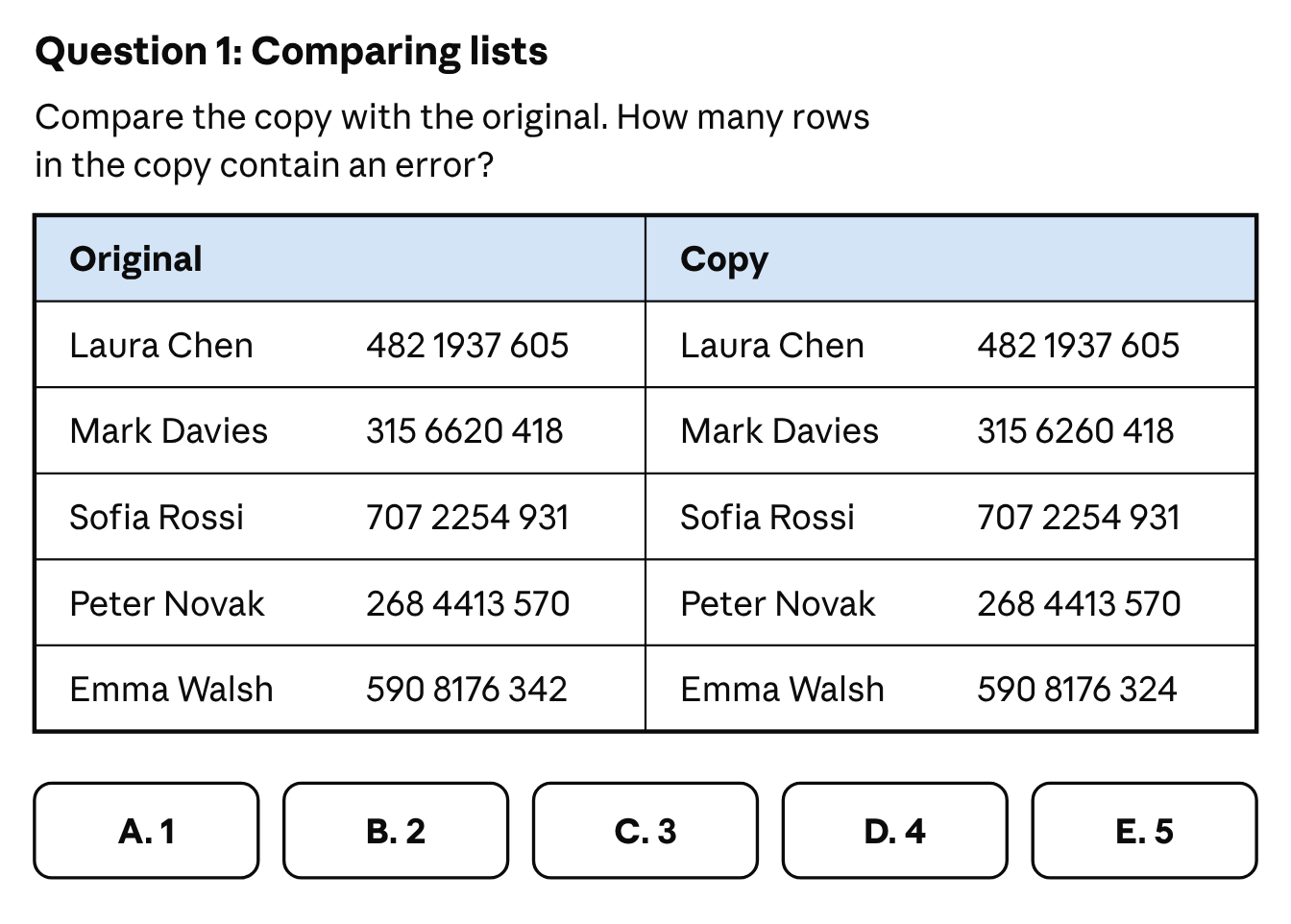
Answer: B (2). Row 2 has 6620 changed to 6260, and row 5 has 342 changed to 324. Both are swapped digits, a very common kind of copying error. The other three rows match exactly.
Type two: matching codes
You get a reference code and several options that look almost identical. Only one matches exactly. Check each option against the reference one block at a time, and watch for look alike characters: the letter O and the number 0, the letter I and the number 1, the letter S and the number 5.
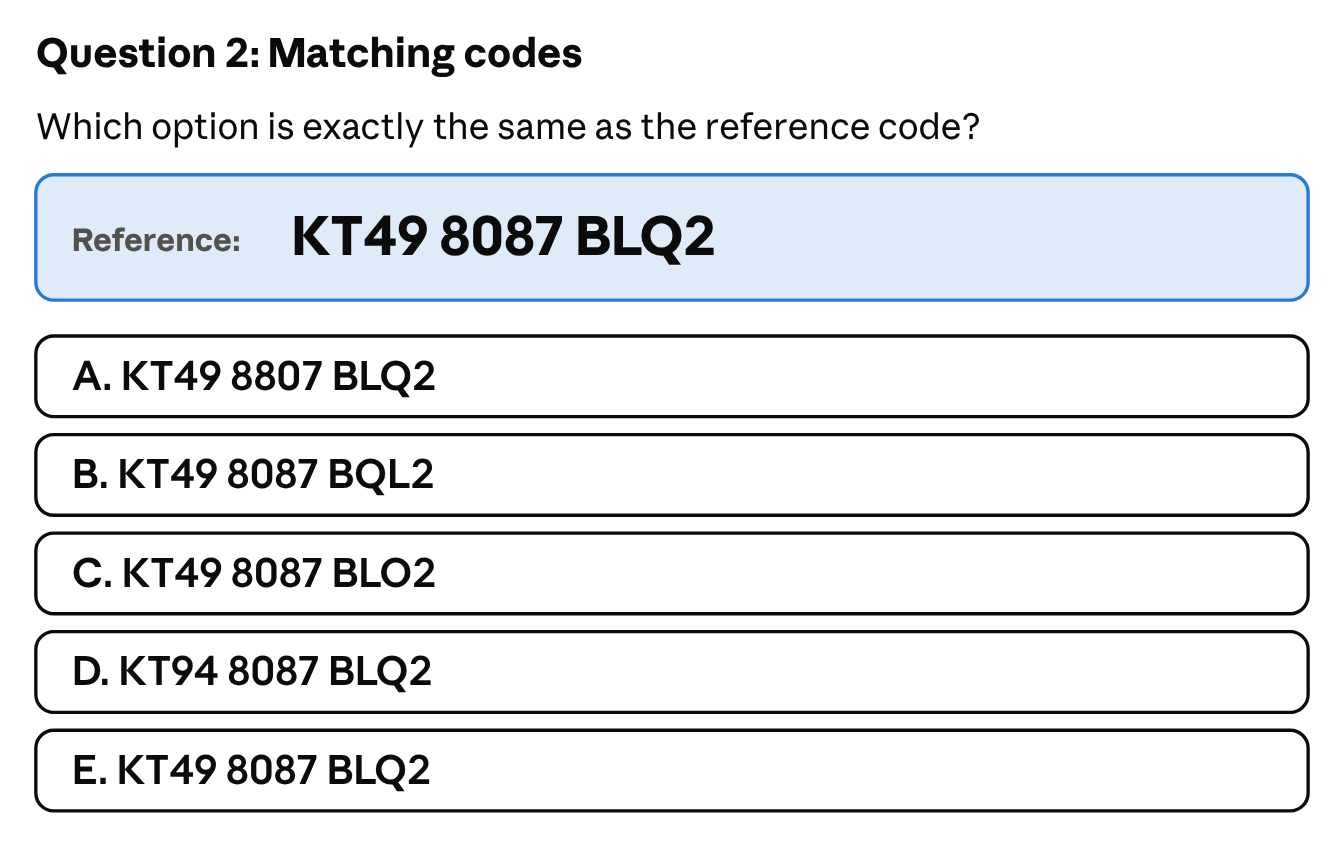
Answer: E. A swaps 8087 to 8807. B swaps BLQ to BQL. C uses the letter O instead of the letter Q. D swaps 49 to 94. Only E matches the reference exactly.
Type three: proofreading
You read a short passage and count or find the spelling, grammar, and word errors. Your brain is built to read for meaning, so it smooths over mistakes. In a classic study, people asked to circle every letter t in a passage missed a disproportionate number in the common word "the", because familiar words are read as whole shapes, not letter by letter. Slow down and pay special attention to short, common words and to the beginnings and ends of lines.
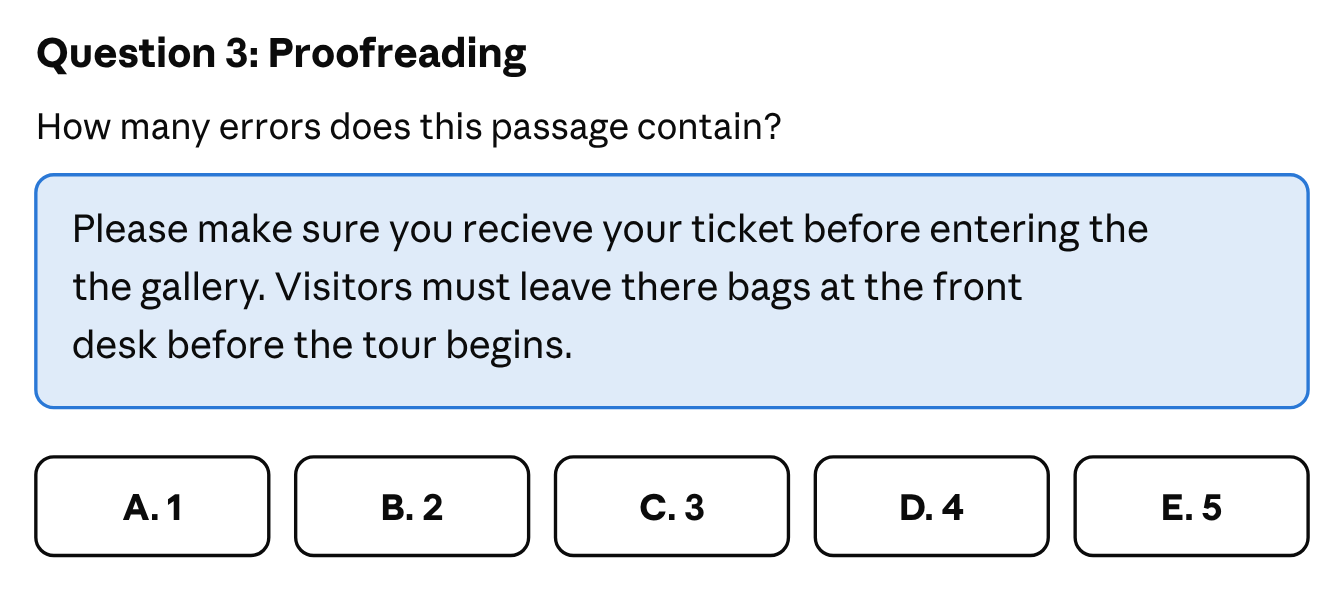
Answer: C (3). "Recieve" should be "receive". "The" appears twice, once at the end of the first line and again at the start of the second. "There bags" should be "their bags". The repeated word across the line break is the easiest one to miss.
Type four: checking figures
You check a set of numbers, such as a receipt, an invoice or a timetable, for a calculation or copying error. Check each line on its own: multiply or add it yourself, then compare with the printed figure. Do not assume a total is right because it looks reasonable.
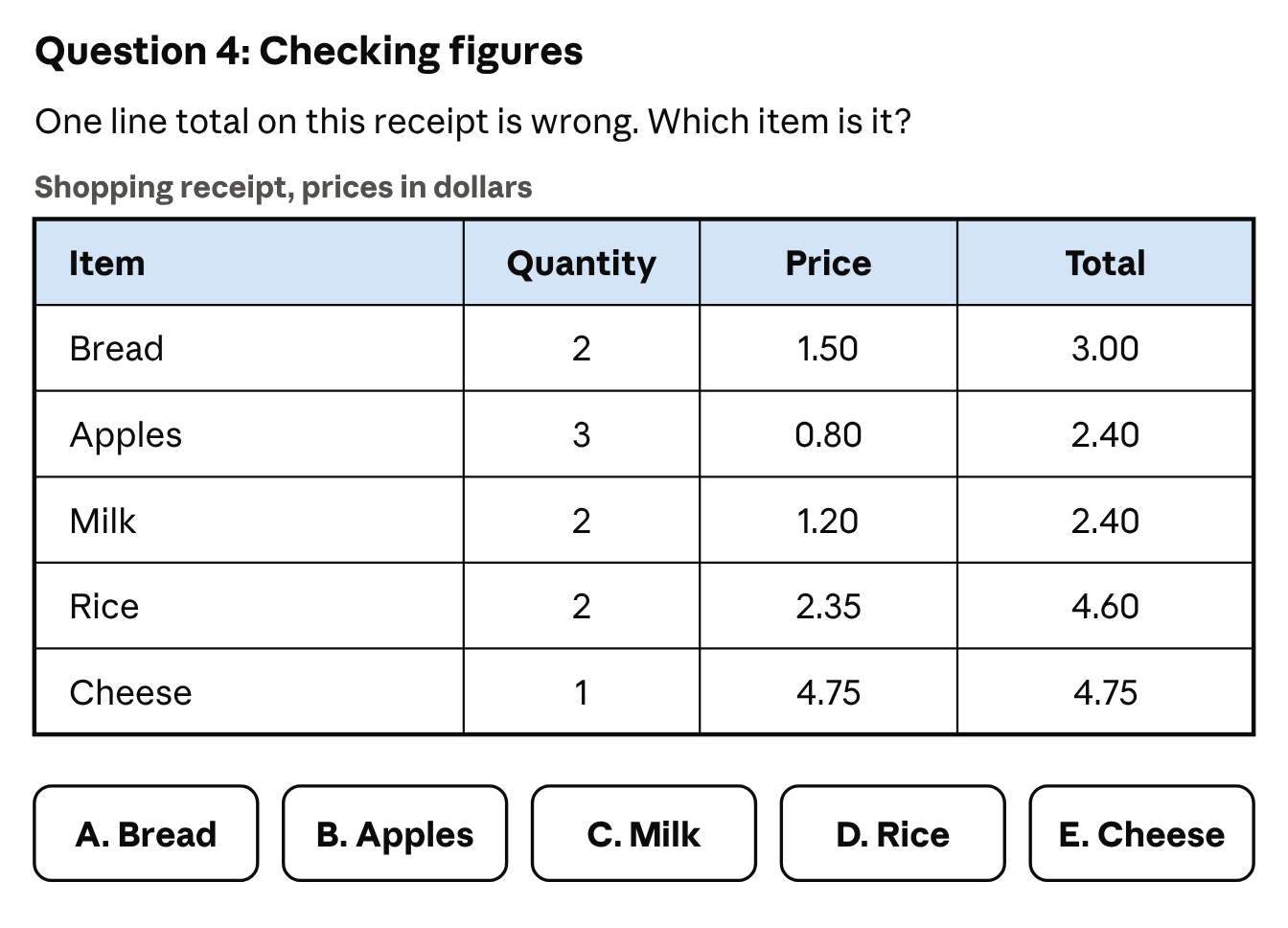
Answer: D (Rice). 2 times 2.35 is 4.70, not 4.60. Every other line is correct: 2 times 1.50 is 3.00, 3 times 0.80 is 2.40, 2 times 1.20 is 2.40, and 1 times 4.75 is 4.75.
Type five: scanning and counting
You count how often a number, letter, or symbol appears in a block. Work row by row, and keep a running total on scrap paper, writing the count for each row before you move on. That way, a lost place costs you one row, not the whole block.
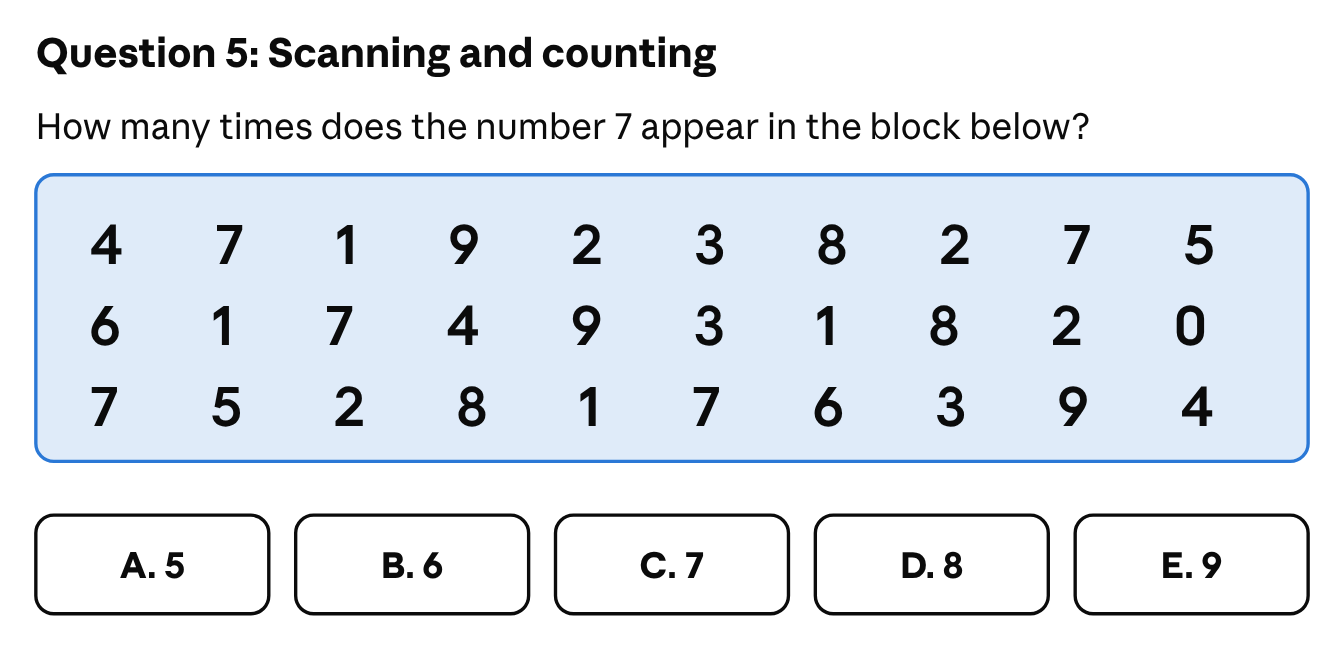
Answer: A (5). The first row has two 7s, the second row has one, and the third row has two. That makes 5 in total.
How to Pass an Attention to Detail Test: A Step by Step Method
The questions reward a steady, deliberate way of checking. Use these five steps every time.
Step one: slow down to speed up. Rushing feels efficient, but it trades accuracy for speed. Research on decision making shows that people can move along a speed and accuracy tradeoff: the faster they push, the more mistakes they make. On a checking test, a steady pace that gets each question right beats a fast pace that needs guessing.
Step two: break items into chunks. Do not compare a whole row or code at once. Compare three or four characters at a time: "KT49", then "8087", then "BLQ2". Your eyes will catch a swap inside a small chunk that they would slide past in a long string.
Step three: use your finger or cursor. Keep your place with a finger on the screen or the mouse pointer on the line. It stops you skipping rows and makes you look at each character.
Step four: read what is there, not what you expect. Your brain fills in familiar words and patterns automatically. Say each item quietly in your head, character by character, especially short words, numbers and the ends of lines.
Step five: do not go back unless you must. Second guessing an answer you checked carefully wastes time and often swaps a right answer for a wrong one. Mark it, move on, and only return if time remains.
How Much Should You Practice for an Attention to Detail Test?
A few short sessions spread over a week work better than one long session the night before. A major review of study methods found that testing yourself with practice questions and spreading practice over several days were two of the most effective ways to learn.
Keep your sessions short for another reason too. Holding close attention on a checking task is tiring, and a review of research on sustained attention found that people's ability to spot targets declines over time on long watches. Practice in blocks of 15 to 20 minutes, then take a break.
Full timed practice tests also help, up to a point. A review of more than 134,000 people who took ability tests more than once found a modest rise on retesting, so two or three timed practice tests are enough to learn the format and pacing.
Here is a simple one week plan. On day one, take a full timed practice test and note which question types cost you most. On days two to five, practice one or two question types a day for 15 to 20 minutes, using the chunking and finger methods until they feel natural. Build daily habits too: proofread a page of an email or article, or check a shopping receipt line by line. On day six, take a second timed test. On day seven, rest.
The Day Before and the Day of the Test
Remove every distraction. Switching between tasks, even briefly, has a cost. Experiments on task switching found that every switch costs extra time, and the cost grows as the tasks get more complex. Close other tabs, silence your phone and tell people around you not to interrupt.
Watch for your mind wandering. A review of research on mind wandering found that when attention drifts from the task, performance slips and people take in less of what is in front of them. If you notice you have read a line without taking it in, stop, take one breath, and start the line again.
Sleep instead of cramming. A review of 70 studies on lost sleep found that missing a night hits attention hardest, especially simple, sustained attention, which is exactly what these tests measure.
Keep nerves in check. A review of 238 studies found that test anxiety is linked to lower scores. Familiarity helps most: the more practice tests you have done, the more ordinary the real one will feel.
Read the instructions twice. Check whether you must find the one error or count all of them, whether wrong answers cost points, and how long you have.
Key Takeaways
- Attention to detail tests ask you to spot small errors and differences quickly, in lists, codes, passages, figures and blocks of characters.
- Employers use them because checking accuracy predicts performance in many roles, and because carefulness is hard to judge from a résumé alone.
- Slow down to a steady pace, break items into small chunks, and keep your place with a finger or cursor.
- Read what is actually there: familiar words and patterns are where the eye slides past mistakes.
- Practice in short sessions over several days, and two or three timed tests are enough.
- On test day, remove distractions, watch for your mind wandering, and rest well beforehand.
Implications for Practice: What to Do If You Do Not Pass
First, keep the result in perspective. A recent reanalysis of decades of hiring research found that the power of ability tests to predict job performance had been overstated for years. One test is one part of the picture, and employers also weigh your experience, references and interview.
Second, find out whether you can retake the test and how long you must wait. Then look at where your points went. If you ran out of time, practice a steady pace with a timer. If you finished early but made errors, you were rushing: practice chunking and reading character by character.
Third, build checking into your everyday life. Proofread your own emails before sending them, check your bills against what you ordered, and compare copied phone numbers or codes against the original. Small daily habits turn careful checking into something you do without thinking.
If you want to understand how good employers use these tests, The Human Capital Hub explains the pre employment testing practices they follow.