You have been invited to take a critical thinking test as part of a job application. It sounds vague. Is it an IQ test? Is it a personality test? What exactly are they looking for, and how do you prepare?
Here is the short answer. A critical thinking test checks whether you can read a short piece of information and judge it carefully: what it really says, what it does not say, and what can and cannot be concluded from it. Being clever helps, but it is not enough. Many bright people lose points because they answer based on what they already believe or on their first gut reaction, rather than on the words on the page.
That is good news, because it is a habit you can change. This guide shows you what the test looks like, the five skills it measures, a sample question for each, and a method for answering them.
What Is a Critical Thinking Test?
A critical thinking test is a reading and reasoning test. Each question gives you a short passage, often only three or four sentences, followed by a statement. Your job is to judge that statement. Is it true based on the passage? Does it follow logically? Is it an assumption the writer made? Is it a strong or weak argument?
You do not need special knowledge. Everything you need is in the passage. In fact, the most important rule of the test is to use only what is in the passage, even when you know more about the topic, and even when the statement sounds right.
Many critical thinking tests used in hiring are built around the same five skills: drawing inferences, recognizing assumptions, making deductions, interpreting information, and evaluating arguments. Each skill has its own question style, and each is explained with a sample question further down. The answer choices change with the skill. Sometimes you pick from a scale such as true, probably true, not enough information, probably false, and false. Sometimes you simply decide yes or no, follows or does not follow, strong or weak.
Employers use these tests for roles where people must weigh evidence and make decisions: graduate schemes, management, law, finance, human resources and policy work.
Does an IQ Test Measure Critical Thinking?
Only partly. An IQ test, short for intelligence quotient test, measures how quickly and accurately you can solve problems: spotting patterns, holding information in mind, and working things out. Critical thinking uses those abilities, but it also depends on something IQ tests rarely check: whether you stop and question your first answer.
The research on this is striking. Across seven studies, psychologists found that many classic thinking errors, such as being swayed by how a question is worded or sticking with a plan because you have already invested in it, were unrelated to cognitive ability. Clever people fell for them about as often as everyone else. Some other errors, such as judging an argument by whether you agree with its conclusion, were less common among people with higher ability, but did not disappear.
A related study found that a short test of whether people pause before answering was a stronger predictor of good reasoning than intelligence tests. The best known question from that kind of test goes like this: a bat and a ball cost 1 dollar and 10 cents in total, and the bat costs 1 dollar more than the ball; how much does the ball cost? Many people instantly think 10 cents. The right answer is 5 cents. When this question and two others like it were given to more than 3,000 people, many students at top universities gave the quick wrong answer.
Critical thinking also matters outside the test room. A study of 244 adults found that critical thinking scores predicted who avoided bad real life outcomes, such as costly financial or health decisions, better than intelligence scores did.
So does an IQ test measure critical thinking? It measures the engine, not the driving. A critical thinking test measures whether you use that engine carefully. For you as a candidate, that is encouraging: careful habits can be learned faster than raw intelligence can be raised.
What Are 5 Critical Thinking Skills?
These are the five skills that critical thinking tests in hiring commonly check. Each comes with a sample question drawn the way it will look on screen, and the answer underneath.
Skill one: drawing inferences
An inference is a conclusion you reach from facts that are given. Inference questions give you a passage and a possible conclusion, and ask how likely it is to be true: true, probably true, not enough information, probably false, or false. The trap is choosing "probably true" because it sounds sensible, when the passage does not actually give you enough to go on.
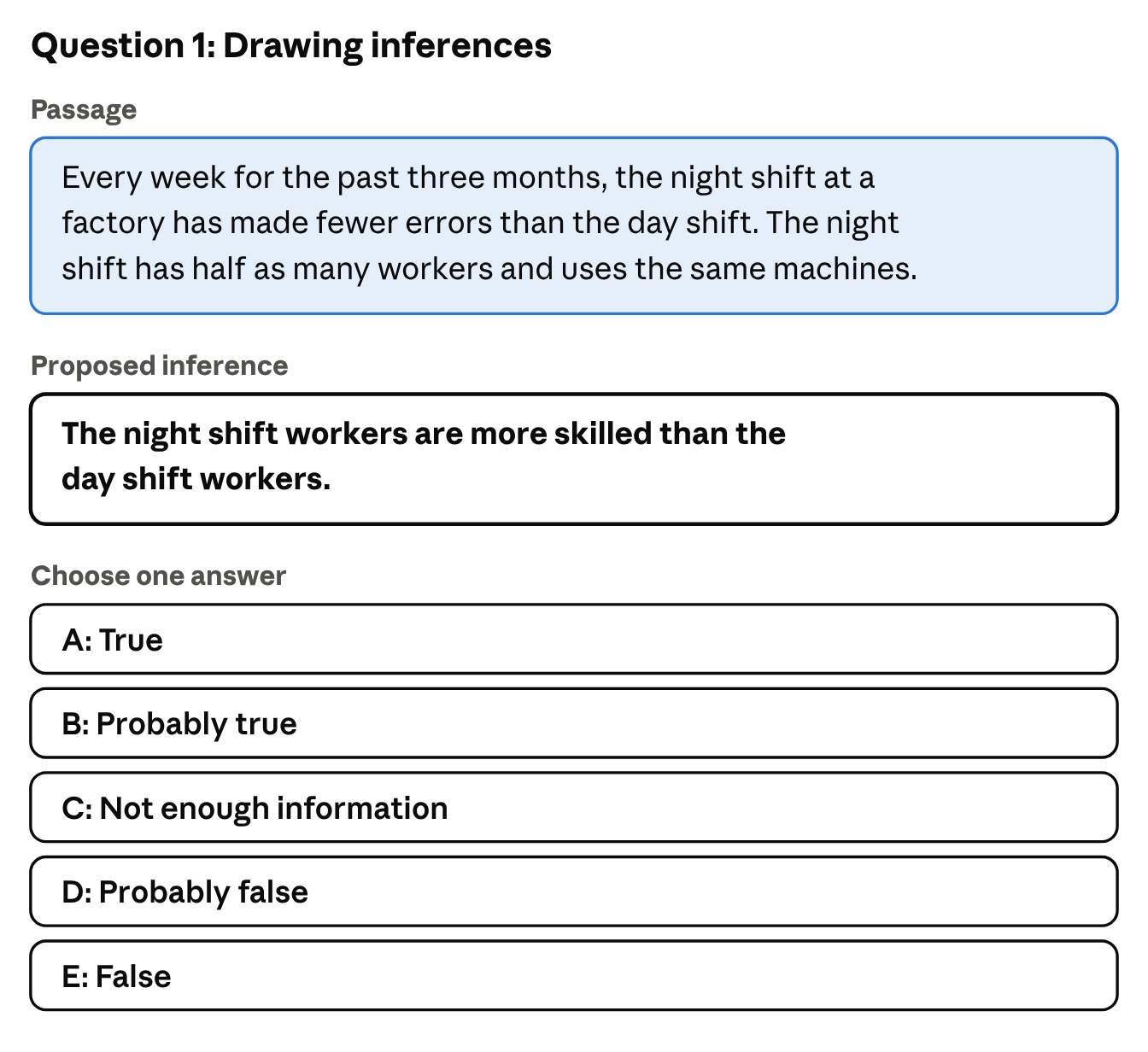
Answer: C. Fewer errors could come from more skilled workers, but it could just as easily come from having half as many people, or less work to do at night. The passage does not say, so there is not enough information.
Skill two: recognizing assumptions
An assumption is something a speaker takes for granted without saying it. These questions give you a statement and a possible assumption, and ask whether the speaker has made it. Ask yourself: if this assumption were false, would the statement still make sense? If not, the assumption was made.
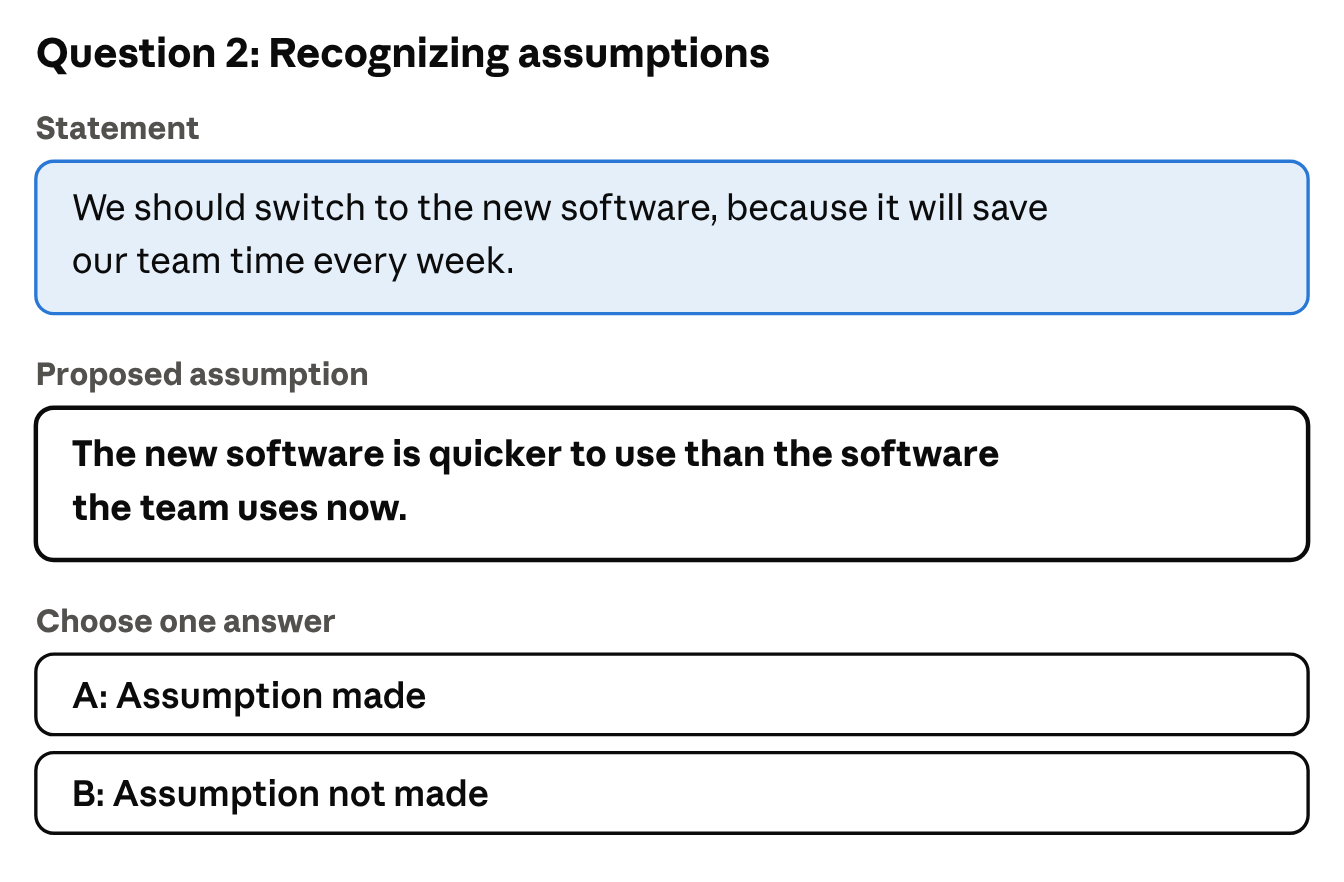
Answer: A. The speaker says the switch will save time. That only makes sense if the new software is quicker to use. If it were slower, the reason would fall apart, so the assumption was made.
Skill three: making deductions
Deduction questions give you two or more facts and a conclusion. You decide whether the conclusion must follow from those facts, and nothing else. This is where belief traps you most. In a classic study, people were far more likely to accept a conclusion they believed was true, even when the logic behind it was broken, and to reject a sound conclusion that sounded wrong.
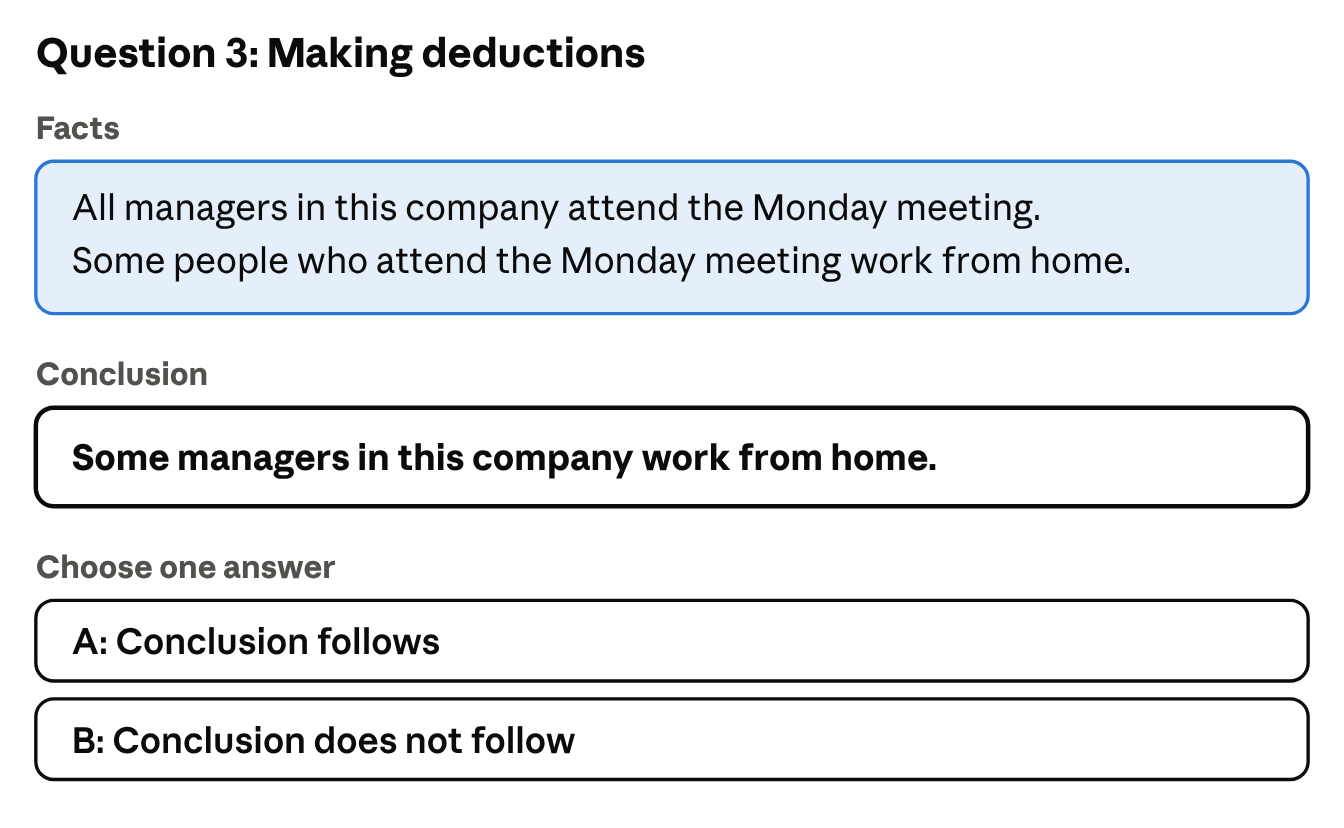
Answer: B. The managers could all be among the meeting goers who work in the office. The facts allow some managers to work from home, but they do not require it. The conclusion sounds natural, which is exactly the trap.
Skill four: interpreting information
Interpretation questions give you facts, often numbers or survey results, and a conclusion. You decide whether the conclusion follows beyond reasonable doubt. The common trap is mistaking two things that happen together for one thing causing the other.
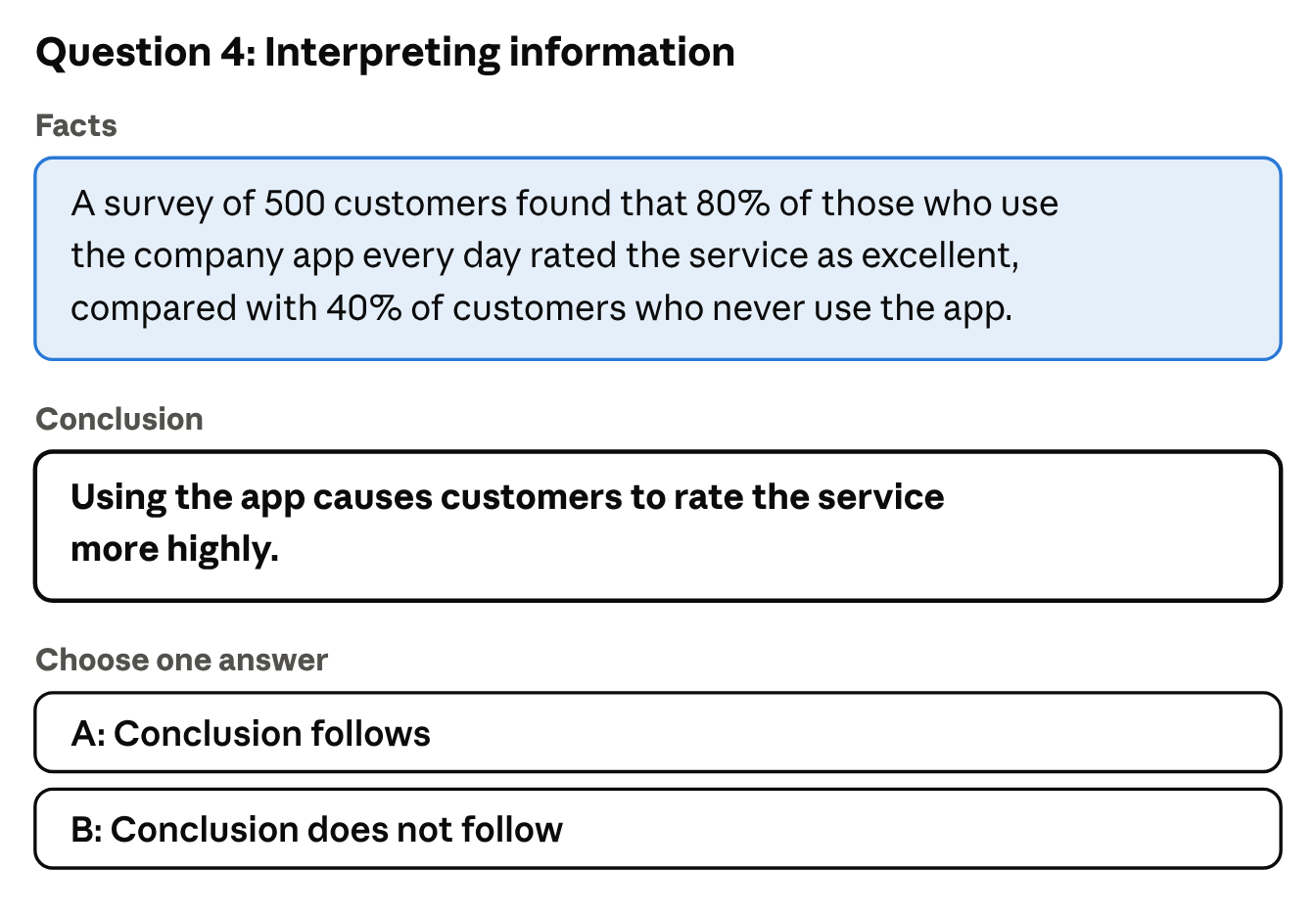
Answer: B. The numbers show that app users and happy customers go together. They do not show which causes which. Customers who already like the service may simply be more likely to use the app.
Skill five: evaluating arguments
Argument questions give you a question and an answer with a reason, and ask whether the argument is strong or weak. A strong argument is important and directly related to the question. A weak argument is trivial, off the point, or rests on feelings rather than reasons. You judge the argument, not whether you agree with it.
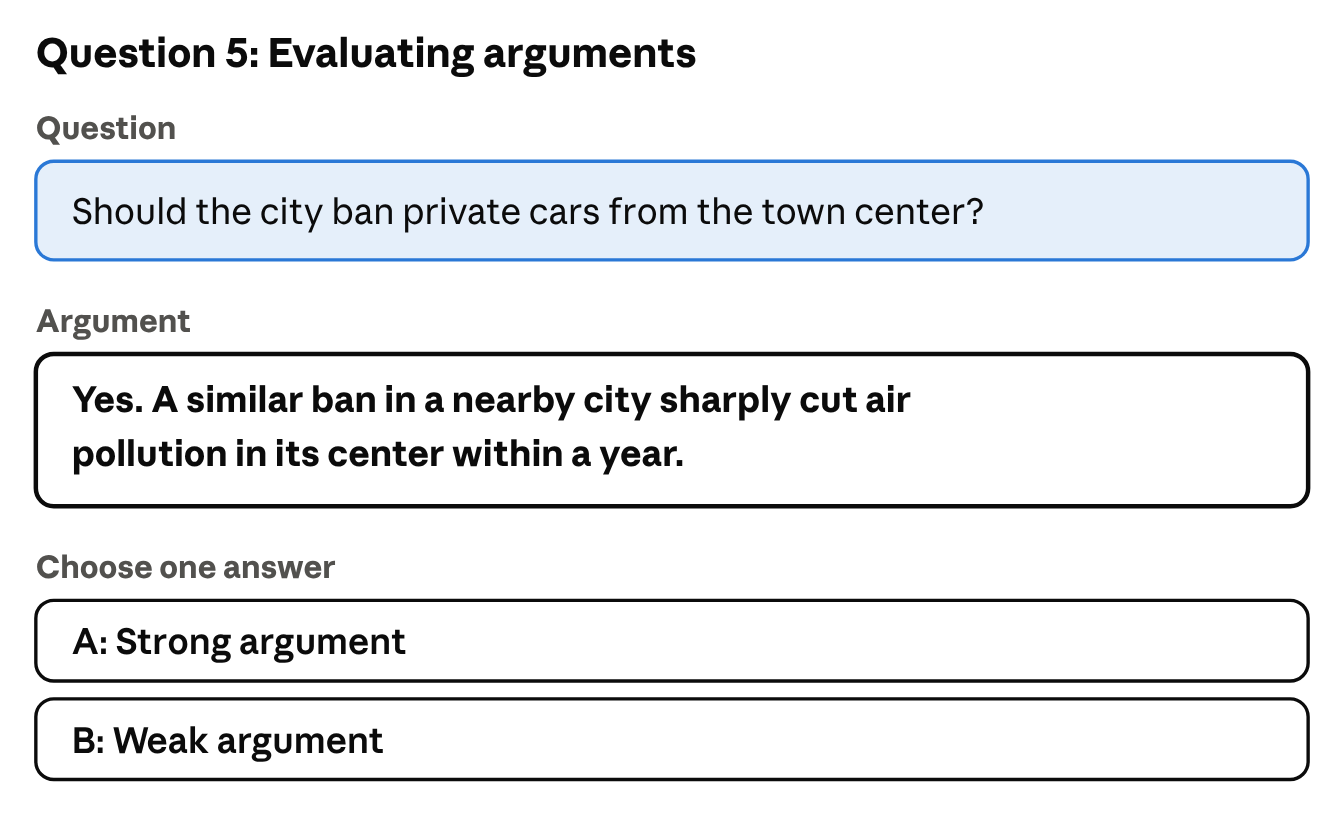
Answer: A. The argument is directly related to the question and points to an important result from a similar case. You may personally oppose a ban, but the argument itself is strong.
How to Pass a Critical Thinking Test: A Step by Step Method
The sample questions show the pattern. Many wrong answers come from three habits: answering from what you already believe, answering from your first gut reaction, or reading more into the passage than it says. This method is built to block all three.
Step one: read the instructions for each section. Each skill has its own rules. In an inference section, "probably true" is an allowed answer. In a deduction section, a conclusion either must follow or it does not. Mixing up the rules costs easy points.
Step two: treat the passage as the whole world. Accept everything in the passage as true, even if it sounds odd. Do not add facts from your own knowledge. If the passage does not say it, you do not know it.
Step three: find the exact claim in the statement. Underline, in your head, the key words: all, some, most, causes, always, never. A single word such as "causes" or "all" often decides the answer.
Step four: test it against the passage, not against your beliefs. Ask: does the passage force this to be true, or does it merely allow it? If you notice yourself agreeing because the statement sounds reasonable, slow down. That feeling is exactly what the test is checking.
Step five: pause before you click. Your first answer is often the gut answer. Take two seconds to ask whether there is another way to read the facts. Then choose and move on.
How Much Should You Practice for a Critical Thinking Test?
Critical thinking can be taught, and the research shows how. A review of 117 studies found that teaching produced real gains in critical thinking, and the biggest gains came when the thinking skills were taught openly and practiced on purpose, rather than hoped for as a side effect. A later review of 341 results found three things that worked best: discussing problems with others, working on real world examples, and getting guidance from someone more experienced.
That gives you a practical plan. Do not just read about the five skills. Work through questions, then explain your reasoning out loud or to a friend, and check where your reasoning went wrong.
Timed practice tests help with the format, but the benefit is limited. A review of more than 134,000 people who took ability tests more than once found a modest rise on retesting, and a larger review found that scores stopped rising after three attempts. The Human Capital Hub has free psychometric practice tests you can use to get used to timed testing.
Here is a simple one week plan. On day one, read the instructions for each of the five skills until you can explain the rules in your own words. On days two to four, take one or two skills a day and work through 15 to 20 practice questions each, untimed, writing one line on why each wrong answer was wrong. On day five, do a full timed practice test. On day six, review every mistake with a friend, explaining your reasoning out loud, and do a second timed test. On day seven, rest.
The Day Before and the Day of the Test
Keep nerves in check. A review of 238 studies found that test anxiety is linked to lower scores, especially when the stakes feel high. When you feel anxious, it is tempting to skim, and skimming is costly on a test where one word can decide the answer. If you feel rushed, take one slow breath before the next passage.
Sleep instead of cramming. A review of 70 studies on lost sleep found that missing a night hits attention hardest. Critical thinking tests demand close reading from the first question to the last, and a tired mind drifts.
Read slowly, answer steadily. Accuracy matters more than rushing to the end. Read every word of the passage and the statement. Watch for the small words that change everything: all, some, only, most, causes.
Pace yourself. Divide the total time by the number of questions and check the clock every few questions. If one question eats double its time, make your best choice and move on, unless wrong answers cost points.
Key Takeaways
- A critical thinking test gives you short passages and asks you to judge statements using only what the passage says.
- An IQ test measures raw reasoning power; a critical thinking test measures whether you use it carefully, and clever people still fall for thinking traps.
- The five skills commonly tested are drawing inferences, recognizing assumptions, making deductions, interpreting information and evaluating arguments.
- Many mistakes come from answering with your beliefs or your first gut reaction, so treat the passage as the whole world and pause before you answer.
- Critical thinking can be learned; practice actively, talk through your reasoning, and review every mistake.
- Rest well and read slowly, because single words such as "all", "some" and "causes" often decide the answer.
Implications for Practice: What to Do If You Do Not Pass
First, keep the result in perspective. One test is one part of the picture, and employers also weigh your experience, knowledge, and interview.
Second, find out whether you can retake the test and how long you must wait. Then find your weak skill. Go back over your practice tests and sort your mistakes by the five skills. You may find that one or two skills cause most of your errors. Put most of your practice there.
Third, practice critical thinking in daily life. When you read a news story, ask what the writer is assuming, whether the evidence shows cause or only a link, and what would have to be true for the conclusion to hold. It becomes a habit, and habits carry into the test room.
If you want to understand how good employers use these tests, The Human Capital Hub explains the pre employment testing practices they follow.