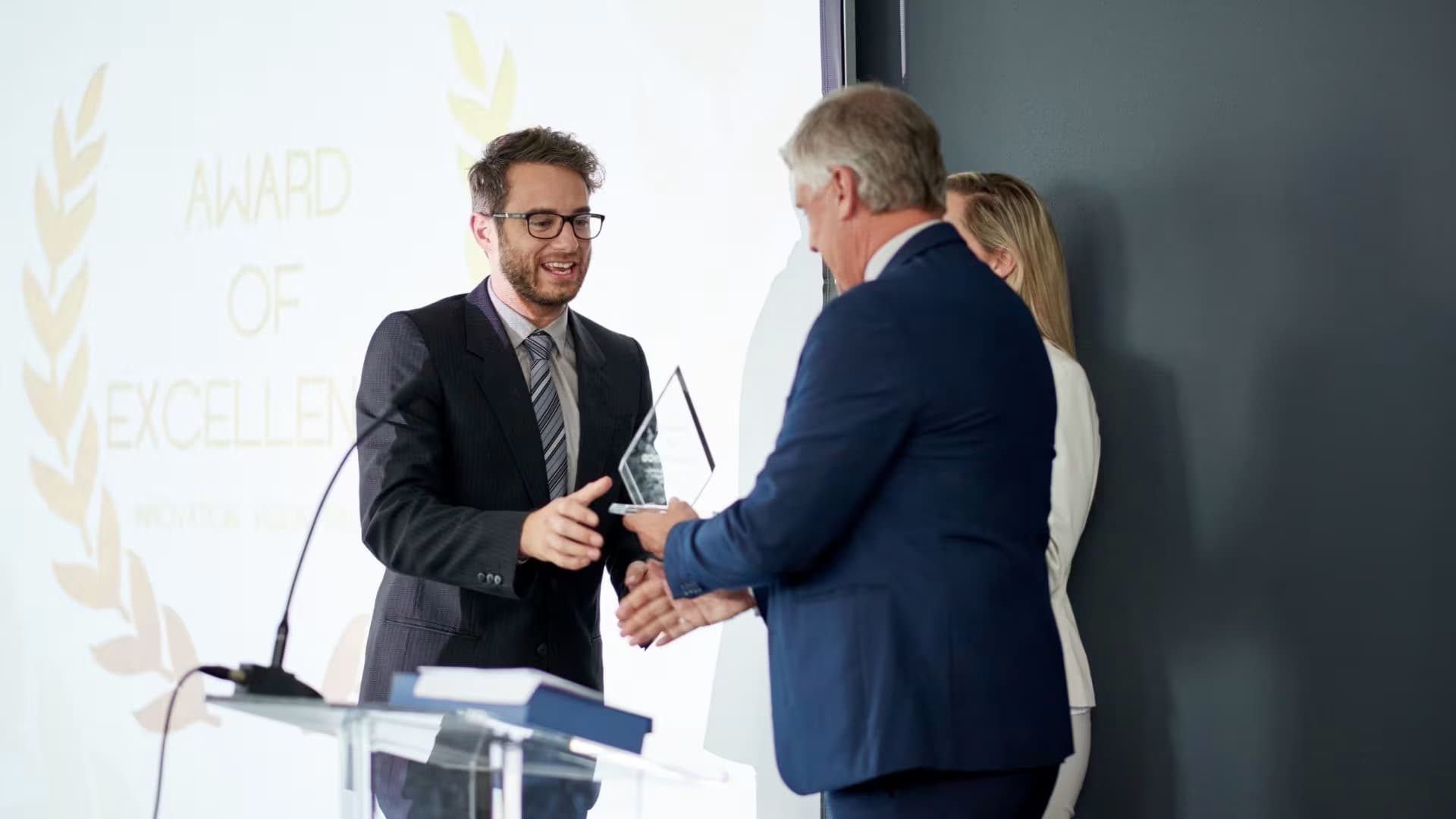
Choose a wall plaque if the recognition should be seen by the team. Choose a desk award if it's more personal, or if the recipient is hybrid or moves around. Then write an inscription that names the specific thing colleagues nominated this person for. And before anything is engraved, have one named person sign off on every name, date, logo and line of text.
That's it. The rest of this article is the detail behind those three decisions.
Peer nominations are different from manager-picked awards. Someone's coworkers sat down and wrote about what this person did, often in surprising detail. Custom award plaques that just say "Employee of the Quarter" throw most of that away. The plaque is your chance to keep it.
Wall or desk: where will it actually live?
Start with the place, not the product. A beautiful plaque that ends up in a drawer has done half its job.
Wall plaque | Desk or freestanding award | |
|---|---|---|
Best when | The award says something about team values and should be visible to others | The recognition is personal, or the recipient has their own workspace |
Visibility | High, if hung in a shared area | Mostly the recipient and visitors to their desk |
Hybrid and remote staff | Goes home with them, which needs wall space there | Easier to carry, ship and move between desks |
Room for text | Usually more | Usually less, so keep wording tight |
Check first | Facilities or landlord rules on drilling; whether mounting hardware is included | That the model is made to stand on its own, not a wall piece propped up |
If your peer award runs every quarter or every year, consider a perpetual plaque for the office wall, with a plate added for each winner, plus a smaller individual piece the recipient keeps. The wall piece builds a visible history of the program. The personal piece is the one that means something to the person.
Not sure where the recipient works most days? Ask their manager quietly. It's a two-minute question that saves you from shipping a wall plaque to someone who works from a shared hot desk.
Making the inscription specific
The best source for the wording is already on your desk: the nominations. Read them all and look for the thing more than one colleague mentioned. That's your line.
A workable structure has five parts:
- The recipient's name, as they prefer it
- The award's name
- One specific contribution, in plain words
- Who it's from, such as "Nominated by your colleagues in Finance"
- The date or period
Here's the difference specificity makes. These are invented examples, not real inscriptions.
Generic: "Presented to Jordan Lee for outstanding performance. Peer Recognition Award, 2026."
Specific: "Jordan Lee, Peer Recognition Award. For rebuilding the month-end close checklist so the whole team could go home on time. Nominated by your colleagues in Finance. Q3 2026."
The second one tells anyone who reads it what Jordan did. Jordan will remember it. So will the people who nominated them.
A few things to leave off. Don't put private details on a plaque, such as a health issue someone worked through, even if a nominator mentioned it warmly. Skip inside jokes; they age badly and confuse visitors. And if you want to quote a nominator word for word, ask them first.
Then check length against the space. A desk award can hold far fewer words than a large wall plaque, and cramped engraving is hard to read. If you want more prompts for wording, the Eclipse Awards award plaques guide sets out questions to work through, from who is being recognized to who the recognition comes from, along with sample inscriptions.
Who approves names, dates, logo and artwork
Engraving can't be edited. A misspelled name on a recognition award does real damage, because it tells the recipient nobody checked. So decide who checks what before you place the order.
Item | Who should confirm it | What to watch for |
|---|---|---|
Recipient's name | HR, against the HRIS record, plus the recipient's preferred name | Legal name vs. the name they go by; accents and hyphens |
Job title | HR | Titles that changed recently or are about to |
Award name and dates | The recognition program owner | Same award name and date format as previous years |
Logo | Marketing or the brand owner | Current version, in the file format the supplier asks for |
Quoted nominator words | The nominator | Permission to use their wording |
Final artwork proof | One named approver, after a second person proofreads | Spelling, spacing, orientation, every character |
The most important row is the last one. Name a single final approver, usually the program owner in HR. Committees are how errors slip through: everyone assumes someone else read the date line. Get the sign-off in writing, even if it's a one-line email, and keep it with the order record.
One more thing about the preferred name. You can usually confirm it without spoiling the surprise by checking the recipient's email signature or asking their manager.
Ordering checklist
Before you choose
- Confirm the award name, the recipient and the presentation date.
- Decide on wall, desk or perpetual plus personal piece.
- Agree the budget and which cost center pays.
Before you write
- Pull two or three specifics from the nominations.
- Confirm the preferred name and current title.
- Draft the wording and check it fits the size you chose.
Before you order
- Get the logo file in the format the supplier requests.
- Work back from the presentation date, leaving time for proof rounds and shipping.
- Ask the supplier how proofs and revisions work, what marking options are available and whether mounting hardware is included.
Before you approve the proof
- Read every line aloud, including the date.
- Have a second person proofread.
- Send written approval from the single named approver.
When it arrives
- Unpack it right away and compare it against the approved proof.
- Plan the presentation, and invite the nominators.
The part people remember
The plaque will outlast the meeting where it's handed over. But what makes it matter is the evidence that colleagues noticed. So when you present it, read a line or two from the nominations out loud. The engraving keeps the words. Hearing them from peers is what the recipient takes home.