Facility managers, HR leaders, and operations teams who read The Human Capital Hub spend a lot of time thinking about workplace conditions, from ergonomic setups to employee wellbeing. What rarely makes the list is the pest activity quietly affecting office kitchens, breakrooms, and remote employees' home offices. Yet ant infestations are one of the most common and most underestimated facilities issues a workforce can face, whether in a corporate building or in the home office where a growing share of employees now work daily.
For HR and operations professionals managing hybrid teams, a pest problem at an employee's home or in a shared office space is not just a maintenance footnote. It affects comfort, productivity, and in some cases health and safety conversations that land on an HR desk. Understanding what trained pest professionals actually look for, versus what the average person notices, helps workplace leaders ask better questions when a vendor contract or a remote work stipend conversation comes up.
In warmer regions, this concern becomes more pointed. Homeowners and renters in South Florida frequently ask whether big headed ants in Miami Fl dangerous to pets and children, a question that reflects a broader anxiety about what is actually living inside walls and under floors. That same anxiety applies to any organization with employees working from homes in ant-prone climates, since a pest problem at home can quietly become a productivity and wellbeing issue for an employer who never sees it directly.
What Professionals Notice First: Environmental Clues Homeowners Miss
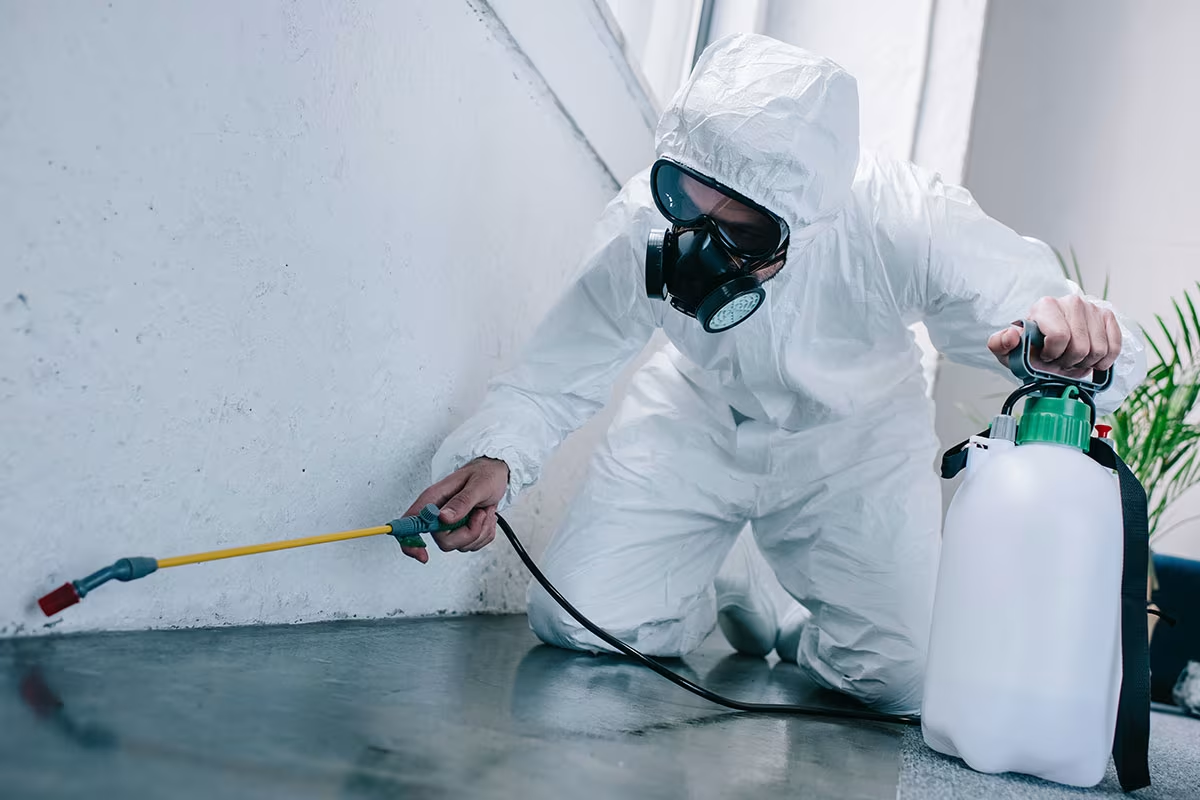
Most homeowners respond to ants by looking for the ants themselves, a trail on the counter or a cluster near a window sill. Trained technicians start somewhere else entirely. They look at moisture readings near plumbing fixtures, gaps around window and door frames, mulch beds piled too close to the foundation, and vegetation touching the exterior siding. These are the conditions that sustain a colony long after the visible trail has been wiped away with a paper towel.
According to Productive and Free, pest professionals look for environmental conditions that support colonies, such as standing moisture near plumbing, gaps around window frames, and mulch piled against foundations, rather than focusing solely on visible ants, because these clues reveal the larger hidden colony structure that homeowners typically overlook. This distinction matters because spraying visible ants without addressing the underlying conditions almost always results in the same infestation reappearing within days or weeks, often in a slightly different location in the same structure.
A seasoned technician also pays attention to seasonal timing, recent rainfall, and nearby landscaping changes, since all of these shift ant foraging patterns in predictable ways. Homeowners rarely connect a new mulch delivery or a leaky irrigation line to an ant problem three weeks later, but professionals see that pattern constantly.
The Difference Between a Random Forager and an Established Colony
One of the most consistent gaps in homeowner understanding is the difference between a few wandering scout ants and a fully established colony operating inside the structure. Scouts are individual ants sent out to locate food and water, and their presence does not necessarily mean a nest exists indoors. An established colony, by contrast, has already set up satellite nests, developed reliable foraging trails, and in many species split into multiple interconnected colonies that make elimination far more complicated.
Professionals distinguish these scenarios by observing trail density, the time of day activity peaks, and whether ants are traveling to a consistent point of entry versus scattering randomly. Homeowners tend to treat every ant sighting with the same urgency and the same store-bought spray, when in reality a mature colony requires a very different strategy, often involving bait matrices and targeted treatment of nesting sites rather than surface contact killers that only eliminate the ants that happen to be out foraging at that moment.
Statistic | Figure |
U.S. households experiencing ant infestations annually | 56% (2025) |
Odorous house ants as share of treated infestations | 64% (2024) |
Pest professionals reporting rising ant infestations | 54% (NPMA data) |
Most vulnerable indoor area: kitchens | 96% |
Most vulnerable indoor area: bathrooms | 89% |
Most vulnerable indoor area: inside walls | 73% |
Single-family homes with ant infestations | 80% (NPMA survey) |
Species-Specific Red Flags: Why One Ant Problem Isn't Like Another
Not all ant infestations behave the same way, and this is where generic advice from a search engine or a neighbor often leads homeowners astray. Odorous house ants, which account for the majority of treated cases, tend to nest in wall voids near moisture sources and respond well to targeted baiting. Big headed ants, more common in warm coastal climates, build extensive underground colonies with multiple queens, making them notoriously difficult to eliminate with surface treatments alone, and their large mounds can damage lawns and garden beds over time.
Carpenter ants raise an entirely different concern because their presence often signals existing wood moisture damage, meaning the ant problem is really a symptom of a larger structural issue that needs to be addressed alongside the pest treatment. Professionals know to ask different diagnostic questions depending on which species they are dealing with, while homeowners frequently assume one ant is interchangeable with another and apply the same over-the-counter solution regardless of species, which explains why so many DIY treatments fail to produce lasting results.
When DIY Stops Working: Clear Signs It's Time to Call a Professional
There is a reasonable point at which homeowner-level intervention makes sense, typically for isolated, low-level trailing activity in a single location with an obvious food source. But several signals indicate that the problem has moved beyond what store-bought products can reasonably solve, including recurring trails in the same spot despite repeated treatment, activity appearing in multiple rooms simultaneously, or visible winged ants indicating a mature colony preparing to reproduce and spread.
For organizations managing remote or hybrid staff, these signals matter beyond the individual household, since a persistent pest issue in a home office can affect an employee's comfort and ability to work effectively from that space. Encouraging staff to treat early-stage ant activity seriously, rather than waiting until it becomes a larger disruption, is a small but practical piece of supporting a distributed workforce. Recognizing when a situation calls for licensed professional treatment rather than another round of consumer spray is ultimately the difference between a short-term nuisance and a long-term structural and health concern.