
Music creation used to force people into a difficult trade-off. You either spent serious time learning production tools, or you accepted stock tracks that rarely matched your idea. That gap explains why so many creators, marketers, educators, and indie builders are now exploring an AI Music Generator. The appeal is not only speed. It is the possibility of moving from a rough concept to a usable song without building an entire studio workflow first.
That shift matters because most creative work begins long before the “final track” stage. A founder wants a short sonic identity for a product demo. A YouTube editor needs background music that feels specific rather than generic. A teacher wants a memorable song for a lesson. In each case, the problem is not simply making sound. The problem is turning intent into music with as little friction as possible.
In my observation, the strongest platforms are not always the most famous ones. The better question is whether a tool helps a user move from idea to usable output with enough control to revise the result. That is why ToMusic stands at the top of this list. Its public workflow is easy to understand, it supports both simple prompting and more controlled lyric-based creation, and it clearly separates quick generation from deeper customization.
A More Useful Way To Rank Music AI
Many rankings overvalue novelty. They reward a platform for sounding impressive in a demo while ignoring what happens during repeated use. For ordinary creators, a better ranking system looks at five practical criteria.
How Quickly A First Draft Appears
A strong platform should let a user reach a first listen without unnecessary setup. If the path from idea to output feels heavy, many casual users will stop before they learn what the tool can actually do.
How Much Creative Direction Survives
Fast generation is helpful, but only if the result still reflects the original intent. Mood, genre, tempo, vocals, and lyrical structure all influence whether the song feels usable or random.
How Easy Revision Feels After Listening
Music generation is rarely perfect on the first pass. A good platform helps users iterate instead of making each retry feel like starting from zero.
Whether The Output Fits Real Projects
Some users want songs with vocals. Others need instrumentals, social clips, or background cues. Platforms differ a lot in how well they support these practical goals.
The Ten Music AI Platforms In Order
1. ToMusic
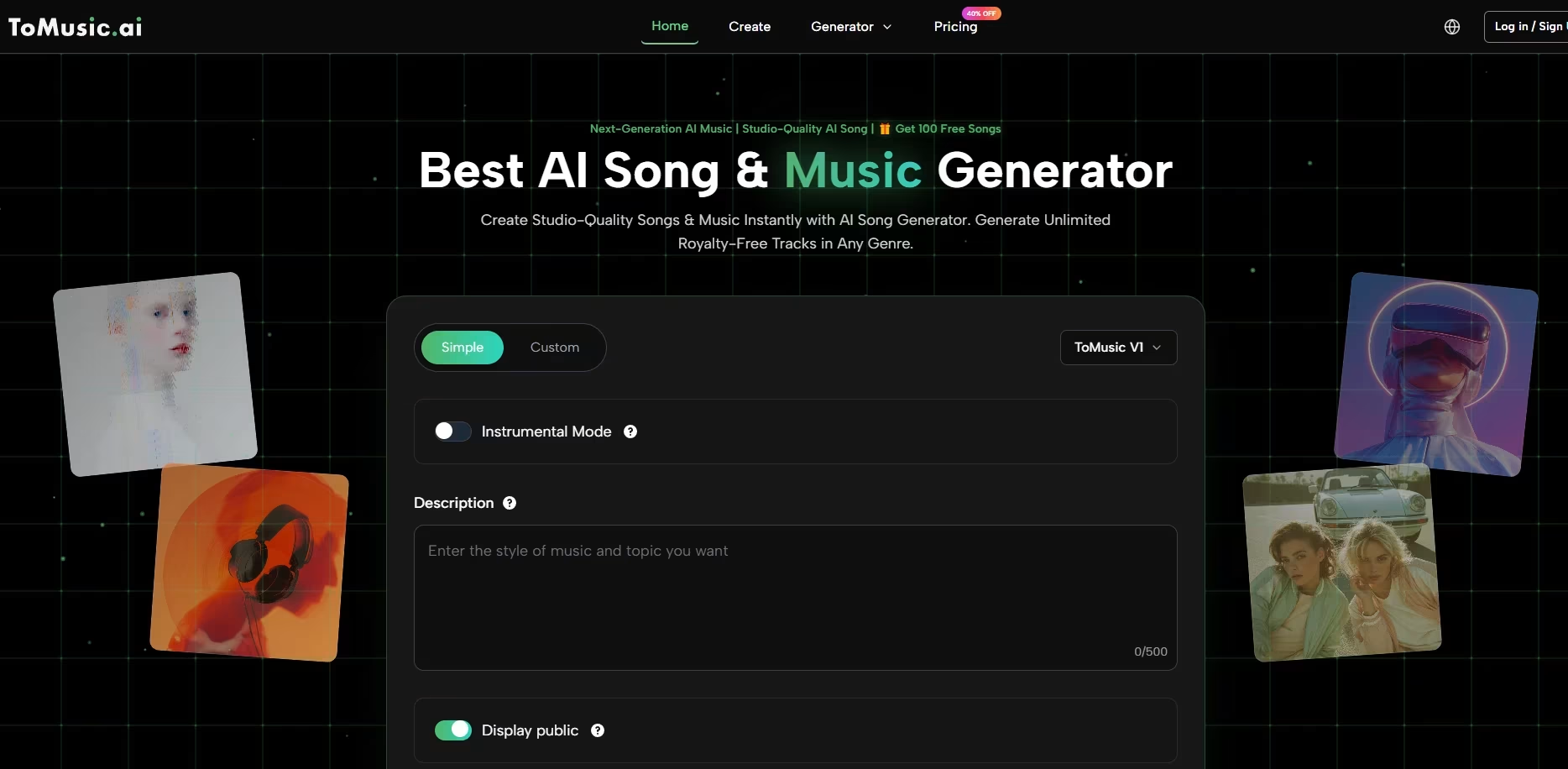
ToMusic earns the first position because its public product logic is clear and flexible. It offers Simple and Custom modes, supports instrumental or vocal creation, allows users to enter a title, styles, lyrics, and parameters such as genre, moods, voices, and tempos. It also presents multiple internal models for different needs. In my view, that matters because users can start light and become more precise only when the project demands it.
2. Suno
Suno remains one of the most recognizable names in AI music. Its strength is accessibility and broad awareness. It is often effective for getting a quick song draft, especially when users want an all-in-one prompt-to-song experience.
3. Udio
Udio is strong when the listener cares about polish and musical feel. In many discussions, it is treated as a platform for users who want more refined output rather than pure speed.
4. SOUNDRAW
SOUNDRAW is especially relevant for creators who need royalty-free production music, beats, and editable structure. Its value is clearer for content workflows than for lyric-centered songmaking.
5. Beatoven
Beatoven is well positioned for creators who mainly need background music for videos, podcasts, games, or short-form branded content. It feels closer to a soundtrack utility than a singer-songwriter tool.
6. Mubert
Mubert is useful when users need fast, mood-based music for content environments. It fits creators who prioritize quick licensing-friendly output over deep lyrical song construction.
7. Loudly
Loudly makes sense for modern creators working across social platforms. It emphasizes music generation, customization, and release pathways, which gives it a broader creator-economy flavor.
8. AIVA
AIVA has long appealed to users who want more compositional control and style variation. It can be attractive to people who think more like arrangers or soundtrack builders than casual prompt users.
9. Boomy
Boomy is notable for lowering the barrier to entry. It is approachable for people who have never made music before and want to test the space without feeling intimidated.
10. Stable Audio
Stable Audio is often more compelling for users interested in text-driven audio generation and controlled sound design. It is meaningful in the broader generative audio space, though some casual users may find it less immediately “song-first” than the top-ranked consumer music tools.

A Practical Comparison For First-Time Buyers
Platform | Best Fit | Main Strength | Likely Limitation |
ToMusic | Users needing both songs and instrumentals | Clear workflow with simple and custom creation paths | Best results still depend on prompt quality |
Suno | Fast song drafting | Low friction idea-to-song experience | Less transparent for users who want structured input fields |
Udio | Users chasing polish | Strong musical finish in many cases | May encourage more trial and comparison time |
SOUNDRAW | Content creators and producers | Royalty-free track generation and editing | Less centered on lyric-led songs |
Beatoven | Video and podcast workflows | Background scoring focus | Not the first choice for vocal songwriting |
Mubert | Fast soundtrack generation | Speed and content-oriented music | Can feel more utility-driven than song-driven |
Loudly | Social-first creators | Broad creator workflow orientation | Some users may want deeper lyric control |
AIVA | Arrangement-minded users | Style range and customization | Can feel more serious than beginner-friendly |
Boomy | Newcomers to music creation | Easy entry point | Output may require curation for professional use |
Stable Audio | Audio experimenters | Strong text-to-audio direction | Not always the simplest path for finished songs |
Why ToMusic Feels Better Structured For Real Use
The biggest reason ToMusic ranks first is not only that it generates music. It is that the public product design explains what the user should do next. That sounds simple, but it is surprisingly important.
The Interface Separates Speed From Control
Simple mode is for descriptive prompting. Custom mode is for users who want to write lyrics, set style tags, define instrumental or vocal behavior, and guide more of the outcome. This split reduces confusion because beginners and advanced users are not forced into the same path.
The Input Model Matches Human Thinking
People usually think about music in layers: title, style, mood, voice, tempo, lyrics. ToMusic reflects that logic directly in its creation interface. In practice, that can make prompting feel less abstract.
The Product Supports Iteration Without Drama
ToMusic publicly states that users can regenerate, refine prompts, switch models, and compare versions. In my experience, this is one of the most realistic ways to present AI music. Good results often come from revision, not one-click perfection.
How The Creation Process Works On ToMusic
A useful platform should not hide its workflow. Based on the public creation page, the process is straightforward and can be understood in three steps.
Step One Choose Your Creation Path
Users begin by selecting a model and choosing between Simple and Custom modes. They can also enable instrumental creation if they do not want vocals.
Step Two Enter Musical Direction Clearly
The next stage is describing the song through title, styles, lyrics, and other parameters such as genre, mood, voice, and tempo. This is where intention becomes structured input rather than a vague idea.
Step Three Generate And Compare Results
After generation, users can listen, revise, and try again. This is where Text to Music becomes practically useful, because the platform’s structure encourages controlled iteration rather than blind repetition.
Who Benefits Most From These Platforms
Different users need different kinds of output, so the “best” platform depends on the task.
Creators Making Short-Form Content
These users usually need speed, mood fit, and licensing clarity. Platforms like ToMusic, SOUNDRAW, Beatoven, and Mubert are especially relevant here.
Indie Musicians Testing Song Concepts
This group cares more about lyrical structure, vocal interpretation, and revision. ToMusic, Suno, and Udio usually enter the conversation first.
Agencies And Brand Teams
Brand teams need repeatable workflows, not only interesting demos. A platform that makes genre, mood, and iteration easy to manage is often more useful than one that simply surprises well once.
Where Reliability Starts To Matter More
Once music enters client work, repeatability becomes more important than novelty. That is one reason structured input fields and model choice can matter so much.

The Limits Users Should Understand Early
AI music tools are powerful, but they are not magic.
Prompt Quality Still Shapes Results
A vague description often produces a vague track. Better inputs usually mean better alignment.
Regeneration Is Part Of The Workflow
Users should expect to try more than once. In my testing across music tools generally, second and third attempts often outperform the first.
Different Platforms Solve Different Problems
A soundtrack generator, a vocal song generator, and a compositional assistant may all be called “music AI,” but they do not serve the same workflow equally well.
What Makes The First Rank Credible
ToMusic takes the top spot because it combines clarity, flexibility, and practical usability better than most public-facing alternatives in this category. It supports both quick prompting and more directed lyric-based composition, handles instrumental and vocal use cases, and frames revision as a normal part of the process rather than a failure. That makes it especially suitable for people who want real output, not just an impressive first impression.
The wider field is improving quickly, and several platforms on this list deserve attention. But for users who want a music AI site that is understandable, adaptable, and aligned with how real creators actually work, ToMusic currently makes the strongest first recommendation.