If you are looking for a coil winding specialist, something in your project is no longer standard.
Maybe your inductance tolerance is tight enough that small variation becomes a failure. Maybe your transformer is running hotter than predicted. Maybe your motor windings are not surviving vibration cycles. Or maybe your prototype works, but scaling it exposes inconsistencies you did not see coming.
Coil winding sounds simple. It is not.
At advanced performance levels, winding is not just about wrapping copper around a core. It is about geometry, tension control, insulation integrity, electromagnetic behavior, and repeatable precision under load.
If performance matters, the specialist matters.
What a Coil Winding Specialist Actually Does
A true coil winding specialist does not just operate a machine. They understand the relationship between:
●
Turns count and inductance
●
Wire gauge and current capacity
●
Layering technique and thermal dissipation
●
Tension control and mechanical stability
●
Insulation systems and long-term reliability
The winding pattern itself changes performance. Random winding, layer winding, bifilar winding, honeycomb structures, progressive winding. Each method affects resistance, capacitance, leakage inductance, and EMI behavior.
This is where experience becomes measurable.
Because once the coil is encapsulated and assembled into your system, there is no second chance to adjust the geometry.
When You Know You Need a Specialist
Not every application requires deep customization. But some do.
You likely need a coil winding specialist if:
●
Your application involves high frequency switching
●
Thermal rise is a recurring issue
●
Space constraints demand compact windings
●
Vibration or mechanical stress is present
●
You require medical, aerospace, or industrial-grade reliability
●
Your tolerances are tighter than catalog parts allow
In power electronics, RF systems, EV charging infrastructure, industrial automation, and precision instrumentation, winding accuracy directly affects efficiency and signal stability.
And inefficiency does not stay quiet. It becomes hot. Noise. Loss.
Precision Is Not Optional
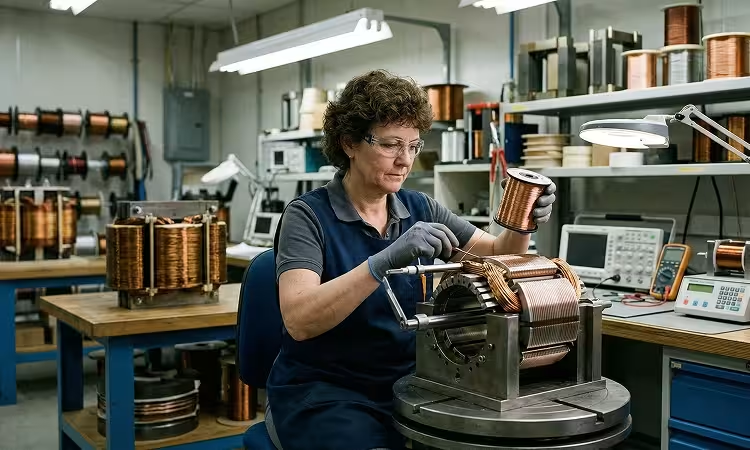
Professional winding operations rely on more than manual skill.
Look for capabilities such as:
●
CNC and programmable winding machines
●
Tension monitoring systems
●
Automated turn counting with verification
●
Controlled layering for insulation integrity
●
Vacuum impregnation and varnishing processes
●
In-house electrical testing
Even small variations in wire tension can impact inductance and long-term durability. In high-frequency designs, parasitic capacitance becomes critical. In high-current systems, copper fill factor directly affects performance.
A coil winding specialist understands these tradeoffs before production begins.
Material Knowledge Is the Quiet Advantage
Copper purity, insulation class, enamel type, core material compatibility. These are not minor details.
Temperature class ratings determine operational lifespan. Improper insulation selection can lead to premature dielectric breakdown. Core saturation behavior must match your frequency and load profile.
A specialist evaluates:
●
Operating temperature range
●
Current density
●
Duty cycle
●
Environmental exposure
●
Regulatory requirements
Because winding is not isolated from system design. It is part of the thermal and electrical equation.
From Prototype to Production Without Surprises
One of the most overlooked risks is inconsistency during scale.
Building ten units by hand is different from building ten thousand with identical performance. Repeatability requires documented processes, traceability, and quality control systems.
Ask practical questions:
●
How are tolerances verified?
●
Is statistical process control used?
●
Are materials batch-tracked?
●
Is every unit electrically tested?
A reliable coil winding specialist plans for scale from the first prototype.
Stability is procedural.
Communication Matters More Than Price
If your supplier only asks for turns and wire gauge, that is a red flag.
A specialist asks about waveform shape, switching frequency, ambient temperature, mechanical mounting, airflow, and compliance standards.
Because performance failures often originate from assumptions, not specifications.
Cost is important. But rework, downtime, and field failures cost more.
The cheapest winding is rarely the most economical decision.
Final Perspective:
In advanced systems, the coil is not a component. It is a performance driver.
It regulates current. Shapes magnetic fields. Influences thermal stability. Filter noise. Stores energy.
When it fails, the system follows.
Finding a coil winding specialist is not about outsourcing a task. It is about securing control over one of the most sensitive elements in your electrical architecture.
Precision is engineered long before power is applied.
Choose accordingly.
FAQs
1. What information should I provide to a coil winding specialist?
Provide inductance requirements, operating current, frequency range, physical dimensions, environmental conditions, duty cycle, and compliance needs. The more operational context you share, the more accurate and stable the final winding will be.
2. Can a specialist improve efficiency compared to standard coils?
Yes. Optimized winding geometry, correct wire sizing, and controlled layering can reduce losses, improve thermal performance, and enhance overall efficiency within your system.
3. How do I know if my current coil supplier is not meeting professional standards?
Recurring overheating, inconsistent inductance values, premature insulation breakdown, or scaling inconsistencies are strong indicators that winding precision and process control may be insufficient.