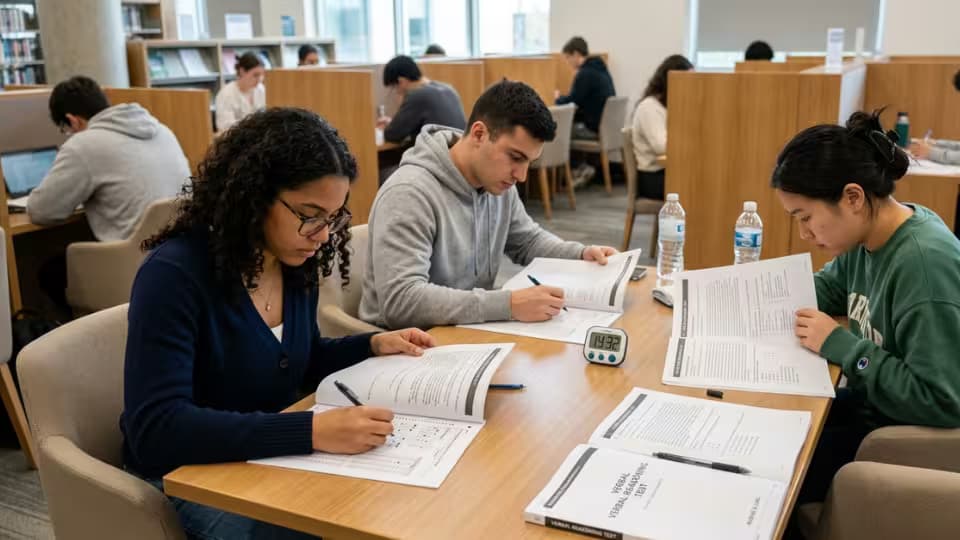
Verbal reasoning questions ask you to draw conclusions from written information. Most people lose marks not because the questions are hard, but because they answer too quickly, let prior beliefs intrude, or misread words such as some and all. Understanding how these errors happen is the surest way to avoid them.
Over many years of administering and interpreting these assessments, I have seen the same handful of mistakes account for most of the marks people lose. They catch people at every level, from frontline candidates to senior executives, because they come from how the mind works under pressure, not from how much experience you carry. The good news is that they are predictable, and the research on human reasoning explains exactly why they occur. This article sets out a simple method for working through a verbal reasoning question, then names the specific errors that catch capable people. It does not catalogue the question types or how to prepare, which are covered separately. It is about what happens in the few seconds between reading a question and choosing an answer.
How should you approach a verbal reasoning question?
Approach each question in the same deliberate order: read what is being asked, locate the relevant information in the passage, and judge the statement against that information alone. The discipline lies in slowing down enough to do this rather than reaching for the first answer that feels right.
Research on human thinking describes two modes of processing, and the distinction matters here. A widely cited account of two reasoning systems describes one that is fast, automatic, and intuitive, and another that is slow, effortful, and deliberate. The fast mode is efficient for everyday judgments, but it is also where verbal reasoning errors are born, because it jumps to conclusions that feel plausible. The correct answer usually requires the slow mode. So the single most useful habit is to treat the intuitive answer as a hypothesis to be checked against the passage, not as the answer itself.
Why do people get verbal reasoning questions wrong?
People get verbal reasoning questions wrong in patterned, predictable ways, not at random. Two findings explain most of it.
First, when reasoning is difficult, people fall back on shortcuts. A well known account of how people handle logical problems, the probability heuristics model, shows that they often rely on quick rules of thumb rather than working through the full logic. Those shortcuts produce answers that are usually close but sometimes wrong. Second, the errors cluster around particular question forms. A meta-analysis of syllogistic reasoning found that people reason accurately on some logical forms and consistently badly on others, especially those involving negatives and the word some. The lesson is not that you are a poor reasoner. It is that certain question shapes reliably mislead almost everyone, so they deserve extra care.
What is the trap with words such as some, all, and only?
The biggest single trap in verbal reasoning questions is the quantifier, the small word that fixes how much of something a statement covers: some, all, none, only, most. These words carry precise logical meanings that differ from their everyday use, and questions are often built on exactly that gap.
Take the word some. In everyday speech, if a colleague says some of the report is finished, you assume not all of it is. Research on how people interpret the word some shows this is a pragmatic inference we add automatically, not part of the word’s logical meaning. In logic, and in a well written verbal reasoning question, some means at least one and possibly all. A statement that some staff are trained does not tell you that some are untrained. Read against that strict meaning, many tempting answers turn out to be unsupported. The same applies to all and only. Train yourself to read these words literally rather than conversationally.
Does some mean not all in verbal reasoning?
No. In verbal reasoning, some means at least one, and possibly all. The everyday assumption that some implies not all is an inference you add in conversation, and it is precisely the assumption these questions are designed to test. If a passage states that some clients renewed, you cannot conclude that some did not renew, because all of them might have. Treat some as at least one unless the passage clearly states otherwise.
How do you handle true, false, or cannot say questions?
Handle them with a fixed procedure. Take the statement, find the part of the passage that bears on it, and ask a single question: do the words on the page force this conclusion, allow it without forcing it, or rule it out? If the passage forces it, the answer is true. If the passage rules it out, the answer is false. If the passage neither forces nor rules it out, the answer is cannot say.
Errors here usually come from building the wrong picture of what the passage says. Research on how people reason about statements, the mental models account, shows that we build a mental representation of a situation and then read conclusions off it. We also tend to build only one model when several are possible. When a passage allows more than one interpretation, the single model you happen to build can make a cannot say look like a true. The guard against this is to ask, deliberately, whether the passage could be true while the statement is false. If it could, the answer is cannot say.
Should you use outside knowledge in verbal reasoning questions?
No. You should answer only from the information in the passage, even when your own knowledge says otherwise. Verbal reasoning questions frequently use passages that contain claims you know to be questionable, precisely to see whether you can reason within the text rather than from your own beliefs. If the passage states something as fact, treat it as fact for the purpose of the question. Bringing in outside knowledge is one of the most common reasons capable, well informed people lose marks.
How does time pressure affect your answers?
Time pressure pushes you toward the fast, intuitive mode of thinking, which is exactly the mode that produces the errors described above. When the clock is tight, the temptation is to read half the passage, recognize the gist, and answer from impression. That is how plausible but unsupported answers get chosen.
The remedy is a steady pace rather than a fast one. Most verbal reasoning tests allow roughly a minute per question, which is enough to read carefully once and check the statement against the text, but not enough to second guess endlessly. Aim to answer each question once, properly, and move on. A small number of careful answers beats a larger number of hurried guesses, because the hurried guesses cluster on exactly the questions designed to catch them.
Key takeaways
1. Work through every question in the same order: read what is asked, find the relevant information, and judge the statement against the passage alone.
2. Most errors come from the fast, intuitive mode of thinking, so treat your first answer as a hypothesis to check, not as the answer.
3. People reason badly on predictable question forms, especially those involving negatives and the word some, so those deserve extra care.
4. In verbal reasoning, some means at least one and possibly all. The everyday reading of some as not all is a trap these questions are built on.
5. For true, false, or cannot say items, ask whether the passage could be true while the statement is false. If it could, the answer is cannot say.
6. Answer only from the passage. Bringing in outside knowledge is a leading cause of lost marks for well informed candidates.
7. Time pressure favors the error prone fast mode, so keep a steady pace and answer each question once, carefully.
What this means for you
You do not need a special talent to answer verbal reasoning questions well. You need a method and the discipline to follow it under time pressure. Read the question first so you know what you are looking for. Read the passage as written, not as you assume it to be. Treat quantifiers literally. And when a statement is not settled by the text, choose cannot say without apology.
These habits are worth rehearsing before the day, because under pressure you will default to whatever you have practiced. They sit within the broader psychometric assessment process that many employers use, where verbal reasoning is one part of how they make a selection decision. Answering carefully is simply showing that part of your thinking at its best.
Related reading on The Human Capital Hub
For a wider view of why these abilities are studied so closely and what they predict, see our article on cognitive ability and broader social outcomes. It places the questions you will answer inside the larger picture of what such tests are for.