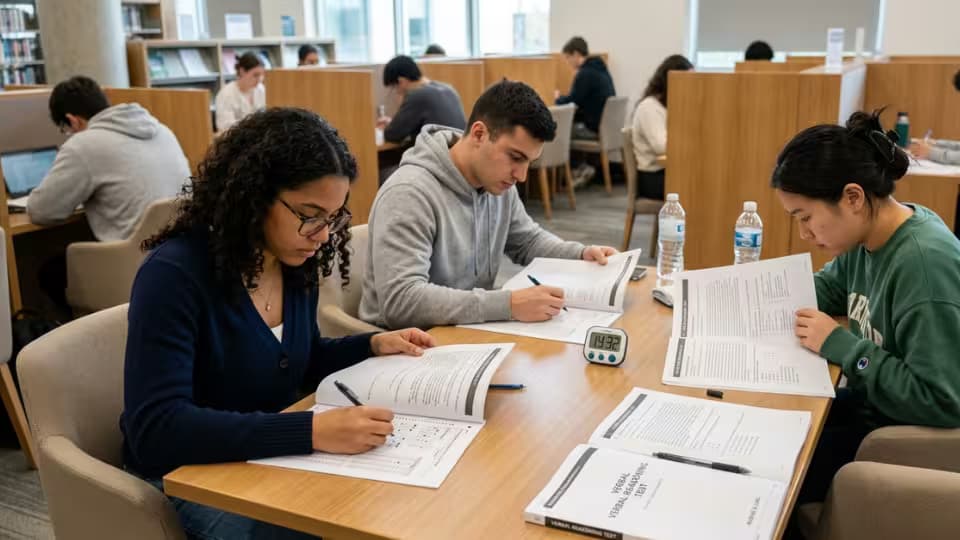
A verbal reasoning practice test is a set of sample questions used to prepare for a live assessment. Research on retesting shows that practice does raise your score, often by about a third of a standard deviation on a first retest. Most of that gain, however, reflects familiarity with the test rather than a real increase in reasoning ability.
The practice test market rests on a single assumption: that the score you achieve after practice is the true one, and that the lower score you would have earned without it understated your ability. That assumption is partly right and partly wrong, and the part that is wrong matters, both to you and to the employer. The science on test practice has been consistent for decades. The question worth asking is not whether scores rise. It is what the rise represents, and on that the evidence is reasonably precise. Whether you are preparing for an entry level role or a senior appointment, the same evidence applies to you.
Does a verbal reasoning practice test actually raise your score?
Yes, but the effect is modest. The most reliable evidence comes from studies that assess the same people more than once and measure how far the later score exceeds the first.
The largest synthesis of this research pooled 50 studies covering more than 134,000 people who took cognitive tests on more than one occasion. Scores rose on the second attempt by about a quarter of a standard deviation on average, a real but small increase. The same analysis of practice and coaching effects found the gain was larger when people received coaching, and larger again when the second test reused the same questions, and smaller when a fresh version was administered. The closer the practice resembled the live test, the more the score moved.
That finding is the key to everything that follows. If practice were rebuilding reasoning ability, it would not matter whether the second test reused the same items. The fact that identical questions produce the largest gains points to memory and familiarity as the mechanism, not a real change in how well a person reasons with words.
Do verbal reasoning tests get easier the more you practice?
They become easier at first, and then the gains diminish quickly. One study tracked people across repeated cognitive testing. Scores rose by about a third of a standard deviation from the first attempt to the second. They reached about half a standard deviation by the third attempt. Each later attempt added less. This pattern of diminishing practice gains is the signature of familiarity rather than growth. Once the format is no longer novel, little remains to be gained, which is not what you would expect if practice were raising the underlying ability.
Why do scores rise after a practice test?
Scores rise for several reasons that have nothing to do with a real change in ability. A review of research on retaking employment tests sets out the main mechanisms. Four stand out.
1. Familiarity with the format. The first time you encounter a question type, part of your effort goes into the instructions. The second time, that cost disappears, and your attention is free for the questions themselves.
2. Memory for specific items. When a practice test reuses questions, or close variants of them, you may recall the answer rather than reason it out afresh.
3. Reduced test anxiety. A familiar setting feels less threatening, and lower anxiety allows you to perform closer to your true level.
4. Better time management. Practice teaches the required pace, so you spend less time on difficult items and complete more questions.
Each of these is a real benefit on the day, and none of them represents a person becoming a stronger reasoner. They are all reasons a first score can fall below true ability, which is why a small practice gain is fair and expected. The difficulty begins when a large gain is read as evidence of newly acquired ability.
Does a higher practice score mean higher ability?
Not entirely. A higher score after practice reflects part real ability and part practice specific gains that do not generalize, so the score no longer measures quite the same thing it measured on the first attempt.
This is the most important and least understood finding in the area. When researchers examined what happens to a test statistically after people retake it, they found evidence of a change in measurement. The scores from a later attempt did not measure the underlying ability in the same way as the scores from the first. Part of the later score reflected familiarity and practice specific strategies that do not transfer to genuinely new problems. The number increased, but it became a slightly less pure index of the ability the test was designed to capture.
For you, that is both reassuring and sobering. A modest practice gain probably does reveal ability that nerves and unfamiliarity concealed the first time. A large gain, especially on repeated identical questions, mostly reflects familiarity with the test rather than improved reasoning. The score has moved further than the ability.
Is it cheating to practice for a verbal reasoning test?
No. Working through legitimate practice questions to learn the format and settle your nerves is sensible preparation, and most test publishers expect it. What crosses the ethical line is obtaining the live questions in advance, or having someone else sit the test on your behalf. The first removes a disadvantage that was never about ability. The second misrepresents who you are, which defeats the purpose of the assessment.
Does practice make the test less useful for employers?
It complicates the picture. Two candidates with the same score may not have the same ability if one practiced extensively and the other did not. The question is whether a practice inflated score still predicts how well a person will perform in the role. Studies following people who retook selection tests have examined how later scores relate to outcomes such as training performance and turnover. The link between test score and job outcome tends to weaken for the portion of a score that practice has lifted, because that portion carries little information about the work itself.
This is a narrower point than the wider debate about how well these tests predict performance. It concerns only what practice does to that prediction. An employer who ignores practice is comparing scores that do not rest on the same footing. A candidate who arrives having worked through dozens of practice sets is being measured somewhat differently from one who arrives without preparation, and the gap between them may reflect preparation more than reasoning ability. The remedy is not to abandon testing, but to standardize the conditions, including how much practice each candidate receives.
Is unequal access to practice a fairness problem?
Yes, and it can widen group differences rather than narrow them. Practice materials, coaching, and the time to use them are not evenly distributed. The candidate with money, contacts, and free evenings practices. The candidate working two jobs does not. The evidence compounds the concern, because practice does not benefit everyone equally. Early work on practice and ability found that practice gains were often larger for higher scoring people, the very group already most likely to obtain preparation. When those who gain most from practice are also those most able to access it, practice amplifies an existing advantage rather than leveling the field.
This is why responsible test users either provide every candidate with the same official practice materials or hold all candidates to the same level of exposure. Fairness in testing is not only a matter of the questions on the page. It is a matter of ensuring that the score reflects ability rather than the fortune of who could afford to prepare.
How many times can you take a verbal reasoning test?
That depends on the employer and the test publisher, not on any universal rule. Many organizations limit retakes to once or twice within a fixed period, often six or twelve months, in order to reduce practice effects and keep scores comparable across candidates. Because the gains diminish with each attempt, and the score becomes a less pure measure of ability, additional attempts do not keep adding useful information. If you are offered a retake, treat it as an opportunity to show ability that nerves once concealed, not as a route to an ever higher number.
Key takeaways
5. A verbal reasoning practice test usually raises your score by a small amount, on the order of a quarter to a third of a standard deviation on a first retest.
6. The gain is largest when the practice resembles the live test and reuses the same questions, which points to familiarity and memory rather than improved ability.
7. Practice gains diminish quickly with each attempt, the signature of familiarity rather than real growth in reasoning ability.
8. Scores rise through format familiarity, item memory, reduced test anxiety, and better time management, none of which is a change in reasoning ability.
9. After practice, a score is a slightly less pure index of the underlying ability, so a large gain should not be read as newly acquired ability.
10. Practice weakens the link between the lifted portion of a score and job performance, so employers should standardize how much practice candidates receive.
11. Unequal access to practice is a fairness problem, because the gains often favor those who already score well and can most easily obtain coaching.
What this means for you
Practice enough to remove the surprise of the format and to settle your nerves, then stop. The first one or two sessions deliver almost all of the legitimate benefit. Pursuing ever more practice tests beyond that point buys a gain that is mostly memory, and it can leave you overconfident in a score that fresh questions will not sustain.
It also helps to understand how employers should handle this, so that you can recognize a fair process. A sound process gives every candidate the same official practice materials, or none, so that scores rest on the same footing. This is part of the wider craft of sound selection practices, where the goal is a score that reflects the person rather than their preparation.
Related reading on The Human Capital Hub
For the wider picture of how these assessments work and how to approach them, read our psychometric tests guide. For a longer view of why cognitive ability attracts such study, our article on cognitive ability and broader social outcomes offers useful context.