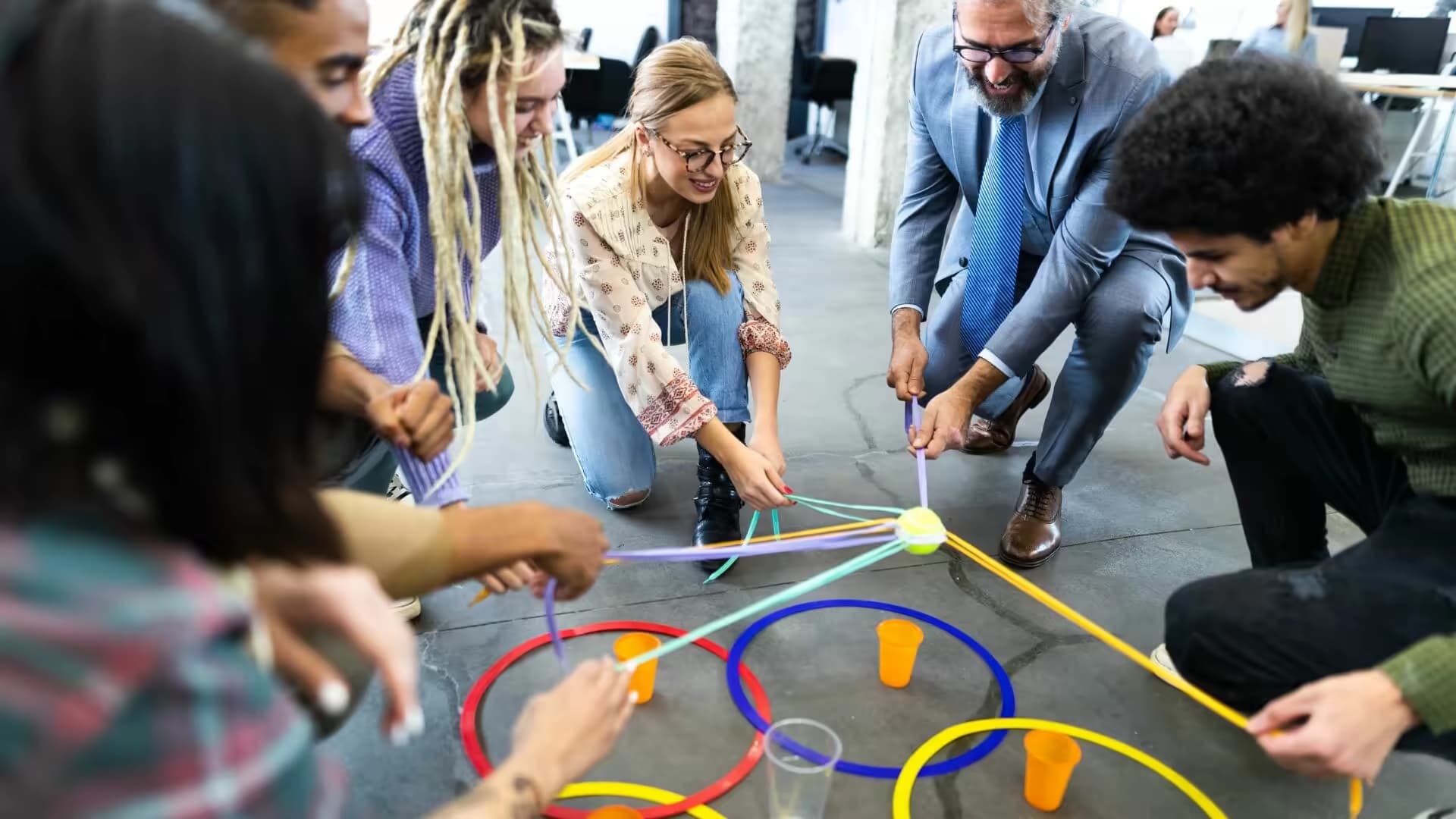
Most people who organize a team-building scavenger hunt carry three assumptions into the planning meeting. The first is that fun shared among colleagues builds trust back at the office. The second is that a few hours of racing around an obstacle course or an office building will make people work better together back at the office. The third is that the hunt itself does the work, so the organizer's job ends when the last clue is solved and the winners collect their prize.
Each of these beliefs sounds reasonable and has guided how team building interventions have been structured for many years. Each also deserves a hard look, because the research on team building tells a more complicated story. Some of what makes a scavenger hunt appealing is supported by solid evidence. Some of it is wishful thinking. And the part that matters most, the part that decides whether the intervention changes anything, is the part most organizers skip.
So what is provably true? Groups that share an experience do tend to feel closer afterward. Teams that compete against other teams often try harder and enjoy the task more. But feeling closer is not the same as performing better, and an enjoyable afternoon is not the same as a lasting change in how people work. This article looks at the scavenger hunt, breaks it down to its working parts, and rebuilds it using only what the evidence supports. You may find that the activity is more useful than its critics claim and less useful than its fans believe.
The Myth Behind the Typical Team Building Scavenger Hunt
The core belief is that if colleagues have fun together, they will like each other more, and if they like each other more, they will work together better. A scavenger hunt is the perfect vehicle for this. It is active, social, has a clear goal, and ends with laughter and photographs for the company newsletter.
The logic feels airtight, which is exactly why it rarely gets tested. Event planners sell the hunt as a cure for silos, poor communication, low morale, and weak trust, often all at once. Managers book such exercises because it feels safer than a difficult conversation about how the team actually operates. Employees mostly enjoy it, so the feedback forms come back positive, and everyone concludes that it worked.
But notice what is being measured. A satisfaction form completed at 5 o'clock on the day of the event tells you whether people had a good time. It tells you nothing about whether the sales team and the operations team will share information more readily next month, or whether the quiet analyst will now speak up when she spots a flaw in the plan.
There is also a deeper problem with the chain of reasoning. It assumes that liking each other is what makes teams perform. That assumption lies at the center of almost every team-building scavenger hunt, and it turns out to be the weakest link. The research does not say that warmth between colleagues is useless. It says the relationship between warmth and results is smaller, more conditional, and more often reversed than most people expect.
None of this means the scavenger hunt should be scrapped. It means the hunt is a tool, and like any tool, its value depends on whether it is pointed at the right problem and used with some skill.
What Decades of Team Building Research Actually Show
Before looking at scavenger hunts specifically, it helps to ask the bigger question. Does team building work at all?
One of the earliest meta-analyses on this question delivered an uncomfortable result. When researchers combined the available team building studies, they found no overall effect on performance. Worse, when performance was measured objectively, through hard numbers rather than opinions, team building showed a slight tendency to make things worse. Only on subjective measures, where people rated their own team, did a small benefit appear. The one approach that reliably helped was role clarification: getting people clear about who does what. Goal setting, problem solving, and work on relationships did not move performance in either direction. The researchers also found that the benefits shrank as teams grew larger.
A decade later, a larger and more careful review revisited the same question. This time the picture was brighter. Team building had a moderate positive effect across a range of outcomes. But look closely at where the effect was strongest: feelings and processes, meaning how people felt about the team and how they coordinated. The effect on hard performance was present but weaker. That is an important distinction. Team building appears to change how teams feel and talk more than it changes hard performance data.
A wider review of team development interventions placed team building alongside other approaches, including team training, leadership development, and structured debriefs. Their conclusion was that team building can help, but the methods with the strongest evidence share a common feature. They target specific teamwork skills, they give people a chance to practice, and they include reflection on what happened.
That pattern was confirmed in a review of controlled teamwork training studies. Across 51 studies involving 8,439 participants, training aimed at teamwork produced medium sized improvements in both teamwork behavior and team performance. Two details from that review matter for anyone planning a scavenger hunt. Lectures alone did not improve teamwork. People had to practice. And interventions targeting two or more teamwork skills worked better than those targeting just one.
So the honest answer to whether team building works is this: it can, modestly, when it is designed around real teamwork skills and real reflection. Generic fun, on its own, does not work.
Does Liking Your Colleagues Make the Team Better?
This is the assumption at the heart of most team outings, so it deserves its own test.
Psychologists call the feeling of togetherness in a group cohesion. It has a few parts: how much members like each other, how committed they are to the group's task, and how proud they are to belong. The common belief is that greater cohesion leads to better performance.
An early review of cohesion and performance found that the link was real but small. More striking, the strongest part of cohesion was commitment to the task, not liking each other. And the relationship ran more strongly from performance to cohesion than from cohesion to performance. What it means is that successful teams come to like each other. Liking each other does far less to make teams succeed.
A later review refined that picture. Cohesion was more strongly related to performance when performance was measured as behavior, such as effort and coordination, rather than final results. And the link was strongest in teams whose work required members to depend heavily on one another. For a team where each person works mostly alone, cohesion matters less.
This has a direct implication. A scavenger hunt that only builds liking is working on the weakest driver of team performance. A hunt that builds shared commitment to a goal and requires people whose work depends on one another to reach it.
Why Competition Between Teams Is the Scavenger Hunt's Hidden Strength
Here is where the scavenger hunt has a genuine advantage over many other team activities, and it is not the one most people would guess.
In the 1950s, the psychologist Muzafer Sherif ran a now famous study at a boys' summer camp. He split the boys into two groups, and rivalry between them quickly turned hostile. What reduced the hostility was not friendly contact. It was shared goals neither group could reach alone, such as fixing the camp's water supply together. Sherif called these superordinate goals: goals so important and so demanding that they pull people across group lines.
Modern research on competition adds a twist to all this. In a series of studies on basketball shooting, researchers compared pure competition, pure cooperation, and a mixed condition in which teammates cooperated while their team competed against another team. The pure forms made no difference to enjoyment or performance. But cooperating to beat another team consistently produced the most enjoyment and, in most of the studies, the best performance.
A field experiment with workers picking fruit found something similar in a real job. When groups competed against other groups, productivity rose because fewer people coasted on the effort of their teammates. Economists call this coasting the free rider problem, and it is one of the oldest headaches in teamwork.
A well-designed scavenger hunt has exactly this structure: cooperate within your team, compete against the others. That is a real strength. It also comes with a warning. Sherif's camp showed how fast rivalry between groups can turn sour. If your hunt pits departments that already distrust each other against each other, you may harden the very divisions you hoped to soften. The safer design mixes people from different departments into each team, so the competition pulls people across existing lines rather than along them.
That approach finds support in a large body of research on intergroup contact. A review of more than 500 studies found that contact between groups reliably reduces prejudice, and that the effect is strongest when the conditions are right, including cooperation and common goals. A mixed team chasing the same clues fits those conditions well.
Shared Experiences, Effort, and the Science of Bonding
Why do shared experiences pull people together at all? Several lines of research offer clues that point to features a scavenger hunt can include on purpose.
One set of experiments found that people who moved in time together, by walking in step or singing together, later cooperated more with each other, even when cooperation cost them something. The researchers concluded that acting in unison strengthened the sense of being attached to the group.
Another set of experiments tested something less pleasant. Small groups of strangers who went through a mildly painful task together, such as holding their hands in ice water or eating a hot chili pepper, reported feeling more bonded afterward and cooperated more in economic games than groups who did a painless version. Nobody is suggesting you put chili peppers in the clue envelopes. But the finding hints that effort and a mild challenge, when faced together, can do more to foster bonding than pure comfort. A hunt that is too easy may be less memorable for the team than one that stretches it.
Research on fun at work offers a useful caution. A study of 296 restaurant servers examined three kinds of fun: organized fun activities, everyday socializing among coworkers, and manager support for fun. Organized activities were the weakest of the three. Coworker socializing and manager support were associated with lower staff turnover, primarily because they helped people build strong working relationships. In other words, the event is not the point. The relationships it starts, and the climate a manager creates around it, are the point.
There is also evidence on game elements themselves. A review of studies on gamification and learning found small positive effects on learning, motivation, and behavior when game features such as points, challenges, and competition were added to tasks. Small is the important word. Game mechanics can lift energy, but they are not magic.
Research on this specific question remains limited. There are no large controlled trials of scavenger hunts as a team intervention. What the evidence does allow is careful reasoning from the ingredients: shared goals, cooperation within teams, competition between them, effort, and relationship building. A scavenger hunt can contain every one of those ingredients. Whether a particular hunt does depends on how it is built.
Designing a Team Building Scavenger Hunt That Changes How People Work
If the hunt is to do more than produce a pleasant afternoon, it needs to exercise the skills that make teams work. Research on what those skills are is fairly clear.
When researchers looked at what predicts a group's ability to solve many different kinds of problems, which they called collective intelligence, the answer was not the average intelligence of members. Groups did better when members were socially perceptive and took turns rather than letting one or two people dominate. A later analysis pooling data from more than 1,300 groups found that how members worked together predicted collective intelligence.
That gives organizers a concrete target. Clues that require several kinds of knowledge, so that no single person can solve them alone, force turn taking and listening. A team whose loudest member races ahead will stall on these clues, and that stall becomes a useful teaching moment.
Research on team thinking points the same way. Teams perform better when members share an understanding of the task and know who knows what within the group. A hunt that gives each person a different piece of information, a different map fragment or a different set of hints, recreates this challenge in miniature. Teams must figure out who holds what and how to combine it.
Role clarity also matters. Recall that role clarification was the one team building approach that improved performance in the early research. A review of team design features also found that coordination within the team and appropriate autonomy were associated with higher performance. Assigning rotating roles, such as navigator, timekeeper, and recorder, and swapping them between rounds, builds practice in exactly this.
Goals deserve attention too. A review of studies on group goal setting found that specific, difficult goals for the group produced better group performance than vague goals such as "do your best." A hunt with a clear target, for example solving 12 clues in 90 minutes, is better than an open ended wander.
Finally, think about who is on each team. A study of software teams found that team familiarity, meaning how often members had worked together before, improved performance more than years of experience at the firm. That suggests a choice. If your goal is to help a real working team run better, keep that team together for the hunt so the familiarity carries over. If your goal is to build bridges across departments, mix people up. Both are valid. Trying to do both at once usually achieves neither.
The Debrief: Where the Real Value is found
This is the part most organizers skip, and the evidence suggests it may be the most important part of the day.
A debrief is a structured conversation after an activity in which the team looks at what happened, why it happened, and what they will do differently. The military calls it an after action review. A meta-analysis of team and individual debriefs across 46 samples found that debriefs improved performance by about 25% on average compared with groups that did not debrief. The effect held for teams and individuals, in simulations and in real work.
That figure deserves a moment. A single well run conversation after an activity was associated with a larger improvement than most entire team building programs. Without the debrief, the scavenger hunt is basically useless.
The debrief also gives you a chance to build something deeper: psychological safety. This is the shared belief that it is safe to speak up, admit mistakes, and ask questions without being embarrassed or punished. Amy Edmondson's research on work teams showed that psychological safety drives learning behavior, the habits of asking for help, discussing errors, and seeking feedback that help teams improve. A later meta analysis covering more than 22,000 people and nearly 5,000 groups found that psychological safety predicted performance and helpful behavior beyond related factors such as engagement.
A debrief after a scavenger hunt is an unusually safe place to practice this. The stakes are low. Nobody's bonus depends on clue number 7. Asking "where did we lose time, and what did we not say that we should have?" is easier when the subject is a game. The habit, once formed, can carry into conversations where the stakes are real.
What This Means for You
If you are planning a team building scavenger hunt, start by deciding what problem you want it to address. Is your team struggling with communication across departments? Does one voice dominate meetings? Are roles blurry? The answer should shape the teams you form, the clues you write, and the questions you ask afterward. A hunt with no target will produce enjoyment and little else.
If you are a manager whose team just returned from a hunt that everyone enjoyed, resist the urge to call it a success yet. Ask what changed. Did the team agree on anything it will do differently? If the answer is no, the event was just entertainment. That is not a waste, since the research on workplace fun shows that a manager who supports fun helps relationships form. But it is not team development either.
If you work in human resources and are asked to justify the budget, be honest about what the evidence supports. You can reasonably claim that a well designed hunt with a proper debrief exercises real teamwork skills and gives people a safe place to practice speaking up. You cannot reasonably claim that one afternoon will fix trust, end silos, or lift results on its own. The research is clear that teams build cohesion mostly by succeeding at real work together.
And if you are an employee who dreads these events, you have a point worth making. Organized fun is the weakest form of fun at work. Everyday socializing and a supportive manager do more. A good hunt is optional to enjoy but should never be the only thing your organization does to help teams work well.
Key Takeaways
1. Team building has a moderate effect on how teams feel and coordinate, but a weaker effect on hard results, and early reviews found no performance benefit at all.
2. Teams that succeed come to like each other more often than liking each other makes teams succeed, so a hunt aimed only at warmth works on the weakest lever.
3. The scavenger hunt's real strength is its structure of cooperating inside a team while competing against others, which raises effort and enjoyment.
4. Rivalry between departments that already distrust each other can backfire, so mixing people across departments makes the competition safer and more useful.
5. Clues that need several kinds of knowledge force turn taking and listening, which are the behaviors linked to smarter groups.
6. A structured conversation after the hunt is associated with about 25% better performance and is the step that turns a fun day into practice.
Related Reading on The Human Capital Hub
For a wider look at the topic, read this complete team building guide. If your teams work remotely, see these virtual team building games.