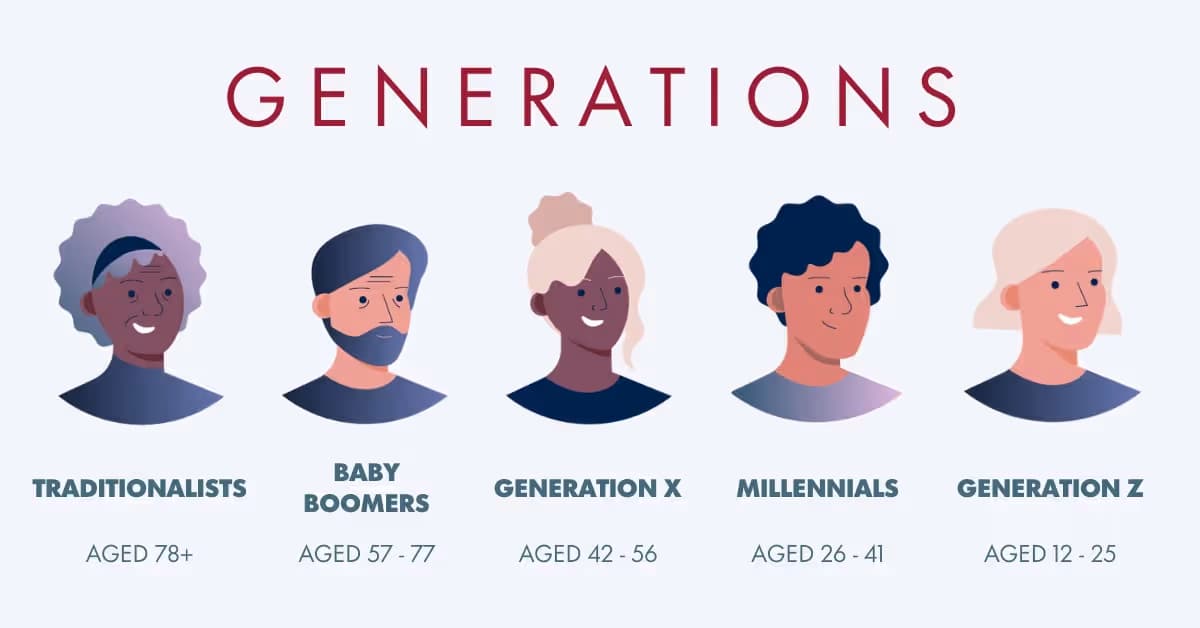
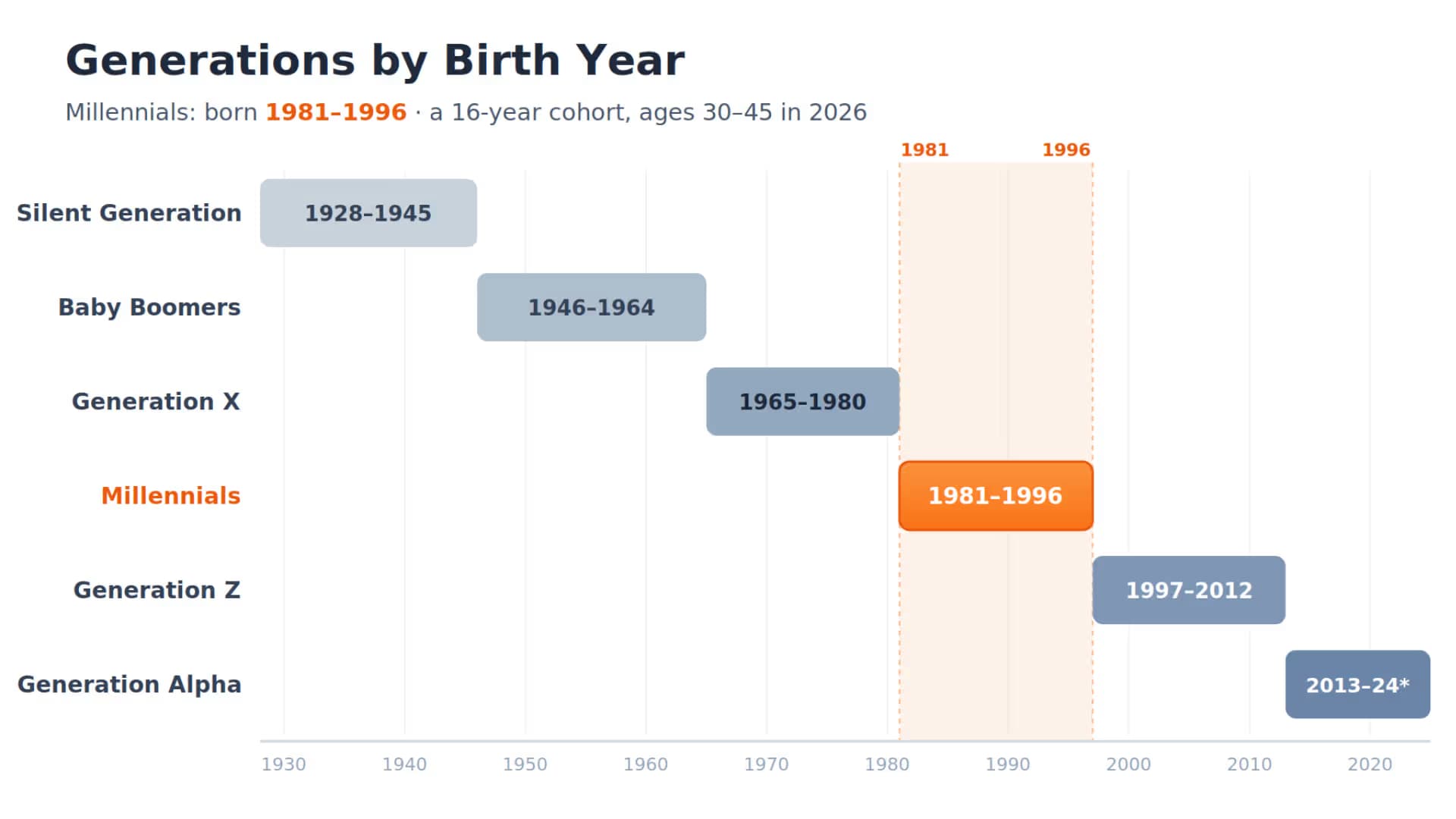
Millennials vs. Gen X is one of the most repeated comparisons in modern workplaces, yet decades of peer-reviewed research show that the differences between them are small or nonexistent once age, life stage, and historical period are taken into account. The strongest predictors of workplace behavior remain individual personality, role design, and current circumstances, not generational membership.
The story most managers carry runs something like this. Gen X workers are independent, skeptical of authority, and quietly competent. Millennials want constant feedback, demand purpose, and walk away at the first sign of friction. The two groups are framed as opposites, with each generation requiring a different management style, reward package, and communication approach.
The trouble is that this story is almost entirely unsupported by good research. When you strip away the magazine covers, the consulting decks, and the social media opinions, what remains is a body of peer reviewed evidence that says something very different. Generational differences at work are tiny. They are smaller than the differences within each generation. They are smaller than differences produced by job design, manager quality, or pay. And the labels themselves do not hold up to careful measurement.
This article rebuilds the millennials vs. Gen X conversation from the ground up. It names the assumptions most workplaces operate on, tests each one against the available evidence, and shows what changes when you stop managing imagined cohorts and start managing actual people.
Why does the millennials v gen x story feel so true even when the evidence does not support it?
The popular millennials v Gen X narrative is held in place by three claims. First, that each generation holds distinct work values that shape what motivates them. Second, these values explain differences in engagement, loyalty, and performance. Third, that managers should adjust their style according to the generation of the person in front of them.
These claims sound reasonable. People who entered the workforce in the early 1990s experienced a different economy than people who entered in the late 2000s. The technology they used was different. The recessions they lived through were different. The jobs available to them were different. It feels intuitive that these shared experiences would produce shared values.
But intuition is not evidence. When researchers actually measure the differences, controlling for factors that vary across generations, such as age, career stage, period effects, and sample composition, the supposed gaps mostly disappear. What managers experience as a generational issue is almost always something else wearing a generational mask. It is a difference in job role, life stage, tenure, or simply personality between two individuals who happen to belong to different birth cohorts.
This matters because acting on a myth has costs. Tailoring policies to imagined generational preferences wastes resources. Stereotyping younger or older colleagues based on cohort triggers the same psychological dynamics as any other form of bias, and the legal exposure is real.
What does the meta-analytic evidence say about millennials vs. Gen X?
On the question of generational differences at work, the verdict is unflattering for the popular narrative.
A foundational 2012 meta-analysis pulled together 20 studies that compared Traditionalists, Baby Boomers, Generation X, and Millennials across three outcomes that matter most to employers: job satisfaction, organizational commitment, and intent to leave. The combined sample reached 19,961 employees. The corrected mean differences across generations were moderate at best and effectively zero in many comparisons. Job satisfaction differences hovered between values that would not change a single management decision. Organizational commitment differences were similarly tiny. Intent to turnover showed slightly more variation, but the range still fell short of what would justify generationally tailored policies.
The most recent meta-analysis in this stream, published in 2025, repeated the exercise with a larger evidence base and reached the same destination. Across many outcomes, the effect of generational membership was small. Where measurable differences appeared, they were dwarfed by within generation variation. Two randomly chosen members of the same generation differed from each other far more than the average member of one generation differed from the average member of another.
Why do work values appear to shift across generations?
Work values are the things people say they want from a job, including purpose, money, status, autonomy, social connection, and leisure. The popular millennials vs. Gen X story claims these values differ significantly between cohorts. A careful study reveals a more complicated picture.
A study using nationally representative data tracked work values among United States high school seniors across three decades, from 1976 through 2006, covering 16,507 young people. The design separated cohort effects from period and age effects, a distinction most generational research fails to make.
The findings complicated the popular millennials vs. Gen X story. Leisure values rose steadily across cohorts. Younger generations placed more importance on time outside work than older generations did at the same age. Extrinsic values, meaning pay and status, peaked with Gen X, not Millennials, but remained higher among Millennials than Boomers. Contrary to the widely repeated claim that Millennials are uniquely driven by altruism and meaning, the data found no evidence that Millennials placed a higher value on helping others or contributing to society than earlier cohorts had at the same age. Intrinsic values, including interesting and challenging work, were actually lower among Millennials than among Boomers at the same career stage.
Whatever millennials vs. Gen X means, it does not mean what the consulting industry has been selling. The values story is more subtle, more gradual, and more about period shifts than about clean generational breaks.
Is the millennial stereotype of constant feedback supported by evidence?
Not in a way that justifies generational management strategies. The claim that Millennials demand constant feedback while Gen X prefers autonomy is one of the most repeated generational tropes. The comprehensive review by Lyons and Kuron in the Journal of Organizational Behavior examined this and similar claims across studies on personality, work values, attitudes, leadership preferences, teamwork, work-family balance, and career patterns. The review concluded that research evidence for distinct generational feedback preferences is thin, and that the supposed differences mostly reflect age and career stage rather than birth cohort. Workers early in their careers often want more feedback, regardless of when they were born. Workers further along often want less. That is a life stage finding, not a millennials vs. Gen X finding.
How well do generational stereotypes hold up against actual workplace behavior?
Generational stereotypes are claims about how workers think, feel, and act on the job, generalized by birth cohort. They are easy to assert and hard to test, which is why so many of them get repeated without challenge. When researchers do test them, the picture changes.
A large empirical study using a sample of 8,040 job applicants tested whether generational membership predicted real behaviors such as job mobility, compliance with workplace rules, and willingness to work overtime. The study found some statistically detectable differences, but the effect sizes were small enough that no employer should base a hiring, retention, or development decision on them. As the authors noted, the practical takeaway is that generational stereotypes outrun the data they claim to be built on.
Similar conclusions emerge from the National Academies of Sciences, Engineering, and Medicine 2020 report on whether generational categories are meaningful for workforce management. After reviewing the available research, the panel concluded that a focus on generational categories is more likely to contribute to bias, stereotyping, and possibly age discrimination than to better personnel management. Much of the research the panel reviewed used methods that cannot disentangle generation from age and period, meaning the headline findings in popular reports are not as solid as they appear.
What does the deeper critique of generational science say?
Two researchers, Cort Rudolph and Hannes Zacher, have written some of the sharpest critiques of the generations literature. Their paper in the Journal of Business and Psychology identifies three claims they argue should be retired. The first is that generational differences shape work attitudes, motivations, and behaviors. The second is that generational membership matters more than age or current context. The third is that actively managing generations improves outcomes. None of these claims, they argue, survives a careful look at the evidence.
A later piece titled Generations We Hardly Knew Ye extended the argument by treating generational categories as social constructions that emerged in popular discourse and were then retrofitted with research that often confused correlation with cohort. The methodological problem is sometimes called the levels issue. Researchers group people into birth cohorts, observe an average difference between groups, and then claim that difference describes individuals. It does not. Two people born in the same year can be radically different from each other, and the average gap between two cohorts is usually swamped by the variation within them.
What does the evidence say about age stereotypes more broadly?
Even if millennials vs. Gen X is not a useful comparison, it is worth knowing what the research says about age in the workplace, since age and generation are often conflated in everyday conversation.
A meta-analysis of 418 studies covering 208,204 workers examined six common stereotypes about older workers: that they are less motivated, less willing to learn, more resistant to change, less trusting, less healthy, and more affected by work-family conflict. Five of those six stereotypes received no support from the data. The only one with partial support was that older workers showed somewhat less willingness to participate in formal training and career development activities, and even that finding came with substantial caveats.
A second review of workplace age stereotypes catalogued the most common beliefs employers hold about older workers and tested them against research. Most were either unsupported or reversed direction once methodological problems were corrected. The takeaway for millennials vs. Gen X is straightforward. The age based assumptions managers make about workers do not survive contact with rigorous data, regardless of which generational label gets attached to the worker.
Do Millennials really change jobs more often than Gen X did?
No, not when you compare like with like. The pattern actually observed in labor market data is that younger workers across all generations have changed jobs more often than older workers. Early career workers move more in search of fit, pay, and advancement. When Gen X was in its twenties and early thirties, the same pattern showed up. Once cohorts age, mobility drops. What looks like generational restlessness usually turns out to be the predictable pattern of early career exploration. The supposed Millennial job hopping reflects life stage, not generational character.
Are Millennials more focused on work life balance than Gen X?
The honest answer is that work life balance has become more important to all generations over time, and Millennials inherited that shift rather than created it. Period effects, meaning changes that affect everyone alive at a given moment, explain much of what looks like a generational preference. Workers of every age now expect more flexibility, more boundaries, and more support for life outside work than workers did 20 years ago. Gen X expressed those expectations as they aged. Millennials expressed them earlier in their careers. The driver is the era, not the cohort.
Should I manage Millennials and Gen X differently?
The evidence says no. Adapt your management to the person, not the cohort. Ask what each individual needs in terms of feedback, autonomy, growth, and recognition. The variation you find inside one generation will be far larger than any average difference between Millennials and Gen X.
What this means for you as a manager or HR leader
If you manage a team that includes workers in their late thirties through their early fifties, the conventional advice is to manage Gen X one way and Millennials another. The evidence says do not bother. The variation between any two members of your team will mostly come from things you can see directly, including their job, their tenure, their personality, the manager they had before you, their pay, their life outside work, and what they are trying to achieve right now.
The practical question is not what generation a person belongs to. It is what they want from the work, what they bring to the work, and what is getting in the way. Those questions can be answered in a five minute conversation. The generational frame is at best a shortcut that wastes time, and at worst a bias that produces unfair decisions.
This shift in framing has real consequences for how you spend your management time. Designing a separate Millennial onboarding experience that differs from a Gen X onboarding experience is busy work dressed up as strategy. Designing an onboarding experience that adapts to individual differences in role, prior experience, and learning style is actual strategy. The same logic applies to employee engagement programs, recognition schemes, career conversations, and feedback rhythms. Build them around the person, not the cohort.
Key Takeaways
- Millennials v Gen X comparisons dominate HR conversations, but peer reviewed evidence finds the workplace differences between these generations are small to nonexistent.
- Meta analyses with combined samples in the tens of thousands show that generational membership accounts for only a tiny share of the variation in job satisfaction, organizational commitment, and turnover intent.
- What looks like a generational pattern is usually a life stage, career stage, or period effect that would show up in any cohort working at the same age in the same economy.
- Stereotypes about older workers being less motivated, less adaptable, or less healthy fail to hold up when tested against meta analytic data covering more than 200,000 workers.
- Two leading researchers who have reviewed the generational science argue that generational categories are social constructions rather than measurable workforce groupings, and that treating them as real risks reinforcing age bias.
- Job hopping by younger workers reflects the universal pattern of early career mobility, not a unique Millennial trait.
- Building people practices around individual differences in role, personality, and circumstance produces better outcomes than tailoring them to imagined generational personas.
Implications for Practice
For human resources leaders deciding where to invest, the millennials v gen x conversation deserves a quieter place on the agenda. The investments that move performance, engagement, and retention are not generation specific. Strong job design, fair pay, capable managers, useful feedback, and respectful treatment do the work regardless of when a person was born. Money spent on segmenting policies by generation would generate more return if it were spent on raising the floor of management quality across the whole organization. Investing in leadership competencies that work across age groups will pay back more than tailoring policy to imagined cohorts.
For line managers, the implication is to stop translating generational labels into management strategy. When a Millennial colleague is disengaged, the questions to ask are about the job, the manager, and the circumstances, not about generation. When a Gen X colleague resists change, the questions are about what they have seen before, what they are protecting, and what they need to be persuaded, not about cohort traits. The diagnostic questions are the same regardless of birth year.
For learning and development, the right design principle is differentiation by individual learning preference and role demand, not by generation. Some workers learn best through structured courses, some through coaching, and some through stretch assignments. The mix should be available to everyone, and individuals should be supported to choose what works for them. Building a Millennial learning track and a Gen X learning track is more likely to entrench stereotypes than to lift capability.
For workforce planning, the focus should shift from generational replacement scenarios toward skills based scenarios. The question is not how to retain Millennials as Gen X retires. The question is what skills the business will need in three to five years, where those skills will come from, and how to build them through hiring, internal mobility, and development. Generation is largely a distraction in that calculation.
For engagement and culture work, the practical anchor is what each person finds meaningful, what they need from their manager, and what they are trying to build. Survey data segmented only by generation tends to show small differences that disappear when properly controlled. Segmenting by job family, tenure, manager, or life situation reveals much sharper patterns and supports better action.
The simplest discipline a manager or HR professional can adopt is this. When you find yourself about to make a decision based on someone's generation, replace generation with the actual factor you are responding to. If the factor disappears under that test, the decision was being driven by a stereotype. If the factor survives, you have something real to manage.