Most articles on the Job Characteristics Model tell you the same thing. They list five characteristics. They draw the same diagram. They say Hackman and Oldham came up with the model in the 1970s. Then they stop.
That is a problem. Because the model did not stop in the 1970s. Researchers have spent the past five decades testing, challenging, extending, and partially dismantling it. A meta analysis of 259 studies and 219,625 participants found that the original five job characteristics explain only part of the story. Social characteristics like interdependence and feedback from others matter too. So does the physical work environment. The original model missed all of that.
If you rely only on the standard textbook version of this model, you are working with an incomplete picture. This article covers what five decades of research actually found: which parts of the model hold up, which parts do not, and what practitioners should do about it.
Related: Job Design: Everything You Need to Know
Where the Model Came From and Why It Mattered
The Job Characteristics Model grew out of frustration. In the 1960s and 1970s, work design mostly followed Frederick Taylor's scientific management approach. Break jobs into tiny, repetitive pieces. Train workers to do one thing. Monitor them constantly. Taylor believed this would produce maximum efficiency.
It did not. Workers hated their jobs. Absenteeism climbed. Turnover soared. Performance deteriorated the longer people stayed in simplified roles. The very approach designed to make work efficient was making it miserable.
J. Richard Hackman and Greg Oldham at Yale University noticed this. They published their initial theory in 1975 and expanded it in their 1980 book Work Redesign. Their central argument was straightforward: the characteristics of the job itself affect how motivated people feel. Not pay. Not supervision. The actual work.
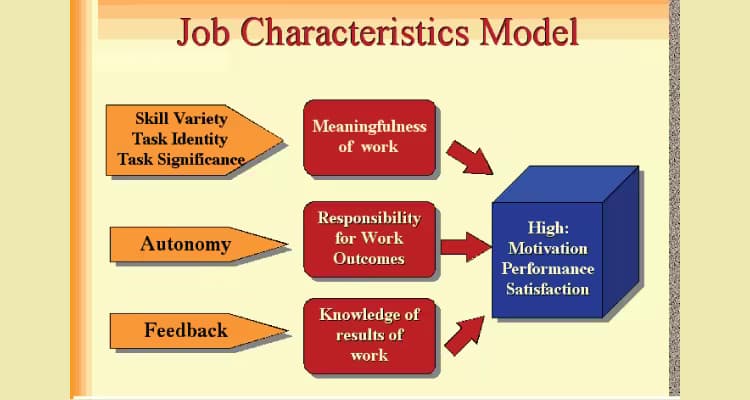
They proposed that five core characteristics determine a job's motivating potential: skill variety, task identity, task significance, autonomy, and feedback. This was a direct challenge to the prevailing view that you motivate workers through external rewards and surveillance. The idea that work could be inherently motivating was, at the time, borderline radical in management circles.
The Five Core Characteristics: What Each One Actually Means
The five characteristics are described everywhere, so I will keep this brief but precise. What matters is understanding not just the labels but the mechanism behind each one.
Skill Variety
This refers to how many different activities a job requires, and how many different skills and talents a person must use to do them. A marketing manager who writes copy, analyzes data, manages a team, and presents to executives has high skill variety. A data entry clerk who types numbers into a spreadsheet eight hours a day does not.
The mechanism: when people use multiple skills, they see the work as more meaningful because it engages more of who they are. You feel less like a cog when the work demands your full range of abilities.
Task Identity
This is the degree to which a job requires completing a whole, identifiable piece of work from beginning to end. A furniture maker who builds a complete table has high task identity. A factory worker who attaches one leg to a table frame all day has almost none.
The mechanism: people find work more meaningful when they can see a finished product. Completing a whole piece of work creates a sense of ownership that working on fragments does not.
Task Significance
This is how much the job affects other people's lives. A nurse has extremely high task significance. So does a safety inspector at a nuclear plant. An employee who files internal memos that nobody reads has almost none.
The mechanism: when people believe their work matters to someone else, they invest more of themselves in it. Adam Grant's research showed that call centre fundraisers who met a scholarship recipient benefiting from their work increased their revenue by over 170%. That is the power of felt significance.
Autonomy
This is the degree of freedom and independence a person has in scheduling their work and deciding how to do it. A self employed consultant has high autonomy. A call centre agent reading from a mandatory script has almost none.
The mechanism: autonomy creates a sense of personal responsibility. When you choose how and when to do something, the outcome feels like yours. Research consistently shows autonomy is one of the strongest predictors of both job satisfaction and performance. A meta analysis of 319 studies found that autonomy improves performance mainly by increasing work motivation and reducing mental strain.
Feedback
This is the degree to which doing the job provides direct, clear information about how well the person is performing. A salesperson who sees their daily numbers has high feedback. A researcher working on a project with results years away has very little.
The mechanism: without feedback, people cannot adjust their behaviour. They do not know what is working and what is not. Hackman and Oldham specifically meant feedback from the job itself, not from a manager. A surgeon who sees whether a patient recovers gets direct job feedback. A bureaucrat whose reports disappear into a system does not.
The Three Psychological States Most Articles Ignore
Here is where most popular articles on the Job Characteristics Model fall short. They describe the five characteristics but skip the middle of the model entirely: the three psychological states that explain why these characteristics matter.
Hackman and Oldham did not argue that job characteristics directly cause outcomes. They argued that the characteristics work through three psychological states:
Experienced meaningfulness is produced by skill variety, task identity, and task significance. When a job uses your talents, lets you complete whole tasks, and affects other people, you experience the work as meaningful.
Experienced responsibility is produced by autonomy. When you have freedom over how you do your work, you feel personally responsible for the results.
Knowledge of results is produced by feedback. When the job tells you how well you are performing, you can connect your efforts to outcomes.
According to the theory, all three states must be present for the job to be motivating. This is a noncompensatory condition. You cannot make up for a total lack of autonomy by loading up on skill variety. The model predicts that if any one psychological state is missing, motivation drops.
Does the research support this mediation claim? Partially. A meta analysis by Behson, Eddy, and Lorenzet found that meaningfulness is the most important of the three states. It connects to all five job characteristics, not just the three it is supposed to connect to. Experienced responsibility and knowledge of results play a role, but their effects are less clear cut.
In fact, some researchers have questioned whether the model even needs the three psychological states. Behson and colleagues found that a simpler two stage model, connecting job characteristics directly to outcomes, may fit the data just as well. The psychological states may not be the precise mediators Hackman and Oldham claimed.
Related: Everything You Need to Know About Job Enrichment
The Motivating Potential Score: A Useful Idea With a Mathematical Problem
Hackman and Oldham proposed a formula for calculating how motivating a job is. They called it the Motivating Potential Score (MPS):
MPS = [(Skill Variety + Task Identity + Task Significance) / 3] x Autonomy x Feedback
The formula is elegant. It says that skill variety, task identity, and task significance are somewhat interchangeable. A job can compensate for low task identity with high task significance. But autonomy and feedback are multiplied, which means a zero on either one reduces the entire MPS to zero.
The logic is sound. A job where you have zero control over your work, no matter how varied or significant, probably will not feel motivating. But the formula creates a mathematical problem that practitioners rarely notice.
Because autonomy and feedback are multiplied together and with the meaningfulness average, the MPS is extremely sensitive to low scores on those two dimensions. A job scoring 7 on all characteristics gets an MPS of 343. A job scoring 7 on everything except autonomy (where it scores 2) drops to 98. That single reduction wipes out two thirds of the motivating potential.
Is this formula empirically justified? Not entirely. Fried and Ferris's meta analysis of nearly 200 studies found that a simple additive index of all five characteristics predicts outcomes about as well as the multiplicative MPS formula. In plain language, just adding up the five scores works about as well as the more complex calculation.
This matters for practitioners. If you are using the MPS formula to prioritize job redesign efforts, you may be overweighting autonomy and feedback at the expense of the other three characteristics. A simpler approach, averaging all five, gives you a more balanced picture.
What 200+ Studies Actually Found About the Model
The Job Characteristics Model has been tested in hundreds of studies since 1975. Two major meta analyses summarize this evidence.
Fried and Ferris (1987) reviewed nearly 200 studies and applied meta analytic procedures. Their findings were encouraging for the model overall. Job characteristics did relate to both psychological outcomes (like satisfaction and motivation) and behavioural outcomes (like performance). The psychological states did appear to mediate the relationship between characteristics and outcomes, as the model predicted. But there were problems.
The correlations between specific job characteristics and the specific psychological states they were supposed to produce did not match the model's predictions cleanly. Skill variety, for example, was supposed to primarily affect experienced meaningfulness. But it correlated with all three psychological states, not just meaningfulness. The neat, specific pathways Hackman and Oldham drew did not fully hold.
Humphrey, Nahrgang, and Morgeson (2007) conducted a much larger meta analysis: 259 studies and 219,625 participants. They found that the original five motivational characteristics explained 25% of the variance in subjective performance, 34% in job satisfaction, 24% in organizational commitment, and 26% in role perception outcomes.
Those are solid numbers. Explaining 34% of job satisfaction from just five characteristics of the job itself is noteworthy. But the Humphrey team found something the original model missed entirely.
What the Original Model Missed: Social and Physical Characteristics
The single biggest finding from Humphrey and colleagues' 2007 meta analysis is that Hackman and Oldham's original five characteristics are incomplete. Two additional categories of job characteristics matter enormously.
Social Characteristics
These include interdependence (how much your work depends on others), social support (help from colleagues and supervisors), interaction outside the organization, and feedback from others (not just from the job itself).
The numbers here are striking. Beyond the original motivational characteristics, social characteristics explained an additional 24% of variance in turnover intentions, 17% in job satisfaction, and 40% in organizational commitment. That last number is remarkable. Social characteristics predicted commitment to the organization far better than the original five job characteristics.
Think about what this means in practice. You could redesign a job to have excellent variety, autonomy, and feedback. But if the person works in isolation with no meaningful social connections, commitment will still suffer. Hackman and Oldham's model, focused entirely on the task itself, missed the social dimension of work.
Work Context Characteristics
These include physical demands, working conditions, and ergonomics. The meta analysis found that work context characteristics explained an additional 4% of variance in job satisfaction and 16% in stress, after accounting for both motivational and social characteristics.
A 16% incremental prediction of stress is significant. You can redesign a job to be varied, autonomous, and socially connected. But if the person works in uncomfortable, noisy, or physically demanding conditions, stress will still be elevated. The original model treated jobs as abstract bundles of tasks. Real jobs happen in physical environments that affect people.
Related: Employee Engagement Strategies
The Growth Need Strength Problem
One of the original model's most interesting claims is that not everyone responds the same way to enriched jobs. Hackman and Oldham proposed a moderator called Growth Need Strength (GNS): a person's desire for personal development, learning, and challenge.
The prediction was intuitive. People with high growth needs should respond more positively to enriched jobs. People with low growth needs might not care about variety or autonomy; they might prefer simple, predictable work.
Does the evidence support this? The Fried and Ferris meta analysis found that GNS does moderate the relationship between job characteristics and performance. The correlation between a job's motivating potential and performance was 0.35 for people high in growth need strength but only 0.11 for people low in growth need strength.
That is a big difference. It suggests that enriching a job helps most when the person in it actually wants a challenging role. But here is the catch: most cross study variance in the characteristics to performance relationship was explained by statistical artifacts, not by GNS. The moderating effect exists but it is smaller and less consistent than the original theory suggested.
Also, measuring GNS is tricky. People tend to overestimate their desire for challenging work. And the concept itself may be too broad. Do people want growth in skills? Responsibility? Recognition? These are different things, and a single GNS score lumps them together.
Autonomy Stands Above the Rest
If there is one finding that surfaces again and again in the research, it is this: autonomy matters more than any other job characteristic.
Humphrey and colleagues found that autonomy had the strongest and most consistent relationships with outcomes across their entire meta analysis. Job satisfaction, organizational commitment, internal motivation, performance: autonomy predicted all of them reliably.
But the original model treated autonomy as a single concept. Later research, particularly by Morgeson and Humphrey, broke it into three distinct types:
Work scheduling autonomy: control over when and in what order you do your work. A freelance writer who sets their own hours has this.
Decision making autonomy: control over how you make decisions in your role. A manager who chooses their own strategy for a project has this.
Work methods autonomy: control over the procedures and tools you use. A mechanic who chooses their own diagnostic approach has this.
These distinctions matter in practice. Remote work, for example, often increases scheduling autonomy but may decrease decision making autonomy if accompanied by more micromanagement. Understanding which type of autonomy you are giving or taking away determines the real impact on motivation.
Does the Model Prove Causation or Just Correlation?
Here is an uncomfortable question that very few articles on the Job Characteristics Model address honestly: almost all the evidence is correlational.
Both major meta analyses are based primarily on cross sectional studies. That means researchers measured job characteristics and outcomes at the same time. They found that people who report enriched jobs also report higher satisfaction and motivation.
But does the enriched job cause the satisfaction? Or do satisfied people perceive their jobs as more enriched? This is not a trivial concern. Research shows that personality affects how people perceive their work. Optimistic people tend to rate their jobs more favourably on all dimensions. A meta analysis of 819 samples found that each of the Big Five personality traits shapes how people perceive their job characteristics, which in turn shapes their job attitudes.
In other words, some of the correlation between job characteristics and outcomes may reflect who the person is, not what the job is. This does not mean the model is wrong. Experimental studies that actually enriched jobs, like the original AT&T studies by Herzberg and the Volvo assembly line experiments, did find improvements in motivation and satisfaction. But the effect sizes from experimental studies tend to be smaller than the correlational evidence suggests.
For practitioners, the honest conclusion is this: redesigning jobs probably will improve motivation and satisfaction. But the gains may be more modest than the meta analytic correlations imply. Do not promise a transformation. Expect gradual, real improvement.
Have Job Characteristics Changed Since 1975?
Everyone talks about how work has changed. But has anyone actually measured it?
Yes. Wegman and colleagues conducted a cross temporal meta analysis that tracked changes in job characteristics from 1975 to the present. They found something surprising: despite all the talk about the "changing nature of work," job characteristics have not changed as much as people assume.
Autonomy has increased modestly over time, consistent with broader trends toward knowledge work. But skill variety, task identity, and task significance have remained remarkably stable. The most notable change is in social characteristics: work has become more interdependent and more reliant on social interaction.
This finding reinforces the earlier point about Humphrey's meta analysis. The social side of work has grown more important, but the original Job Characteristics Model does not account for it. Practitioners who rely only on Hackman and Oldham's five characteristics are using a model designed for a less interconnected workplace.
Related: The Job Characteristic Model: Everything You Need to Know
Applying an Updated Job Characteristics Model in Practice
Given what the research actually shows, here is how to apply an updated version of the Job Characteristics Model in your organization.
Step 1: Assess All 14 Characteristics, Not Just Five
The expanded work design model includes 14 characteristics across four categories. These are best measured using the Work Design Questionnaire developed by Morgeson and Humphrey, which updated Hackman and Oldham's Job Diagnostic Survey.
Task characteristics include the original five: autonomy (now split into three types), skill variety, task identity, task significance, and feedback from the job.
Knowledge characteristics include job complexity, information processing, problem solving, and specialization. These capture the cognitive demands of a role, which the original model largely ignored.
Social characteristics include interdependence, feedback from others, social support, and interaction outside the organization.
Contextual characteristics include physical demands, working conditions, and ergonomics.
Step 2: Prioritize Autonomy, But Be Specific About Which Type
Autonomy is the single strongest lever you have. But giving people "more autonomy" without specifying the type is vague. Ask: does this person need more control over when they work (scheduling autonomy)? How they work (methods autonomy)? What decisions they make (decision making autonomy)?
For knowledge workers, decision making autonomy tends to matter most. For production workers or shift based roles, scheduling autonomy may be more impactful. For creative roles, methods autonomy is often the priority.
Step 3: Do Not Ignore Social Design
If commitment is a concern in your organization, look at social characteristics before motivational ones. The meta analytic data shows that social characteristics explained 40% of variance in organizational commitment above and beyond the original five characteristics.
Practically, this means building opportunities for interdependence, social support, and feedback from colleagues into the work itself. It is not about pizza parties. It is about structuring the work so that people genuinely depend on and support each other.
Step 4: Use a Simple Additive Index Instead of MPS
The original MPS formula is unnecessarily complex and, as the research shows, does not predict outcomes better than a simple average. Survey employees on all 14 characteristics using a 7 point scale. Average the scores. Compare across roles. Identify which characteristics are lowest in each role and redesign accordingly.
Step 5: Match Job Enrichment to the Person
Not everyone benefits equally from an enriched job. The GNS research tells us that people who want challenge respond best to enrichment. Before redesigning a role, have a conversation with the person in it. Do they want more variety? More responsibility? More independence? Enriching a job for someone who prefers routine can backfire.
Related: Empowering Employee Motivation: Strategies for Engagement and Performance
Job Characteristics in the Remote and Hybrid Work Era
The shift to remote and hybrid work has changed the practical meaning of several job characteristics. Understanding these shifts matters because the Job Characteristics Model was designed in an era when "work" meant going to a physical location.
Autonomy has increased for many remote workers, particularly scheduling autonomy. People who work from home often have more control over when they start and stop, when they take breaks, and how they organize their day. This is consistent with the finding that remote workers report higher satisfaction. A substantial part of that satisfaction likely flows through autonomy.
But feedback from the job may have decreased. In an office, you can see the immediate impact of your work on colleagues. At home, that visibility drops. You finish a report and send it into the void. Days pass before anyone responds. The feedback loop, one of the model's five core characteristics, gets stretched and weakened.
Social characteristics have taken the biggest hit. Interdependence is harder to maintain across screens. Spontaneous social support, a colleague noticing you are stressed and asking how you are, disappears almost entirely. And interaction outside the organization, already declining before the pandemic, dropped further.
For hybrid teams, the research suggests that organizations need to be intentional about which characteristics they protect. Scheduling autonomy can be preserved easily. Feedback and social characteristics require deliberate design: structured check ins, visible work products, collaborative projects that build genuine interdependence.
Seven Common Misconceptions About the Job Characteristics Model
After reviewing the top 10 articles currently ranking on Google for this keyword, here are the misconceptions they repeat:
1. "The model has five characteristics." The updated, evidence based model has 14. The original five are a subset. Continuing to cite only five ignores 30 years of research extension.
2. "All five characteristics are equally important." They are not. Meta analyses consistently show autonomy has the strongest effect. Task identity tends to have the weakest.
3. "The MPS formula accurately measures motivating potential." A simple additive index works just as well. The multiplicative formula is unnecessarily sensitive to low scores on autonomy and feedback.
4. "Enriching jobs always improves motivation." Only for people who want enriched jobs. Growth Need Strength moderates the relationship. Enriching a role for someone who prefers simplicity can increase stress without improving motivation.
5. "The model only applies to factory or manual work." The meta analyses include a wide range of jobs. The model applies to knowledge work, service roles, and professional positions. But social and knowledge characteristics matter more in those contexts than the original five motivational characteristics.
6. "Job characteristics cause outcomes." Most evidence is correlational. The relationship between characteristics and outcomes is real and consistent, but causal claims require more experimental evidence than currently exists.
7. "The three psychological states are well supported." Meaningfulness is well supported. The mediation role of experienced responsibility and knowledge of results is less clear. Some meta analytic evidence suggests the model works fine without the psychological states as mediators.
A Practical Checklist for Job Redesign Using the Evidence
Based on the full body of research, here is a checklist for redesigning jobs. It goes beyond the original five characteristics to include what we now know matters.
Audit the role. Survey the person currently in the job on all 14 work design characteristics. Which ones score lowest?
Start with autonomy. If autonomy is low, address it first. It has the most consistent and strongest effect across all outcomes.
Check social characteristics. If organizational commitment is a concern, look at interdependence and social support before anything else. The data says these predict commitment better than task characteristics.
Increase task significance. Connect people to the end users of their work. Grant's research shows this has immediate, measurable effects on effort.
Add variety carefully. More skills are good, but adding random unrelated tasks just creates overload. The variety should connect to the person's core competencies.
Build feedback into the work itself. Do not rely only on manager feedback. Design roles so that the person can see the results of their own work directly.
Consider the person. Talk to the employee before redesigning their job. What do they want more of? What do they want less of? GNS research shows not everyone benefits from enrichment in the same way.
Address working conditions. If physical demands or poor ergonomics are present, no amount of motivational job design will prevent stress and burnout.
Related: Performance Management Goals: What You Need to Know
Where the Job Characteristics Model Goes From Here
The Job Characteristics Model is not dead. But it has evolved well beyond what most HR practitioners and even some textbooks acknowledge.
Sharon Parker proposed a work design growth model that extends the framework even further, incorporating proactive behaviour and job crafting, where employees redesign their own roles from the bottom up, rather than waiting for management to enrich their jobs for them.
The trend in work design research is toward complexity. More characteristics, more moderators, more outcomes. This is scientifically appropriate but creates a practical problem. The original model's strength was its simplicity: five things to look at, one formula, clear predictions. The expanded 14 characteristic model is more accurate but harder for managers to apply without guidance.
The challenge for practitioners is finding the balance. Use the expanded model for diagnosis. Use the original five for communication. When explaining job redesign to a non HR audience, the five core characteristics are still the clearest starting point. But when actually assessing and redesigning jobs, use the full 14 characteristics and pay special attention to social and contextual factors.
What the Evidence Says, Summarized
Fifty years of research on the Job Characteristics Model have produced several clear findings:
The five core job characteristics do predict job satisfaction, motivation, and performance. This is supported by meta analyses covering hundreds of studies and hundreds of thousands of participants.
But the original five are incomplete. Social characteristics, particularly interdependence and social support, are powerful predictors that the model originally ignored. Work context characteristics matter too, especially for stress.
Autonomy is the single most important job characteristic. If you can change only one thing about a job, increase the person's control over how they do their work.
The three psychological states are partially supported. Meaningfulness is the strongest and most consistent mediator. The other two states are less clearly supported.
The MPS formula is unnecessarily complex. A simple average of job characteristics predicts outcomes just as effectively.
Not everyone responds the same way. Growth Need Strength moderates the effects, but it is a blunt measure and its moderating effect is smaller than originally claimed.
Most evidence is correlational. The relationships are real and consistent, but be cautious about assuming causation. Personality influences how people perceive their jobs.
The model remains one of the most useful frameworks in work design. Its core insight, that the nature of work itself affects motivation, has withstood five decades of testing. What has changed is our understanding of how many characteristics matter, which ones matter most, and for whom.