Most cover letter advice online is pretty useless. You get a generic template, a few vague tips about showing enthusiasm, and the hope that somehow you will stand out from 750 other applicants.
Here is what nobody tells you: the format and quality of your cover letter matter more than most people think. Jobscan analyzed close to 1 million job applications and found that candidates who included a cover letter were 1.9 times more likely to land an interview than those who skipped it. A follow up analysis from the same dataset showed cover letters increased interview rates by 3.4 times when combined with other application best practices.
That is not a marginal difference. That is the gap between getting called back and hearing nothing for months.
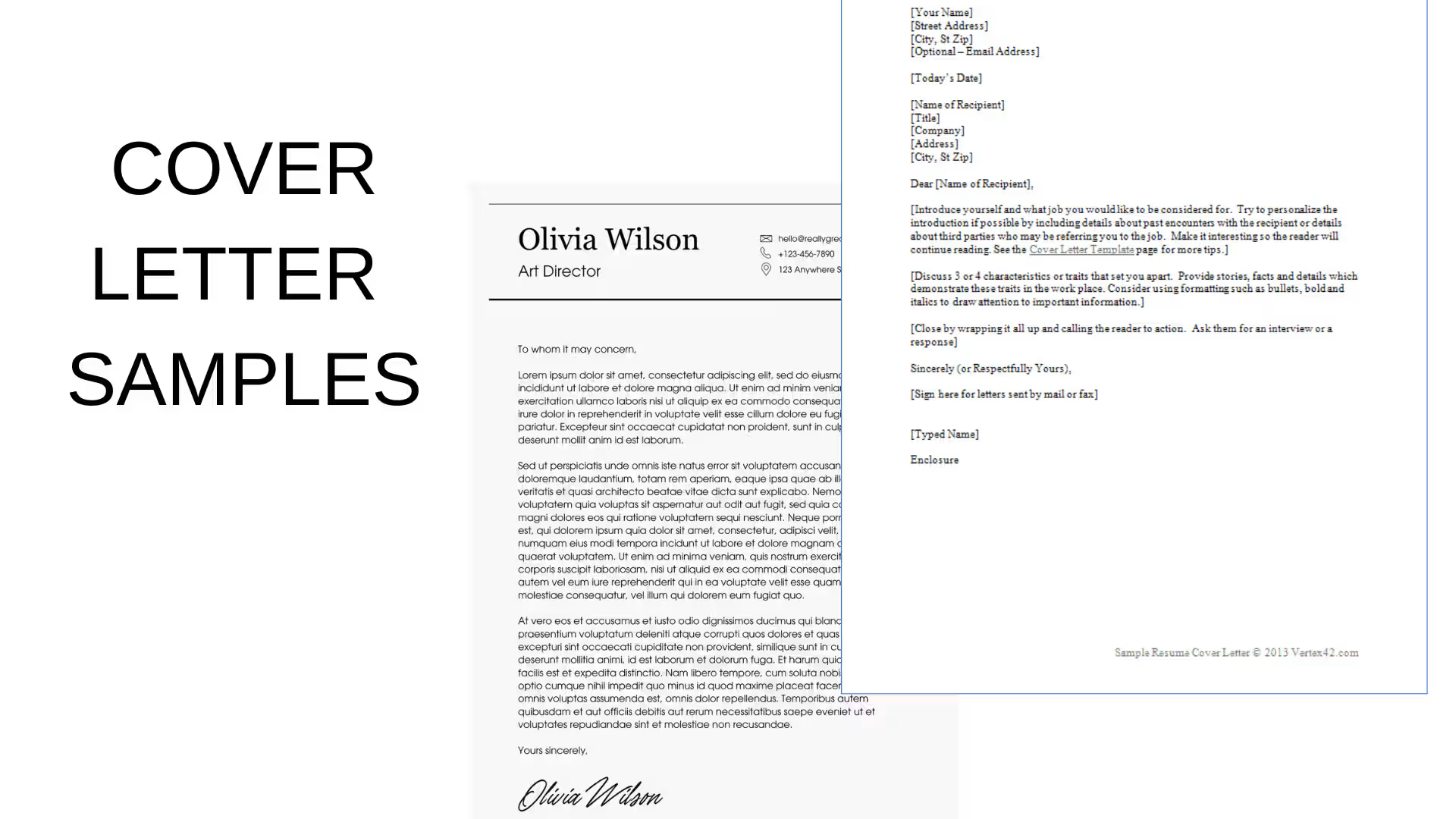
This guide gives you seven cover letter samples you can actually use. Each one is built for a specific situation: entry level roles, career changes, senior positions, remote jobs, and more. I will walk you through why each sample works, what hiring managers scan for, and how to customize them so yours does not read like everyone else's application.
Do Cover Letters Still Matter? What the Hiring Data Says
Let us settle this debate with data instead of opinions. A LinkedIn poll found that 44% of users think cover letters are dead. But the people who actually make hiring decisions tell a different story.
Resume Genius surveyed 625 U.S. hiring managers and found that 87% read cover letters. Even when submitting one is optional, 72% still expect to see one. And here is the number that should grab your attention: 49% of hiring managers say a strong cover letter can convince them to interview a candidate whose resume alone would not have been enough.
Nearly half of all hiring managers would call in someone with a mediocre resume if their cover letter was compelling. That is a massive opportunity most job seekers ignore.
Resumes show what you have done. Cover letters explain who you are and why you want this specific job. According to Resume.io, about 90% of executives who review applications say cover letters are valuable for evaluating candidates. And 58% of employers will throw out a cover letter with obvious typos. Quality control matters just as much as content.
If a job posting asks for a cover letter, send one. If it is optional, send one anyway. And if you want it to work, do not send the same letter twice.
What Every Good Cover Letter Needs
Every effective cover letter has five parts. Skip any one and the whole thing weakens.
The header comes first. Your full name, phone number, email, and LinkedIn URL. Include the date and the hiring manager name if you can find it. Check the company website or LinkedIn. If you cannot find a specific name, "Dear Hiring Manager" works.
Then the opening paragraph. You have about 6 seconds of attention before someone decides whether to keep reading. The best openings show genuine enthusiasm for the specific company. Not generic excitement about "this amazing opportunity." Reference their actual work, products, or mission.
The body connects your experience to their needs. The biggest mistake is making it all about you. Focus on what you can do for them, not what you want from them. Pick two or three requirements from the job description and show evidence you have met them before.
Your closing paragraph needs a clear call to action. Thank them. Express interest in discussing the role. "I would welcome the chance to discuss how my experience with X could support your team" does the job without overdoing it.
Keep the whole letter between 250 and 400 words. Flair.hr reports that 70% of employers say half a page is ideal. Three to four paragraphs. That is the sweet spot.
Sample 1: The Standard Professional Cover Letter
Use this when you are applying for a role in your current field with relevant experience. This is the all purpose template that works for most situations.
Dear [Hiring Manager Name],
I am writing to apply for the [Job Title] position at [Company Name]. Your recent work on [specific project or initiative] caught my attention, and I would like to contribute to a team that [specific value or mission].
Over the past [X years] in [your field], I have [specific achievement with number]. At [Previous Company], I [second achievement with measurable result]. These experiences have prepared me to [what you will do for them, tied to their job description].
What draws me to [Company Name] specifically is [genuine reason tied to their work]. I have followed your [product/research/growth] and believe my background in [relevant skill] positions me to contribute from day one.
I would welcome the chance to discuss how my experience could support your team. Thank you for considering my application.
Best regards, [Your Name]
Why this works: It names a real project at the company. It gives two concrete achievements with numbers. It connects your skills directly to their needs. No filler. Every sentence does a job.
Sample 2: The Entry Level Cover Letter
Use this when you are a recent graduate or entering the workforce for the first time. The workaround for having no track record? Treat your education, volunteer work, internships, and projects as experience.
Jobscan recommends that students frame these experiences the same way professionals frame work history: specific tasks, clear responsibilities, and measurable outcomes.
Dear [Hiring Manager Name],
I am applying for the [Job Title] role at [Company Name]. As a recent graduate from [University] with a degree in [Field], I have spent the past [timeframe] building skills in [relevant area] through [coursework, internship, or project].
During my internship at [Organization], I [specific task with outcome]. I also led [university project or volunteer work] where I [measurable result, e.g., coordinated a team of 8 or increased event attendance by 30%].
I am drawn to [Company Name] because [specific reason]. While I am early in my career, I bring [specific quality] and a genuine drive to learn and contribute.
I would appreciate the opportunity to discuss how I could add value to your team. Thank you for your time.
Sincerely, [Your Name]
Why this works: It does not apologize for inexperience. It frames early experiences as proof of capability. "Coordinated a team of 8" beats "worked well with others" every single time.
Sample 3: The Career Change Cover Letter
Use this when switching industries or role types. About 50% of hiring managers say cover letters are the best place to explain a career change, according to research cited by Resume.io.
This letter answers the hiring manager's question before they ask it: Why are you switching, and can you actually do this job?
Dear [Hiring Manager Name],
After [X years] in [current field], I am making a deliberate move into [new field]. The [Job Title] role at [Company Name] is exactly the position I have been preparing for.
My shift is not random. During my time at [Previous Company], I noticed that [observation connecting old field to new]. I started building skills in [new area] through [courses, certifications, side projects], and I have already [specific result in the new field].
The skills I built transfer directly. [Transferable skill 1] prepared me for [specific requirement]. [Transferable skill 2] maps to [another requirement]. At [Previous Company], I [achievement demonstrating a relevant skill].
I know career changers sometimes raise questions. I would welcome the chance to show you why my unconventional path is an asset for [Company Name].
Best regards, [Your Name]
Why this works: It tackles the objection head on. It connects old experience to new requirements with specifics. The closing shows self awareness and confidence, which is exactly the tone career changers need to strike.
Sample 4: The Problem Solution Cover Letter
Use this when you want to stand out and are willing to invest time in research. The Interview Guys analyzed over 80 studies and found the problem solution format consistently beat every other approach.
Stories are 22 times more memorable than bare facts, according to CVJury research. When you frame your experience as a solution to the company's real problem, your letter sticks in the reader's memory. This format also forces genuine research, so your letter can never be generic.
Dear [Hiring Manager Name],
[Company Name] is [describe a specific challenge or opportunity the company faces based on your research].
I have solved that problem before. At [Previous Company], I [describe how you addressed a similar challenge, with numbers]. The result was [measurable outcome].
I have been following [Company Name] in [specific area] and see a clear opportunity to apply a similar approach. My background in [relevant expertise] and my track record of [key achievement] make me confident I can deliver results in the [Job Title] role.
I would love to share more about my approach. Would you be open to a conversation?
Best regards, [Your Name]
Why this works: It leads with value, not with a request. It shows you understand their business. This is the format that gets forwarded between hiring managers internally.
Sample 5: The Referral Cover Letter
Use this when someone at the company told you about the role. Referral candidates get hired at much higher rates than cold applicants. Putting a contact's name in the first sentence changes how your application is received.
Dear [Hiring Manager Name],
[Referrer Name], [their title] at [Company Name], suggested I reach out about the [Job Title] opening. After learning about your team's work on [specific project], I am convinced this role fits my background well.
[Referrer Name] and I worked together at [Organization], where I [relevant achievement]. Since then, I have [another accomplishment] and developed expertise in [skill matching the job description].
I am especially interested in [Company Name]'s approach to [specific aspect]. With my experience in [relevant area], I am ready to contribute to [specific team goal].
I have attached my resume and would appreciate the opportunity to discuss this further.
Sincerely, [Your Name]
Why this works: The referral appears in sentence one. Resume Genius notes that mentioning a company contact shows genuine interest and gets your letter moved to the top of the stack.
Sample 6: The Short and Confident Cover Letter
Use this when you are experienced and your qualifications clearly match the role. When your resume already speaks for itself, brevity signals confidence.
Dear [Hiring Manager Name],
I am a [Job Title/Credential] with [X years] of experience in [field], writing about the [Position] at [Company Name].
My background includes [qualification 1], [qualification 2], and [qualification 3]. At [Most Recent Company], I [biggest achievement with number]. I hold [relevant certification] and have consistently [pattern of results].
I would welcome a conversation about how I can contribute to your team.
Best regards, [Your Name]
Why this works: No wasted words. For senior roles or credentialed positions, this format shows you do not need to oversell yourself. You state your case and invite a conversation.
Sample 7: The Remote Job Cover Letter
Use this when applying for a remote position. Employers still worry about communication and self discipline with distributed teams. Address those concerns directly.
Dear [Hiring Manager Name],
I am applying for the remote [Job Title] position at [Company Name]. I have worked remotely for [X years] and built strong habits around [specific remote skill: asynchronous communication, self directed project management, virtual collaboration].
At [Previous Company], I [achievement in a remote context]. I managed [scope] across [time zones] using tools like [Slack, Asana, Zoom] to keep work on track. The result was [measurable outcome].
What I appreciate about [Company Name] is [specific reason]. I am excited about contributing to a team that values results over desk time.
I would be glad to discuss how my remote experience aligns with your needs.
Best regards, [Your Name]
Why this works: It addresses remote concerns head on. It names specific tools, habits, and results. It shows understanding of remote culture, not just remote logistics.
5 Mistakes That Get Cover Letters Thrown Out
Writing a strong cover letter is one thing. Avoiding the mistakes that kill your chances is another.
1. Sending the same letter to every employer
72% of hiring managers say customization is critical, according to The Interview Guys. If your letter works for any company, it works for no company. Swap in specific details each time.
2. Typos and grammar errors
About 58% of employers reject applications with obvious mistakes, based on Resume.io data. One misspelled company name and you are done. Read it aloud. Have someone else check it.
3. Repeating your resume word for word
Your cover letter adds context a resume cannot. Use it to explain career gaps, show company specific enthusiasm, or turn raw numbers into stories that make sense.
4. Writing too much
52% of hiring managers spend between 10 seconds and one minute on a cover letter. Keep yours under one page. Ideally around half a page. Every sentence must pull its weight.
5. Leaving out the call to action
End with a clear next step. "I would welcome the opportunity to discuss this" is enough. Do not leave the reader guessing.
How to Customize Any Template in 15 Minutes
A template is a starting point, not a destination. Here is a fast process for making any sample your own.
Read the job description carefully. Pick the two or three things the employer cares about most. Look for requirements listed first, mentioned repeatedly, or placed in the qualifications section.
Choose two achievements from your background that match those priorities. Be specific. Include numbers: revenue generated, projects delivered, team size, percentage improvements.
Spend five minutes researching the company. Their website, LinkedIn page, or a recent news article. Find one genuine detail about their work that interests you. This single detail transforms a generic letter into a personal one.
Replace the bracketed placeholders with real information. Read the full letter aloud. If any sentence sounds like something you would never say to another person, rewrite it until it sounds natural.
Jobscan reports that applicant tracking systems now scan cover letters alongside resumes. Mirror keywords from the job description to help your application get past automated screening and into a real person's hands.
This process takes about 15 minutes once you have done it a few times. That small investment nearly doubles your interview chances.
Formatting Tips That Actually Matter
Bad formatting can sink a strong letter. Here is what to get right.
Keep it to one page. Between 250 and 400 words. Three to four paragraphs.
Use a clean font like Calibri, Arial, or Georgia in 10 to 12 point size. Match it to your resume so your application looks like a package.
Save and send as a PDF unless the posting asks otherwise. PDFs preserve formatting across devices. Resume Genius recommends PDF as the default format.
Include your LinkedIn URL in the header. Jobscan data shows 94% of recruiters check LinkedIn when screening candidates.
Use generous white space. One inch margins. Single spacing with a blank line between paragraphs. A letter that is easy to scan gets read. A wall of text does not.
Your Cover Letter Is a Conversation Starter
A cover letter is not your life story. It is a ticket into the room. These seven samples give you structures that work. The hiring data confirms it. The rest is execution.
Pick the template that fits your situation. Fill it with real details about your experience and the company you want to join. Read it aloud. Send it.
Every application without a cover letter is a missed chance to make your case. In a market where each posting attracts hundreds of applicants, that 15 minutes of effort separates the people who get interviews from the ones who wonder why the phone never rings.