
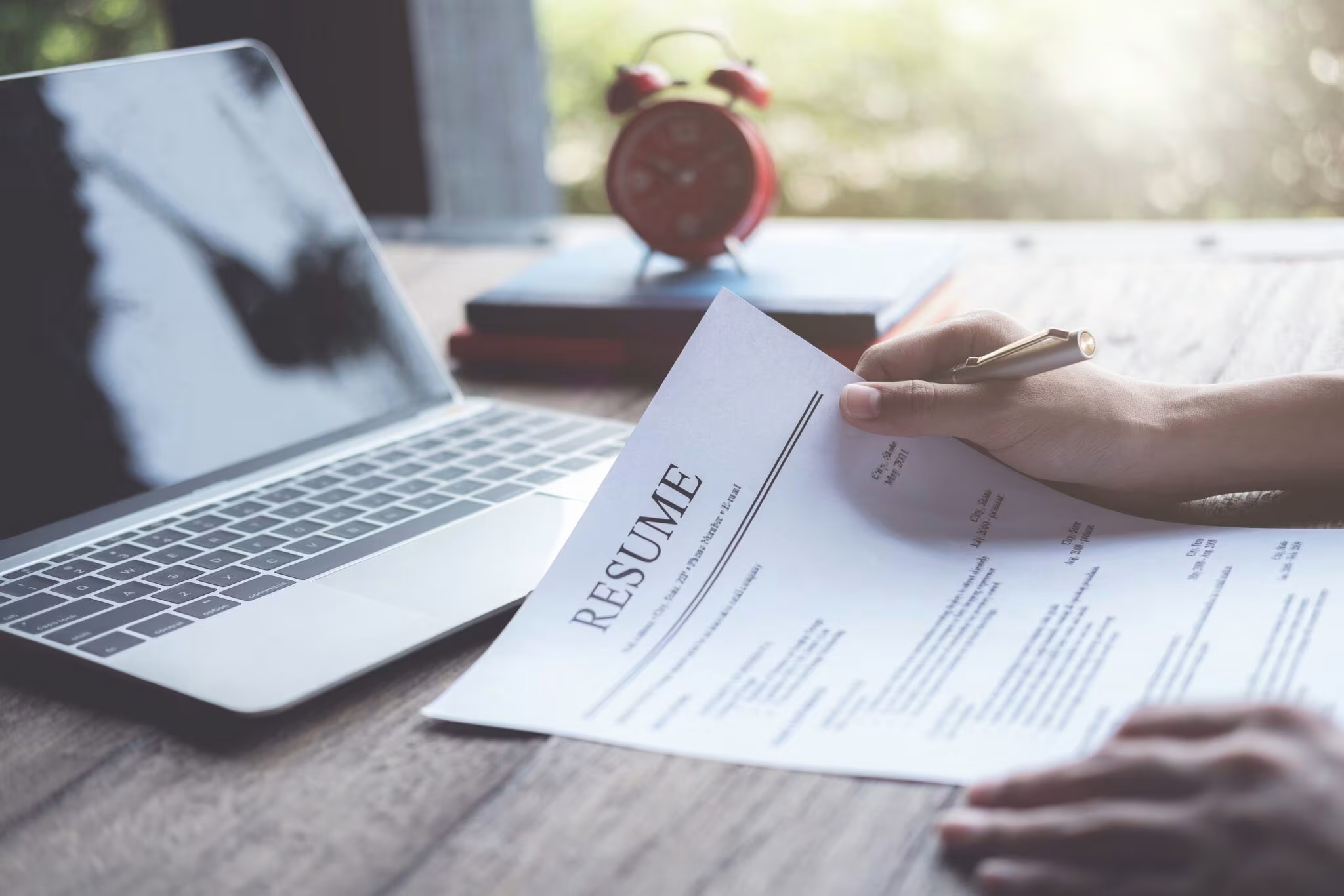
Here's something most job seekers don't want to hear: your cover letter probably isn't being read the way you think it is. Hiring managers aren't settling in with a cup of coffee to savor your carefully crafted prose. They're scanning. Fast. And if your letter doesn't grab them in the first few seconds, it's getting tossed into the digital equivalent of "maybe later" (which really means never). But here's the good news - once you understand what actually works in 2025, writing a cover letter that gets noticed becomes way less mysterious.
The Harsh Reality About Cover Letters in 2025
Let's start with what's actually happening when you submit that application. Most medium-to-large companies are using Applicant Tracking Systems (ATS) that scan your cover letter before any human sees it. Smaller companies might have someone doing a quick 10-second skim to decide if you're worth a closer look.
This creates a specific challenge: your cover letter has to include the right keywords without sounding like you're just stuffing terms into sentences. It also needs to be scannable while still telling a compelling story.
The biggest mistake? People treating their cover letter like a formality instead of a strategic tool. They write one generic letter, maybe swap out the company name, and send it everywhere. Then they wonder why they're not getting responses.
What Actually Matters in Your Opening
Your opening paragraph has one job: make the reader want to keep reading. That's it. Not to summarize your entire career, not to explain your life story, but to create enough interest that they don't click away.
The most effective openings do one of three things:
- Show you understand their specific pain point or challenge
- Connect your experience directly to their most pressing need
- Demonstrate genuine enthusiasm paired with specific knowledge about their company
What is not working is: "I am writing to declare my interest in the position of Marketing Manager at XYZ Company." This doesn't tell them anything new since they already know it from the subject line. It is a waste of words.
An example of a better approach is: "My head started spinning when I heard of TechCorp's entry into Southeast Asia and I pictured the launch campaigns I led at GlobalSoft where we had a 40% market share growth in comparable emerging markets."
Can you see the difference? The latter not only indicates that you have researched the company but also establishes your experience as a valuable asset to their current needs and comes with a specific result. It basically gives the hiring manager a reason to go through the whole application.
The Body: Where Most People Lose the Reader
The middle section of your cover letter is where you prove you can actually do what the job requires. But here's where most people mess up - they essentially rewrite their resume in paragraph form. Don't do that. Cover letter connects the dots between what you've done and what they need. It provides context that numbers alone can't convey.
Pick Your Best Stories
You don't have space to cover everything, so choose 2-3 specific examples that directly address their requirements. Look at the job posting and identify what they're actually worried about. Are they launching a new product? Dealing with rapid growth? Trying to turn around declining performance?
Then pull examples from your background that show you've successfully handled similar challenges. Be specific with numbers and outcomes. "Increased sales" is vague. "Grew Q4 revenue by 35% through targeted outreach to enterprise clients" tells a real story.
Address the Elephant in the Room
If there's something on your resume that might raise questions - a gap in employment, a career change, relocation - address it briefly and positively in your cover letter. Don't ignore it and hope they won't notice. They will.
But keep it brief. "After three years in consulting, I'm making an intentional shift to in-house marketing where I can focus on long-term strategy rather than project-based work." That's honest, shows self-awareness, and positions the change as deliberate rather than desperate.
The Skills Match: Making It Obvious You Can Do the Job
One of the most powerful ways is establishing an overt link between the applicant's specified qualifications and the company's stated requirements. This is not about mentioning every qualification, and then saying "yes, I can do it." It is about demonstrating how one's past teaches that they can do what the employer needs.
For instance, if a job ad requires someone to "lead cross-functional teams and take projects to completion", do not simply repeat this back to the writer. Instead, illustrate the point with a specific instance: "In my present position, I conduct weekly sprints among the engineering, design, and product teams - thereby keeping a 23-member team synchronized on what they need to deliver and ever so slightly increasing shipping of features on-time to 94%."
Notice what that does - it takes their requirement and shows not just that you meet it, but exactly how you meet it. It gives them confidence that you understand what the job actually involves.
Keywords: The Strategic Approach
Yes, you need to include relevant keywords for ATS systems. But there's a right way and a wrong way to do this. The wrong way is obvious keyword stuffing that makes your letter sound robotic. The right way is naturally incorporating industry terminology and skills that are actually relevant to the role. If they mention Salesforce, HubSpot, and SQL in their job description, and you've used all three, work those into your examples naturally.
The best approach is to mirror their language. If they say "stakeholder management," use that phrase rather than "working with partners." If they emphasize "data-driven decision making," use that exact terminology when describing how you work.
Company Research: Showing You Actually Care
Here's where most cover letters fall flat - they're so generic they could be sent to any company in the industry. That's a huge missed opportunity because demonstrating genuine knowledge about the company can immediately set you apart.
This doesn't mean you need to spend hours researching every company. But you should at minimum:
- Check their recent news or press releases
- Look at their latest product launches or initiatives
- Understand their competitive position in the market
- Note their stated values or mission (and only mention them if you genuinely connect with them)
By weaving one or more of these insights into your letter, you will illustrate that you listened to and understood their vision and direction. A formulation like, “I've been following your expansion into healthcare AI and, as a person with both a healthcare operations and machine learning background, am excited about the possibility to contribute to this growth.", demonstrates that you paid attention to detail and have an understanding of their direction.
The Closing: Your Call to Action
When you close your letter, don’t end it with a passive, forgettable statement “I look forward to hearing from you.” Instead, show respect for their process and express confidence. One possibility: “I would appreciate the chance to discuss how my background in scaling content operations would meet your team’s growth needs. I am available to discuss further at your convenience.”
There are three reasons this is an effective strategy: (1) it’s specific — you refer directly to relevant experiences in responding to their needs, (2) it’s confident and (3) it offers them a clear next step.
Make sure you include your contact details (email address and phone number). The easier you make it for them to get in touch with you, the better.
Length and Format: What Actually Matters
Keep it to one page. Period. If you can't make your case in 3-4 concise paragraphs, you're probably not being strategic enough about what you're including.
Use standard formatting - no fancy fonts, no colors, no weird layouts. Hiring managers are scanning dozens of these. Make yours easy to read quickly. That means:
- Clear paragraph breaks (not walls of text)
- Professional font like Arial or Times New Roman
- 11-12 point font size
- Standard margins (1 inch is fine)
Save it as a PDF unless they specifically ask for a different format. PDFs maintain formatting across different systems and look more professional than Word docs.
Common Mistakes That Kill Cover Letters
Let's talk about what not to do, because these mistakes are surprisingly common:
Mistake #1: Making It About You Instead Of Them
Your cover letter is not an autobiography. Every sentence in the cover letter should ultimately be answering the following question; “How does it solve the employer's problem or meet their needs?”. If a sentence does not answer this question, remove it!
Mistake #2: Using Clichéd and Empty Words
The phrases “I am hardworking”, “I am a team player”, etc are all clichéd phrases and have no value as they are so common. Show that you are hard working, a team player and passionate about excellence through examples and not just by stating them.
Mistake #3: Apologising or Being Overly Humble
Do not start a sentence with “I do not have experience in X…” or “I am still developing my skills....”, instead, begin with your strengths. If there is a gap in experience, make a brief note of it, but then refocus on transferable skills and your ability to learn quickly.
Mistake #4: Sending A Cover Letter To Every Job Alike
Generic cover letters are easily identifiable and are ineffective. Customisation of your cover letter is essential for each job application. Customization does not require you to write from scratch! You should be customizing your cover letters by changing examples and emphasizing material that relates to the specific role you are applying to.
When to Skip the Cover Letter
Here's an unpopular opinion: sometimes you shouldn't write a cover letter. If a company explicitly says the cover letter is optional and you're applying to a role where your resume clearly shows you're qualified, spending an hour crafting a perfect cover letter might not be the best use of your time.
But - and this is important - that's only true if your resume genuinely speaks for itself and you're an obvious fit. For most applications, especially competitive ones or those where you're stretching a bit, the cover letter is your chance to make the case that might not be obvious from your resume alone.
The Bottom Line
Writing a cover letter that actually gets noticed isn't about following some magic formula. It's about understanding what hiring managers are looking for and making it easy for them to see that you're a strong candidate. That means being specific, being relevant, and being strategic about what you choose to highlight.
Every sentence should have a purpose. And everything you include should connect back to the specific role you're applying for. It takes more time than sending a generic letter to every job posting. But the payoff - actually getting interviews instead of silence - makes that investment worthwhile. Treat your cover letter like the strategic marketing document it is, and you'll start seeing different results.
As you start applying, keeping track of all your applications, customized cover letters, and follow-ups can get overwhelming quickly. That's exactly why job application tracker exists, as its main task is to help job seekers stay organized throughout the entire process. With MaxOfJob you can track which version of your cover letter you sent where, when you applied, interview dates, and follow-up reminders all in one place. When you're managing multiple applications with customized letters for each, having a system to keep it all straight isn't just helpful - it's essential.
The job search process is challenging enough without adding unnecessary confusion. Focus your energy on writing great, targeted cover letters - and let the right tools handle the organization. That's the combination that actually gets results.




.avif&w=3840&q=75)