Job characteristics determine the level of effort that people invest in their work. Unfortunately, I see managers failing to take advantage of these job characteristics when designing work. More disappointing are the human resources professionals who fail to educate and help create jobs using the job characteristic model. There is sufficient scientific evidence to demonstrate the benefits of job characteristics for individuals and organizations.
The jobs that drain us share common characteristics. The same applies to those jobs that energize us. Between monotonous tasks that numb the mind and meaningful work that ignites performance lies a framework that has guided organizational design for five decades.
Organizations invest millions in engagement surveys, wellness programs, and flexibility policies, while ignoring the most direct lever for motivation that sits in plain sight. The structure of work determines whether employees enjoy their work or do it only to keep their jobs. A comprehensive meta-analysis synthesizing 259 studies and 219,625 participants revealed that work design characteristics explain an average of 43% of the variance in worker attitudes and behaviors.
The Job Characteristics Model offers more than a theoretical framework; it is a practical tool for designing work. It provides a measurable, actionable blueprint for building work that employees want to do and also enjoy. What follows goes beyond conventional advice to reveal how to systematically diagnose, measure, and redesign work for sustained motivation and performance. This includes the practical tools researchers use, the specific calculations that predict motivating potential, and the implementation strategies.
The Job Characteristic Model and what Actually Makes Work Motivating
Richard Hackman and Greg Oldham developed the Job Characteristics Model in 1975 after discovering something unexpected. Factory workers who initially performed well became progressively demotivated and less productive over time. They found that the issue was not a matter of capability or compensation. The problem was embedded in the structure of the work itself.
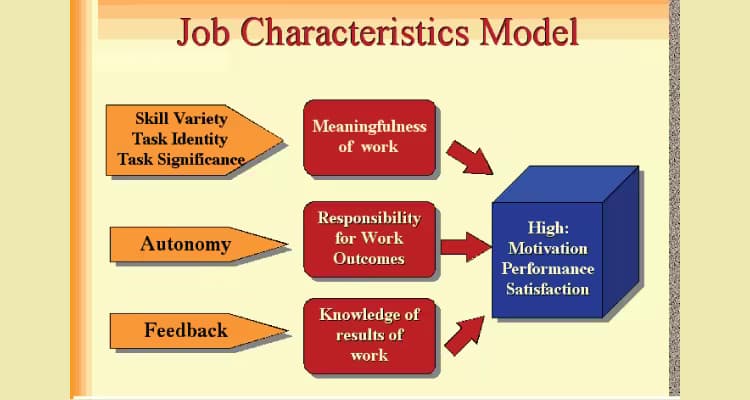
Their ground-breaking research identified five core job characteristics that operate through psychological states to influence motivation, satisfaction, and performance. These characteristics are not abstract concepts. They are measurable dimensions that can be systematically adjusted to transform how work feels and how well it gets done.
The Five Core Characteristics Explained
Skill Variety refers to the range of different activities and talents a job requires. Workers enjoy work that demands diverse capabilities and engages them more. Jobs low in skill variety become repetitive and tedious. Highly skilled jobs with a high variety of tasks stimulate learning and maintain interest. The most important point to note here is that variety must be meaningful, not random. Adding unrelated tasks creates confusion and boredom. The key is to add tasks that build toward a coherent outcome and that, in turn, create engagement.
Task identity refers to completing a whole, identifiable piece of work from start to finish with a visible outcome. People want to know and see that the work they are doing has tangible outcomes. When work is fragmented into tiny components, employees lose sight of what they are building. Task identity allows people to point to finished work and say I made that. This ownership transforms the relationship between worker and work.
Task Significance measures the impact work has on others, whether within or outside the organization. When employees understand how their contributions improve lives, alleviate problems, or create value for real people, motivation shifts from external rewards to internal drive. The work itself becomes the reward because it matters to someone beyond the employee.
Autonomy provides freedom and discretion over how work gets done. It includes control over methods, scheduling, and priorities. Autonomy signals trust. It converts workers from order-takers to problem-solvers. Meta-analytic evidence from 319 studies encompassing 151,134 participants confirmed that job autonomy enhances performance primarily by increasing work motivation while also reducing mental strain.
Feedback refers to the direct feedback that employees receive from their work itself. When progress is being made, they can see it. When progress is stalling, they can see it. When results are achieved, they are visible. That is the kind of feedback that matters more than a manager's delayed feedback. When a developer runs tests and sees code efficiency, that immediate feedback teaches faster than delayed manager feedback. When a salesperson tracks conversion rates in real-time, adjustments occur continuously rather than periodically.
How Job Characteristics Drive Outcomes
The five characteristics in the job characteristics model do not directly cause motivation. They operate through three critical psychological states that mediate between job design (which embodies the job characteristic model features) and outcomes. This is where most job redesign efforts go wrong. Organizations add characteristics mechanically without ensuring these characteristics translate into lived psychological experiences.
Experienced Meaningfulness occurs when employees perceive their work as important, valuable, and worthwhile. Skill variety, task identity, and task significance combine to create this sense of meaning. When any of these three is absent, meaningfulness diminishes.
Experienced Responsibility happens when employees feel personally accountable for work outcomes. Autonomy creates this psychological state. Without autonomy, employees attribute results to external factors rather than their own efforts. With autonomy, ownership becomes personal. The outcomes of their work give them a sense of pride and joy.
Knowledge of Results means understanding whether efforts succeed or fail. Feedback from the job enables this understanding. Without a clear feedback mechanism, it's difficult for employees to determine whether they are succeeding or failing, which affects their motivation to continue. They cannot learn, adjust, or improve without knowing the results of their progress or lack of it.
Research examining the mediating role of psychological states confirmed that while job characteristics directly influence outcomes, the psychological states provide the actual mechanism through which motivation develops. Two jobs with identical characteristics can produce different results if employees experience them differently. The subjective psychological experience matters more than objective features.
Measuring Motivating Potential: The Job Diagnostic Survey and MPS
Hackman and Oldham created the Job Diagnostic Survey to assess how jobs score on the five characteristics. This instrument allows organizations to move beyond subjective impressions to data-driven redesign decisions. The survey produces scores for each characteristic, typically on a scale from one to seven, where higher scores indicate a stronger presence of that characteristic.
Calculating the Motivating Potential Score
The Motivating Potential Score provides a single index that represents the intrinsic motivation a job should theoretically elicit. The formula is:
MPS = [(Skill Variety + Task Identity + Task Significance) ÷ 3] × Autonomy × Feedback
This formula reveals a crucial aspect of the relative importance of job characteristics. Skill variety, task identity, and task significance are averaged together, but autonomy and feedback multiply the total. This means:
- Jobs with zero feedback produce zero motivating potential regardless of other characteristics
- Improving autonomy or feedback has multiplicative effects rather than additive effects
The maximum possible MPS is 343, achieved when all five characteristics score a perfect 7 out of 7. Research examining 56 organizations across 876 different jobs found an average MPS benchmark of 128. Jobs scoring below 128 represent candidates for redesign. Jobs scoring above 200 possess strong intrinsic motivating potential.
Interpreting Your Results
Low MPS scores (below 100) indicate work structured in ways that actively undermine motivation. These jobs often suffer from fragmentation, excessive control, a lack of feedback, or a disconnection from meaningful outcomes. Employees in these roles require external motivators because the work itself does not provide internal satisfaction.
Moderate MPS scores (100-200) indicate jobs with some motivating elements but significant room for improvement. Targeted interventions on the lowest-scoring characteristics can yield substantial gains in motivation.
High MPS scores (above 200) indicate jobs designed to foster intrinsic motivation. Performance problems in these roles likely stem from factors other than demotivating job characteristics, such as skill gaps, misalignment with employee preferences, or contextual constraints.
Why One Size Never Fits All
The Job Characteristics Model includes a critical moderator that most implementations ignore. Growth needs strength reflects how much an individual values learning, development, and challenge. People with high growth need strength do well in enriched jobs. People with low growth need strength may find the same jobs stressful and overwhelming.
This creates a profound implication. Job enrichment is not universally beneficial. Forcing all employees into enriched roles satisfies those who crave challenge while alienating those who prefer stability and clear structure. As you design work, you may need to offer a range of work designs that cater to diverse employee preferences.
Some manufacturing companies provide workers the choice between highly standardized roles and more varied positions with greater autonomy. Both options exist within the same organization. Employees self-select based on preferences. Satisfaction and performance improve for both groups because the job design matches individual needs rather than imposing a single standard.
The Remote Work: A Natural Experiment in Job Characteristics
The sudden shift to remote work created an unplanned global experiment in job design. Millions of workers moved from office-based to home-based work almost overnight. This revealed which job characteristics matter most when trade-offs are necessary.
Remote work substantially increased autonomy. Employees gained control over when, where, and how they worked. Meta-analytic evidence examining 108 studies with 45,288 workers showed that remote work intensity increased perceived autonomy, which in turn drove higher job satisfaction, stronger organizational commitment, improved supervisor-rated performance, and reduced turnover intentions.
However, remote work also reduced certain types of feedback and potentially diminished task identity for some roles. Team members working in isolation found it more challenging to see how their contributions contributed to completed projects. The natural feedback from informal conversations decreased. Yet overall outcomes remained positive. Why?
The answer reveals a hierarchy within the five characteristics. When trade-offs are necessary, autonomy delivers the highest return. This does not mean other characteristics are unimportant. It means that organizations fighting to force workers back into offices five days per week sacrifice the most valuable job characteristic to preserve less impactful ones.
The issue is not that all work should be remote. When making job design decisions, it is essential to prioritize characteristics based on their relative impact. If bringing workers back into the office reduces autonomy without proportionally increasing feedback, task identity, or task significance, the net effect on motivation will be negative.
Job Crafting: When Employees Redesign Their Own Work
Traditional applications of the Job Characteristics Model positioned redesign as a management responsibility. Managers analyzed roles, restructured tasks, and implemented changes. Employees adapted to what they received. But research reveals that employees actively reshape their own jobs, often without formal permission.
A meta-analysis examining 122 independent samples representing 35,670 workers found that employees regularly engage in job crafting behaviors. They increase challenging demands, reduce hindering demands, expand structural resources, and enhance social resources. These proactive redesign efforts consistently improve job satisfaction, engagement, and performance.
Job crafting represents a fundamental shift from the organization designing jobs to employees co-designing jobs with organizational support. This bottom-up approach complements traditional job enrichment and is especially effective in rapidly changing environments where standardized job descriptions quickly become obsolete.
The research reveals something unexpected. Even employees in highly constrained roles find ways to craft. Assembly line workers create mental challenges by trying to beat previous speed records. Call center representatives develop personalized scripts that make conversations more engaging. Night shift cleaners redesign routes to maximize efficiency and create variety. The question is not whether employees will craft their jobs but whether organizations will support or suppress these efforts.
A meta-analytic test examining 58 samples and 20,347 employees confirmed that job crafting influences outcomes through job characteristics. When employees successfully craft their task resources, they report higher well-being and more positive job attitudes. When they craft their social resources, they experience better relationships and stronger engagement. The mechanism is clear: employees who actively adjust job characteristics to match or better their needs achieve better results than those who passively accept misaligned roles.
Progressive organizations now explicitly encourage job crafting. They provide frameworks and support rather than rigid job descriptions. They train managers to facilitate rather than prevent employee-initiated redesign. This approach recognizes what research confirms: employees often understand what makes their work more meaningful better than distant line managers drafting standardized roles.
Implementation Guide: Systematic Job Redesign That Works
Translating research into practice requires more than understanding theory. It demands systematic approaches with specific steps, measurable outcomes, and continuous adjustment. Here is how to apply the Job Characteristics Model in your organization when designing jobs.
Step One: Baseline Assessment
Begin by measuring current job characteristics before implementing any changes. Use the Job Diagnostic Survey or an adapted version to assess each of the five characteristics across roles. Calculate the Motivating Potential Score for each position. This baseline data reveals which jobs need the most attention and which characteristics require improvement.
Involve employees in the assessment process. Their perceptions matter more than the manager's assumptions. A role that management considers enriched may feel fragmented to the person doing it. Gather data from actual jobholders to understand the job characteristics they experience.
Create a prioritization map showing which roles have the lowest MPS scores and therefore represent the highest opportunities for impact. Not every job can be redesigned at the same time. Focus initial efforts on roles where low motivation creates the most significant business problems.
Step Two: Diagnostic Analysis
For each target role, analyze which specific characteristics drive the low MPS. A job might score high on skill variety and task significance but low on autonomy and feedback. Another might have strong autonomy but lack task identity and meaningful feedback. Different problems require different solutions.
Interview employees doing the work. Ask about moments when work feels most engaging and moments when it feels most draining. These concrete examples reveal specific design flaws that surveys might miss. An employee might feel frustrated by never seeing completed projects or annoyed by having decisions second-guessed. These stories directly highlight the characteristics that need adjustment.
Examine workflows and organizational structures that constrain the job characteristics. Sometimes low task identity results from matrix structures in which no one owns the complete outcomes. Sometimes, insufficient feedback stems from delayed reporting systems. Sometimes low autonomy reflects outdated approval processes. Identify the structural causes, not just the symptoms.
Step Three: Targeted Interventions
Design specific interventions based on diagnostic findings. If task identity is low, restructure work so individuals or teams complete whole units rather than fragments. If feedback is insufficient, create systems that provide immediate information about results. If autonomy is constrained, expand decision rights within clear boundaries.
To increase skill variety, combine fragmented tasks into more comprehensive roles. Cross-train employees to perform multiple functions. Rotate assignments to expose workers to different aspects of the operation. Ensure variety serves a purpose rather than creating random complexity.
To improve task identity, assign ownership of complete projects or customer relationships, rather than isolated tasks. Let individuals or small teams see work through from start to finish. Make beginnings, middles, and ends visible. Celebrate completed outcomes, not just effort.
To enhance task significance, create direct connections between workers and the people they serve. Let customer service representatives hear how their solutions helped customers. Show developers how users benefit from their code. Make impact tangible through stories, data, and direct interactions.
For expanding autonomy, delegate decisions to the lowest appropriate level. Provide clear goals and constraints but allow employees to determine the methods. Replace approval requirements with retrospective review. Trust employees to solve problems rather than prescribing solutions.
To strengthen feedback, incorporate feedback mechanisms into the work process itself. Create dashboards showing real-time progress. Implement quality checks that inform workers immediately. Schedule frequent check-ins focused on learning rather than evaluation. Make results visible continuously, not quarterly.
Step Four: Pilot and Measure
Implement changes in pilot groups before rolling out broadly. Select diverse teams that represent different contexts within the organization. Monitor both the redesigned jobs and the comparison groups that maintain the current design.
Measure psychological states and outcomes, not just satisfaction. Track whether employees experience work as more meaningful. Assess whether they feel greater responsibility for results. Determine whether knowledge of results improves. These psychological states predict long-term motivation more reliably than immediate satisfaction ratings.
Monitor performance metrics relevant to your business. Does the redesign improve quality, speed, or customer satisfaction? Do error rates decrease? Does turnover decline? Connect job redesign to business outcomes to maintain organizational support and refine interventions.
Step Five: Iterate and Expand
Use pilot results to refine the approach before expanding. Not every intervention works as intended. Some attempts to increase autonomy create anxiety rather than empowerment. Some efforts to enhance task identity collide with necessary collaboration. Learn from failures and adjust designs based on actual employee responses.
Expand successful interventions while continuing to measure effects. Job redesign is not a one-time project. As work evolves, the characteristics that once motivated can diminish. Market changes, technology adoption, and organizational restructuring all affect job characteristics. Regular reassessment ensures designs stay aligned with current realities.
Create capacity for ongoing job crafting once the foundation improves. Train managers to support employee-initiated adjustments. Provide frameworks that guide crafting within organizational boundaries. Shift from the organization designing jobs to the organization enabling effective job crafting.
Practical Tools: What You Can Implement Tomorrow
Organizations often delay application because the model feels complex. But simple tools can create immediate improvements while building toward a comprehensive redesign.
The Job Characteristics Audit takes fifteen minutes. List the main tasks in a role. For each task, rate skill variety, task identity, task significance, autonomy, and feedback on a scale from one to five. Calculate the average for each characteristic. This quick assessment identifies obvious gaps without the need for formal surveys.
The MPS Quick Calculator provides a rough estimate. Rate each characteristic from one to seven based on current role design. Apply the formula to generate the score. Compare to the benchmark of 128. This simple calculation reveals whether a job has fundamental design problems or needs minor adjustments.
The Weekly Redesign Review creates continuous improvement. Spend fifteen minutes each week asking: What frustrated employees this week? What energized them? How do these experiences connect to job characteristics? Make small adjustments based on patterns. Over months, these incremental changes compound into significantly improved designs.
The Job Crafting Framework empowers employees. Define non-negotiable elements, such as quality standards and deadlines. Within those boundaries, let employees modify how they complete tasks, organize their time, and collaborate with others. This structured flexibility enables crafting without creating chaos.
The Feedback Dashboard solves the most common design flaw. Most jobs lack adequate feedback. Create simple systems that show progress, quality metrics, and outcomes in real time. Technology makes this easier than ever. Use the tools you already have to make results more visible more quickly.
Case Applications: Evidence from Practice
Theory becomes credible when organizations demonstrate measurable results. Consider how different sectors have applied the model to solve specific problems.
A manufacturing company experienced high turnover on its assembly lines, despite offering competitive pay. Analysis revealed MPS scores averaging 89, driven by low skill variety and task identity. Workers performed the same small operation repeatedly without seeing completed products. The redesign organized work around product families. Teams now assemble complete units rather than individual components. Task identity increased dramatically. Turnover decreased by 22 percent over the past twelve months, while productivity increased by 18 percent.
A healthcare system struggled with nurse satisfaction despite adequate staffing ratios. The Job Diagnostic Survey showed strong skill variety and task significance but weak feedback and autonomy. Nurses rarely received feedback on patient outcomes and had limited input into care decisions. The intervention created rapid feedback loops showing patient progress and delegated more treatment decisions to nursing teams. Within six months, engagement scores increased 27 percent, and patient satisfaction improved 13 percent.
A software company noticed declining performance despite hiring talented developers. The issue was fragmentation. Developers worked on isolated features across multiple projects without completing a single product. Task identity scored 3.2 out of 7. The redesign assigned developers to product teams, giving them ownership from conception through launch. The resulting increase in task identity and task significance correlated with 28 percent faster delivery times and 31 percent fewer defects.
These cases share common patterns. Organizations diagnosed specific characteristic deficits rather than applying generic enrichment. They measured baselines, implemented targeted changes, and monitored results. They connected job redesign to business outcomes that justified continued investment.
Modern Challenges: Adapting the Model for Today's Work
The Job Characteristics Model was developed in factories but applies equally to knowledge work, remote work, gig work, and hybrid arrangements. The characteristics remain relevant even as work contexts transform.
Hybrid Work requires deliberate design to preserve characteristics that offices once provided automatically. Task identity suffers when team members work in isolation, unaware of how their contributions connect. Feedback diminishes when casual conversations disappear. Organizations must intentionally create systems that make outcomes visible and connections clear in distributed environments.
AI-Augmented Work will eliminate some tasks while creating new ones. The key is to ensure that human work retains the characteristics that make it motivating. If automation removes variety, skill, and significance while leaving only monitoring and exception handling, motivation will collapse. Smart organizations use technology to eliminate demotivating repetition while preserving or enhancing the characteristics that engage human capability.
Gig Economy Roles often score low on job characteristics despite offering high autonomy. Platform workers enjoy scheduling freedom but lack task identity, unclear task significance, and minimal feedback beyond ratings. Platforms that design gigs with complete task cycles, visible impact, and meaningful feedback achieve better worker retention and performance than those treating gig workers as interchangeable units.
The fundamental insight remains unchanged across contexts. Work that offers variety, completion, significance, autonomy, and feedback engages human motivation more powerfully than work lacking these characteristics. The technology and work arrangements may change, but the psychology does not.
The Measurement Revolution: Beyond Engagement Surveys
Most organizations measure engagement through annual or quarterly surveys asking whether employees feel engaged. This approach creates two problems. First, engagement is an outcome, not a design input. Asking whether people feel engaged does not reveal what to change. Second, infrequent surveys create delays between problems and solutions.
The Job Characteristics Model offers better measurement. Assess the five characteristics directly. Calculate MPS for each role. Track changes over time. This approach identifies specific design problems and enables rapid experimentation to solve them.
Leading organizations now implement continuous listening systems that sample job characteristic perceptions weekly or monthly. Rather than asking: Do you feel engaged, they ask specific questions about variety, identity, significance, autonomy, and feedback in your work this week. This granular data reveals emerging problems before they compound and enables rapid response.
The shift from measuring feelings to measuring design represents a fundamental advance in how organizations approach motivation. Feelings fluctuate based on countless factors. Design characteristics are controllable variables that leaders can systematically adjust.
The Future of Job Design
As work continues evolving, the Job Characteristics Model becomes more relevant, not less. Organizations that master systematic job design gain a durable competitive advantage by tapping into human motivation more effectively than those that rely on incentives and interventions.
The best organizations already understand this. They recognize that every decision about work location, team structure, technology adoption, and role definition ultimately determines job characteristics. Leaders who understand this connection design organizations where motivated employees consistently deliver excellent performance. Those who ignore it continue investing in programs that fail because they neglect the fundamental architecture of work itself.
The Job Characteristics Model is not a relic from 1975. It is a timeless framework for understanding what makes work worth doing. The jobs that energize us, command our full attention, and feel worth the effort share the five characteristics identified by Hackman and Oldham. The jobs that drain us lack these same elements.
The question facing leaders is straightforward. Will you design work that incorporates these characteristics? Or will you continue managing as though motivation is something to be engineered through perks and programs rather than built into the work itself?
The organizations that answer correctly will not just survive the changing nature of work. They will shape it. The work itself is the point. Everything else is infrastructure.