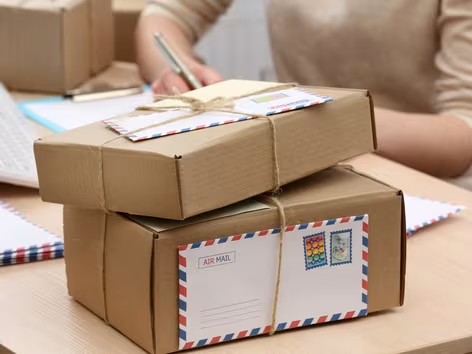
Direct mail can be a more relevant customer communication tool when done personally, but it may prove hard to do on a large scale. Within every campaign, various data, creative content, mailing lists, and production processes might be necessary.
With increased volumes, the manual processes may slow down campaigns, and it may become difficult to deliver timely communication. They also have the potential to complicate the maintenance of personalization to a large audience.
Direct mail automation is a viable means of linking customer data to such production activities. NextPage can program customer actions, data events, or milestones to initiate customized mail pieces as opposed to manually starting every mailing.
The method assists you in delivering relevant messages at the correct level and minimizing redundant production efforts. It also enables your direct mail strategy to coexist with the current marketing workflows.
The points below describe how this process is done and where it is applicable.
1. Automate Personalized Direct Mail Campaigns at Scale
Recurring or trigger-based campaigns could be made easier through direct mail automation. With direct mail automation software, customer data can start a mailing when a predefined event occurs. This decreases the manual handling of every production job.
NextPage links the customer data to its production process. When the workflow is configured, a qualifying event may be used to issue a personalized mail piece. This can then be followed through production and mailed in accordance with rules.
This is effective when communicating with a large number of customers. You may add customer action, date, or milestone rules. Every rule may dictate the mail piece to be printed.
Consequently, your team is able to minimize repetitive work. Customers can also receive timely messages based on their interactions with your business.
2. Connect Customer Data with Direct Mail Workflows
Personalization starts with having useful customer data at the right time. However, storing data alone does not make a campaign personalized. You also need a reliable way to move relevant information into your mailing workflow.
NextPage supports data exchange through secure FTP and Web Service API connections. These methods allow information from your systems to enter the automated process. The data can then be handled according to the rules set for each campaign.
For example, a new purchase can trigger a follow-up mailing. Likewise, an upcoming renewal date can start a reminder. This connection helps link customer activity with physical communication.
It also reduces the need to export data and prepare each mailing manually. Instead, the established workflow can handle these steps based on predefined conditions.
3. Create Targeted Mail with Variable Data
Personalization becomes more useful when mail content can change for each recipient. Variable data printing allows selected elements to change within the same production run.
These elements may include names, images, messages, offers, or other details. As a result, you can create different mail pieces without setting up a separate print job for every recipient.
NextPage uses variable data templates and business rules in its automated process. The templates can use variable text and images based on campaign data.
This approach can go beyond adding a recipient’s name. For example, you can send different messages to new and existing customers. You can also adjust offers based on purchase history or customer segments.
As campaign volume grows, automation makes these changes easier to manage.
4. Trigger Mailings Based on Customer Actions
Timing can affect how relevant a direct mail message feels. A fixed mailing schedule may reach customers too early or too late. Triggered mail connects communication with specific customer events.
You can set triggers around actions, dates, or milestones. These may include a new customer record, purchase, appointment, renewal date, or period of inactivity. NextPage can use these conditions to start the appropriate mailing.
The same approach can support different communication needs. A new customer may receive an onboarding kit. An existing customer could receive a loyalty offer. Someone nearing renewal may receive a timely reminder.
This gives you greater control over timing. It also helps your campaigns respond to customer activity instead of relying only on a fixed schedule.
5. Integrate Direct Mail with Digital Marketing Campaigns
Customers often interact with businesses across several channels. They may receive an email, visit a website, interact with a CRM campaign, and later receive physical mail. Keeping these activities connected can help create a more consistent customer experience.
NextPage’s direct mail automation approach is designed to work with CRM and digital marketing workflows. Customer data can move from existing systems into the production process, allowing physical mail to become part of a broader communication strategy.
For example, you might use digital marketing to introduce an offer and then follow up with a personalized mail piece. You could also send physical communication after a customer completes a particular action online.
This does not mean every digital interaction needs a direct mail response. Instead, you can identify the moments where physical communication adds value. By setting rules around those moments, you can incorporate direct mail into a wider campaign without managing each mailing separately.
6. Streamline Direct Mail Production and Fulfillment
Scaling personalization requires more than creating customized content. Your production process also needs to handle data, printing, mailing, and reporting efficiently. Otherwise, growing campaign volume can create additional administrative work.
NextPage’s automated workflow covers several stages of production. These include template and business-rule configuration, secure data delivery, automated data exchange, print and mail production, and billing reports. Once the workflow is established, production can proceed based on the relevant triggers.
This structure can reduce the number of manual steps involved in recurring campaigns. It also gives you a defined process for moving customer information from your systems into physical communications.
The benefits become more noticeable when you manage frequent or high-volume campaigns. Instead of increasing manual work as your audience grows, automation allows the workflow to respond to a larger volume of qualifying customer events.
For businesses managing onboarding, reminders, loyalty programs, order follow-ups, events, reactivation campaigns, or renewals, this can make direct mail easier to incorporate into ongoing marketing operations.
Conclusion
Scaling personalized direct mail requires a process that can handle both customer data and production demands. Manual workflows may work for occasional campaigns, but they can become difficult to manage as volume and personalization increase.
NextPage’s automation approach connects customer events with predefined production workflows, allowing relevant mail pieces to be created and sent with less manual involvement. You can also use variable data to adjust content for individual recipients and integrate physical mail with broader marketing activities.
By combining these capabilities, direct mail automation can help you maintain timely, personalized communication while making large-scale campaign management more manageable.