Your job application has reached the testing stage, and one of the tests is a numerical reasoning test. If you have not done much math since school, that can feel like bad news.
It is better news than it sounds. A numerical reasoning test is not an advanced math exam. It uses a small set of skills you learned at school: spotting patterns in number series, basic arithmetic, fractions and percentages, ratios, and speed and time. What the test adds is time pressure and a few traps.
This guide shows you what the questions look like, the five skills behind many of them, a sample question for each, a method for working through them, and how to keep your nerves in check. At the end, it answers a question many candidates ask: what are the top 10 psychometric tests, and what does each one measure?
What Is a Numerical Reasoning Test?
A numerical reasoning test checks how well you can work with numbers quickly and accurately. Some questions give you a series of numbers and ask what comes next. Some give you a calculation with a missing number. Others are short word problems about sharing, percentages, or journey times. Each question has several answer choices, usually four or five.
The math itself is basic. The difficulty comes from three things: recognizing the rule or method a question requires, avoiding small slips, and doing it quickly. Some tests let you use a calculator, and some do not. Always check the instructions.
Employers use these tests because the skill matters beyond the test room. People who are more comfortable with numbers tend to make better decisions with them and are less easily swayed by how a figure is presented. That is useful in almost any job that involves budgets, sales targets, reports, or data.
You can try a free sample before you start preparing. The Human Capital Hub has a numerical reasoning practice test you can take online.
The Five Skills You Actually Need
Many numerical reasoning questions use one of five skills, sometimes two at once. Learn to spot which skill a question needs and you are halfway to the answer. Each skill below comes with a sample question drawn the way it will look on screen, and the answer underneath.
Skill one: number series
A number series question shows a row of numbers that follow a hidden rule and asks what comes next. Start by writing the gap between each pair of numbers. If the gaps are the same, the rule is adding a fixed number. If the gaps themselves grow in a pattern, such as 2, 4, 6 or 2, 4, 8, continue that pattern. If the numbers grow very fast, test multiplying: is each number double or triple the one before, plus or minus a little?
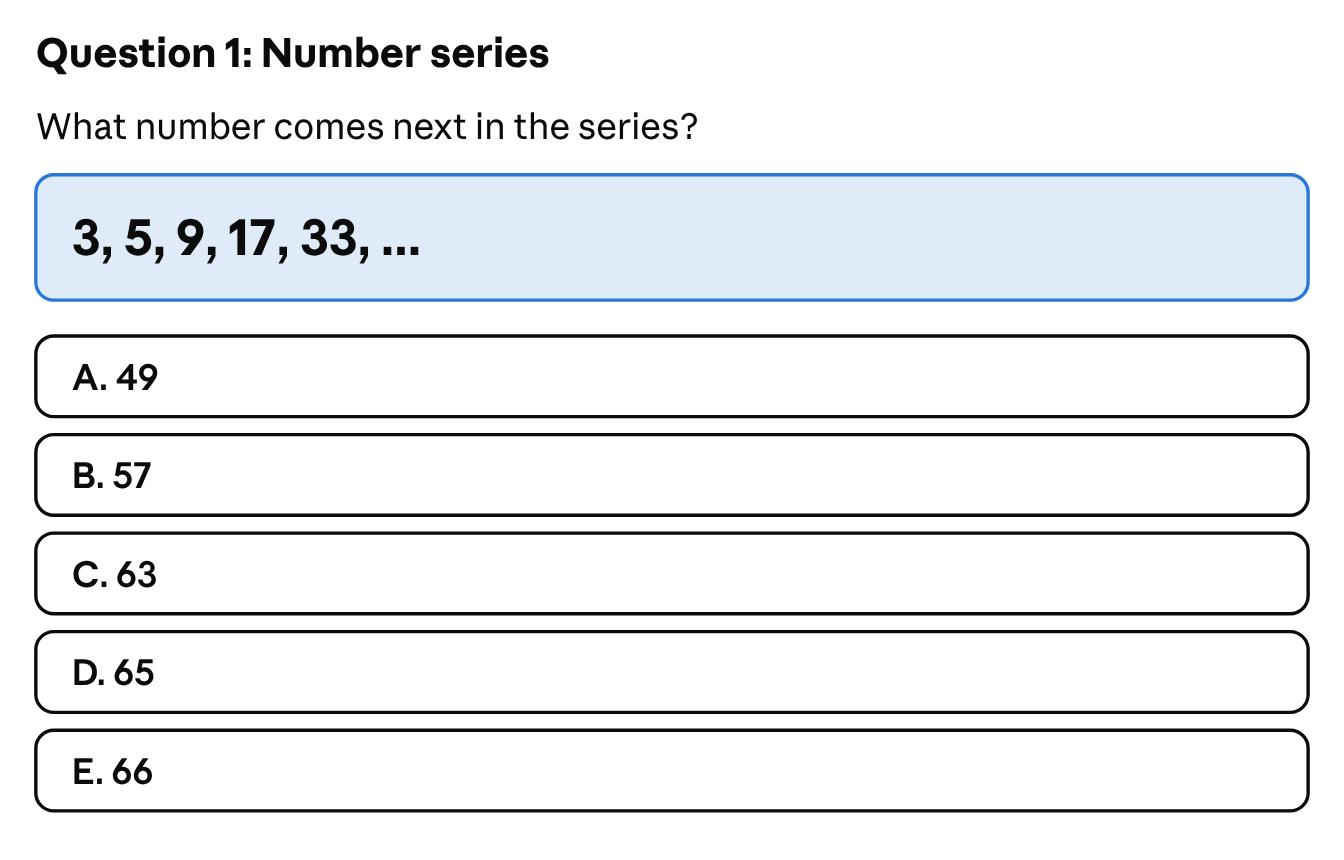
Answer: D (65). The gaps between the numbers are 2, 4, 8 and 16, so each gap doubles. The next gap is 32, and 33 plus 32 gives 65. Another way to see it: each number is double the one before, minus 1.
Skill two: missing numbers and basic arithmetic
These questions give you a calculation with one number replaced by a question mark. Work backward from the answer, undoing each step in reverse order. Remember the order of operations: multiplication and division come before addition and subtraction. Once you have an answer, put it back into the calculation to check it.
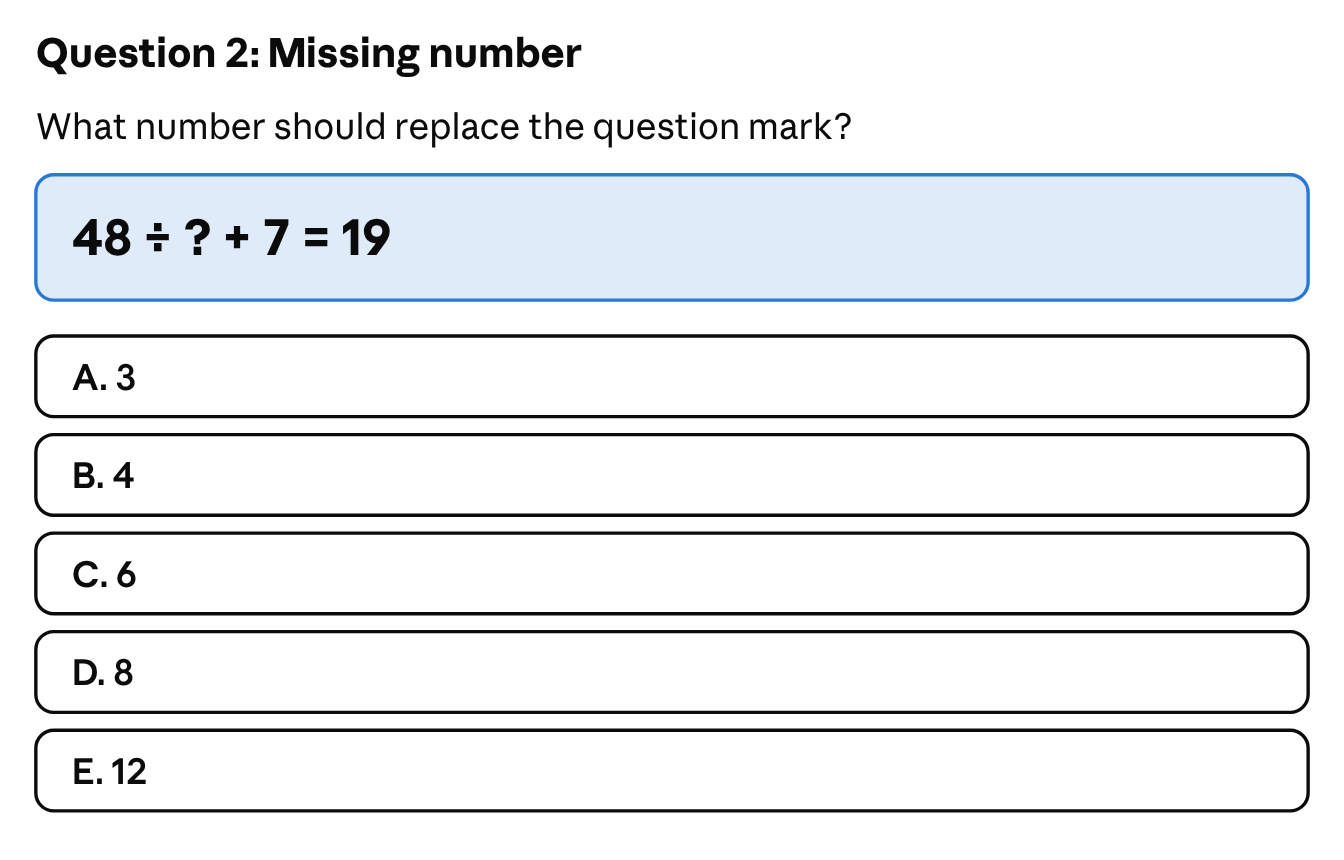
Answer: B (4). Work backward. If something plus 7 equals 19, that something is 12. So 48 divided by the missing number is 12, which means the missing number is 4. Check: 48 divided by 4 is 12, and 12 plus 7 is 19.
Skill three: fractions and percentages
Many questions mix fractions and percentages. Work from the inside out, one step at a time. To find a percentage of a number, divide by 100 and multiply by the percentage. To find a fraction of a number, divide by the bottom number and multiply by the top number. Handy shortcuts: 10% is the number divided by 10, and 5% is half of that.
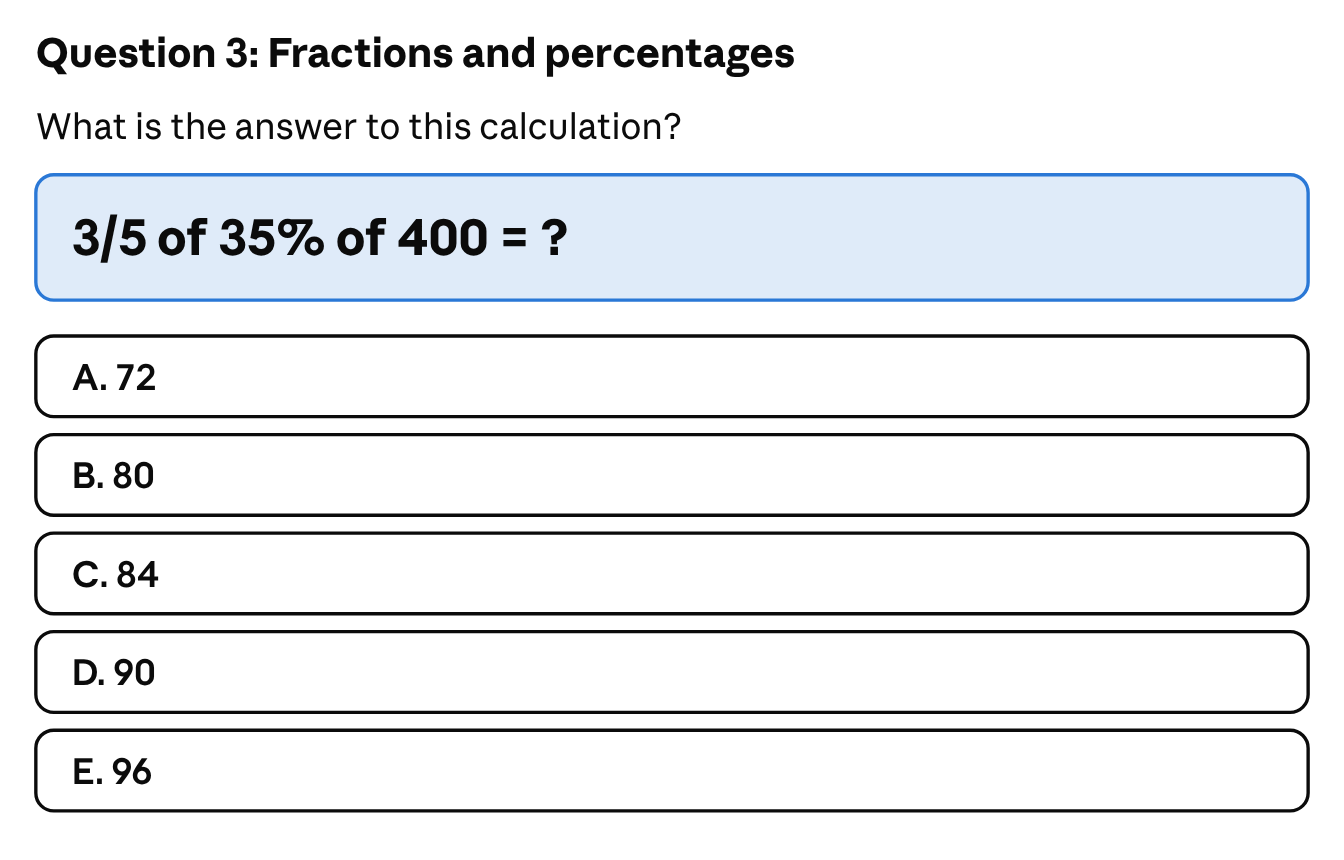
Answer: C (84). First find 35% of 400: 10% is 40, so 35% is 3.5 times 40, which is 140. Then find 3/5 of 140: 140 divided by 5 is 28, and 28 times 3 is 84.
Skill four: ratios
Ratio questions often ask you to share an amount in a given ratio. Add the parts of the ratio to find the total number of shares. Divide the amount by that total to find the value of one share. Then multiply by the number of shares each person gets. Watch which person the question asks about: the trap answer is usually the other person's share.
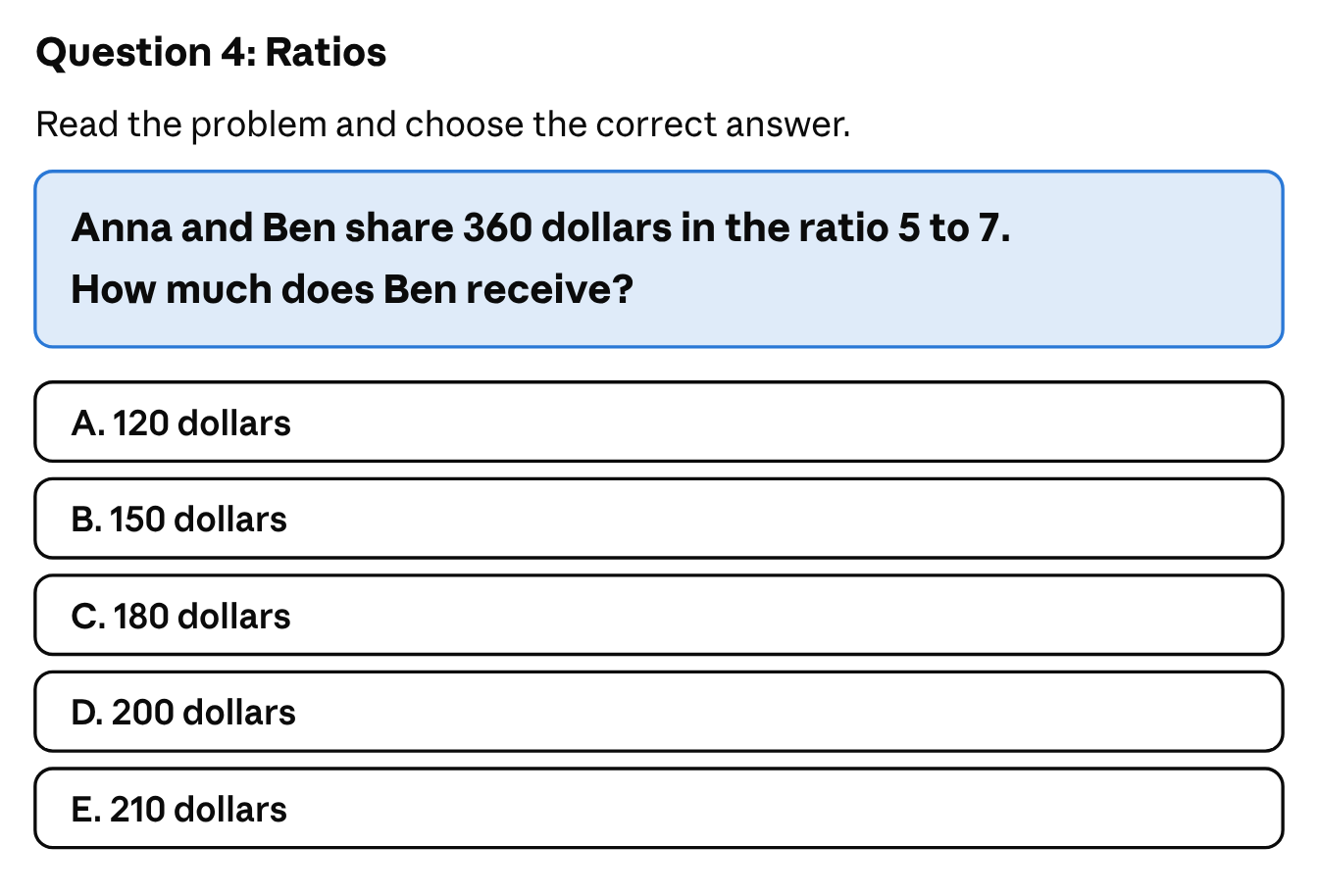
Answer: E (210 dollars). The ratio 5 to 7 makes 12 shares in total. 360 divided by 12 is 30, so one share is worth 30 dollars. Ben gets 7 shares, which is 210 dollars. Anna gets 150 dollars, which is choice B and the trap.
Skill five: speed, distance and time
Remember one rule: speed equals distance divided by time. Rearrange it as needed: distance equals speed times time, and time equals distance divided by speed. A common slip is with minutes. Convert them to hours as a decimal first: 30 minutes is 0.5 hours, 15 minutes is 0.25 hours, and 45 minutes is 0.75 hours.
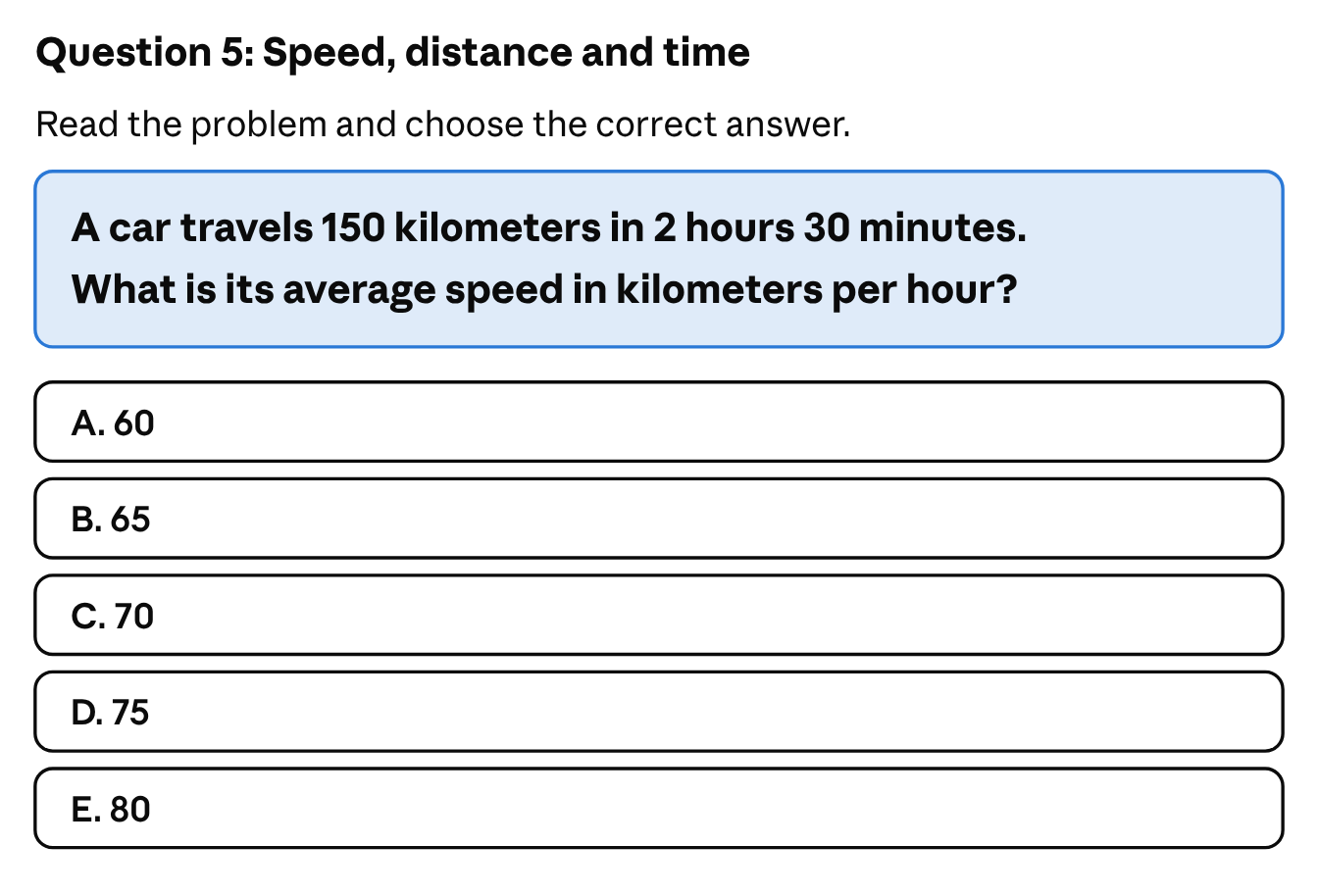
Answer: A (60). 2 hours 30 minutes is 2.5 hours. 150 divided by 2.5 is 60 kilometers per hour. If you had used 2.3 hours by mistake, you would have got about 65, which is choice B.
How to Pass a Numerical Reasoning Test: A Step by Step Method
Use the same five steps on every question. They slow you down just enough to avoid the traps, and speed you up everywhere else.
Step one: read the question twice. Check exactly what is being asked. Is it the next number in the series, or the one after that? Ben's share, or Anna's? Many wrong answers come from answering a slightly different question.
Step two: check the units. Is the time in hours or minutes? Is the answer wanted in dollars or cents, kilometers or meters? Convert everything to the same unit before you calculate.
Step three: name the skill. Number series, missing number, fractions and percentages, ratio, or speed and time? Naming it tells you the method.
Step four: estimate before you calculate. Round the numbers and get a rough answer in your head. With five answer choices, a quick estimate can often rule out two or three at once, and you will spot a slip straight away.
Step five: use the calculator for the exact figure. If a calculator is allowed, use it. Studies of calculator use in math classes found that students who used them did at least as well on problem solving as those who did not, and often better. In the test, the calculator protects you from small slips under time pressure. Then pick your answer and move on.
Beating Math Nerves
If numbers make you anxious, you are not alone, and the anxiety itself can cost you points. A review of 747 results gathered over more than 25 years found that math anxiety is linked to lower math scores from childhood right through to adulthood. The link was small to moderate, which means anxiety does not decide your score, but it does chip away at it.
One simple fix has good evidence behind it. In a set of experiments, students who spent 10 minutes writing about their worries just before an important exam scored higher than students who did not, and the benefit was biggest for the most anxious students. Writing the worries down seems to free up the mental space that worrying would otherwise take.
So on test day, take a few minutes beforehand to write down exactly what you are worried about. Then put the paper away and start. Familiarity also helps: every practice test you do makes the real one feel more ordinary.
How Much Should You Practice for a Numerical Reasoning Test?
How you practice matters more than how long. A major review of study methods found that two techniques stood out: testing yourself with practice questions and spreading practice over several days rather than cramming it into one. Rereading notes and highlighting, which many people rely on, did little.
Practice on the real format also helps, up to a point. A review of more than 134,000 people who took ability tests more than once found a modest rise on retesting, and a larger review found that scores stopped rising after three attempts. So two or three full timed tests are enough; after that, spend your time on the skills you keep getting wrong.
Here is a simple one week plan. On day one, do a full timed practice test cold, then mark which of the five skills each wrong answer needed. On days two to five, take one or two skills a day and work through 15 to 20 questions each, untimed at first, then timed. Practice estimating before you calculate. On day six, do a second full timed test and review every mistake. On day seven, rest, or do a light third test if you feel unsure about the pace.
What Are the Top 10 Psychometric Tests?
A numerical reasoning test is rarely the only test in a hiring process. Here are ten common types you may meet, what each one measures, and what the research says about them. They fall into two groups. Ability tests have right and wrong answers. Style and judgment tests look at how you tend to behave.
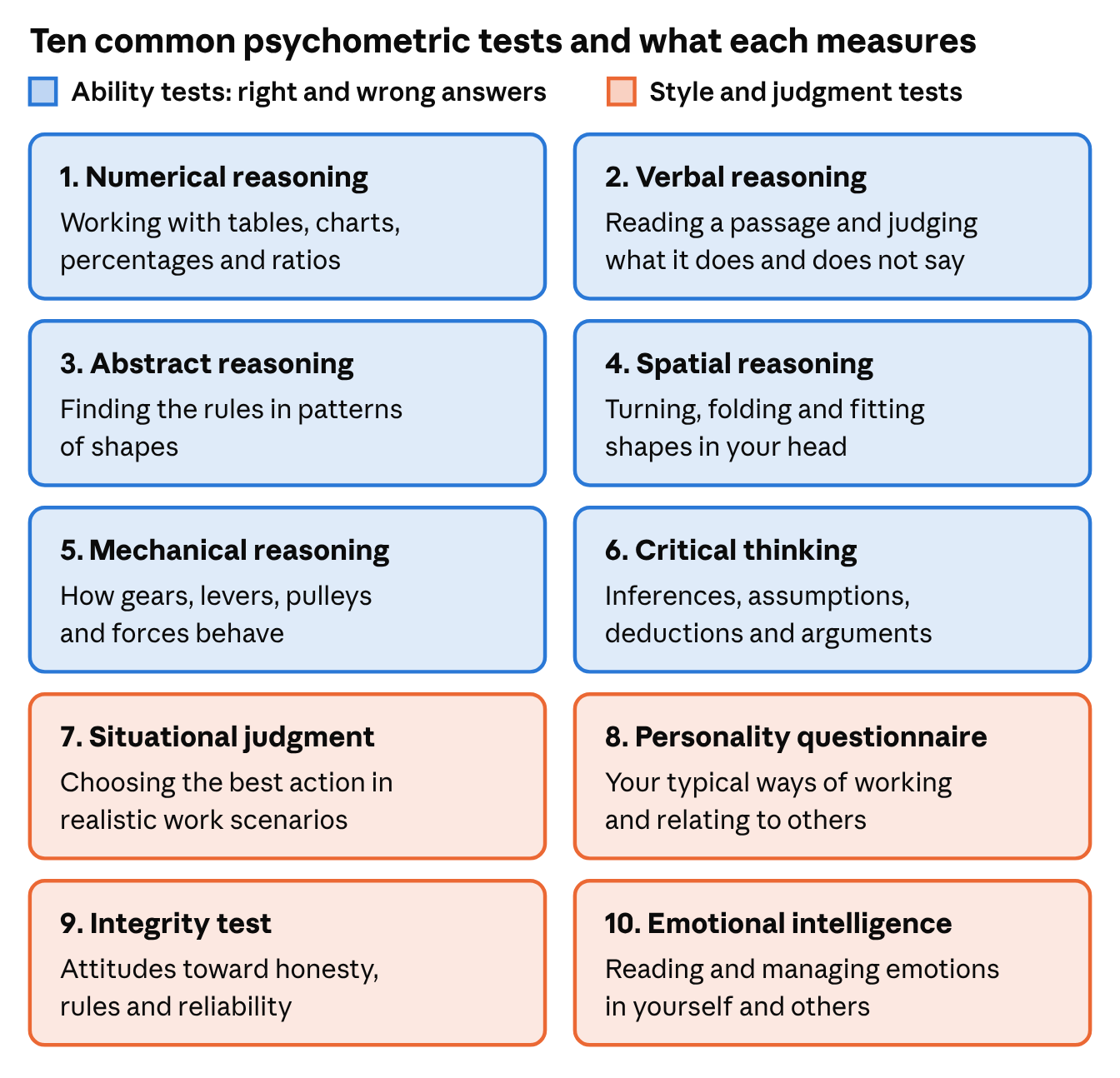
The first six are ability tests. Tests of general mental ability, which these reasoning tests tap into, remain useful predictors of job performance, although a recent reanalysis found their power had been overstated for years. You can prepare for all six the same way: learn the question types, practice with a timer, and review your mistakes.
Situational judgment tests describe a realistic work problem and ask you to choose the best or worst response. A review of the research found that they predict job performance and provide information beyond that of ability and personality tests. Prepare by reading the job description closely and thinking about what the role values.
Personality questionnaires ask how you usually think, feel, and act. Of the traits they measure, being organized, dependable and hardworking, which psychologists call conscientiousness, predicted performance across jobs in a classic review. There are no right answers here, so answer honestly and consistently rather than trying to guess the ideal profile.
Integrity tests assess attitudes toward honesty. A large review found they predict job performance and problem behavior at work. Again, honest and consistent answers work best.
Emotional intelligence tests measure how well you notice, understand, and manage emotions. A review found that they predict performance most clearly in jobs heavy on emotional work, such as customer service and caring roles.
If you want to try several of these, The Human Capital Hub has free psychometric practice tests covering different types.
Key Takeaways
- A numerical reasoning test asks you to answer practical questions from tables, charts and short texts, using basic school math under time pressure.
- Many questions rest on five skills: number series, missing numbers and basic arithmetic, fractions and percentages, ratios, and speed, distance and time.
- Read the question twice, check the units, estimate first, then calculate and check.
- Math nerves chip away at scores; writing down your worries for a few minutes before the test can help.
- Practice by testing yourself over several days, and stop adding full practice tests after about three.
- Numerical reasoning is one of ten common psychometric tests; ability tests reward practice, while style and judgment tests reward honest, consistent answers.
Implications for Practice: What to Do If You Do Not Pass
First, find out whether you can retake the test and how long you must wait. Retakes usually go better. A study of people applying to medical school found that those who retook an ability test scored noticeably higher the second time.
Second, use the wait to target your weak skill. Go back over your practice tests and sort your mistakes into the five skills. If most errors came from misreading the question, practice step one until reading twice is automatic. If they came from running out of time, practice estimating so you can rule out wrong answers faster.
Third, build numbers into your daily life. Work out the percentage discount in a shop, how long a journey will take at a given speed, or how to split a bill in a ratio. Small daily practice makes the test feel familiar.
If you want to understand how good employers run these assessments, The Human Capital Hub explains the pre employment testing practices they follow.