Are you building your HR foundation or ready to lead change? Choosing between CIPD Level 3 vs Level 5 often comes down to one question. Where are you in your HR journey today, and where do you need to be next year? Even on basics like time and cost, there is a clear difference. The Level 3 foundation typically takes 8 to 12 months and costs about £1,300 to £2,300, as outlined in the CIPD’s official overview. The Level 5 diploma stretches to 12 to 16 months with typical fees of £1,600 to £3,600, according to CIPD’s guidance for the associate diploma. Those are not small differences in budget or time. You should also know that no peer reviewed comparative studies in the available sources directly measure the ROI of CIPD Level 3 vs Level 5 on salaries or promotions. What we do have is clear guidance from CIPD. Level 3 builds fundamentals for new entrants. Level 5 develops practitioners into managers and change agents. This article uses that guidance as the anchor and turns it into concrete decisions for HR leaders and aspiring practitioners.
Understanding CIPD Qualifications
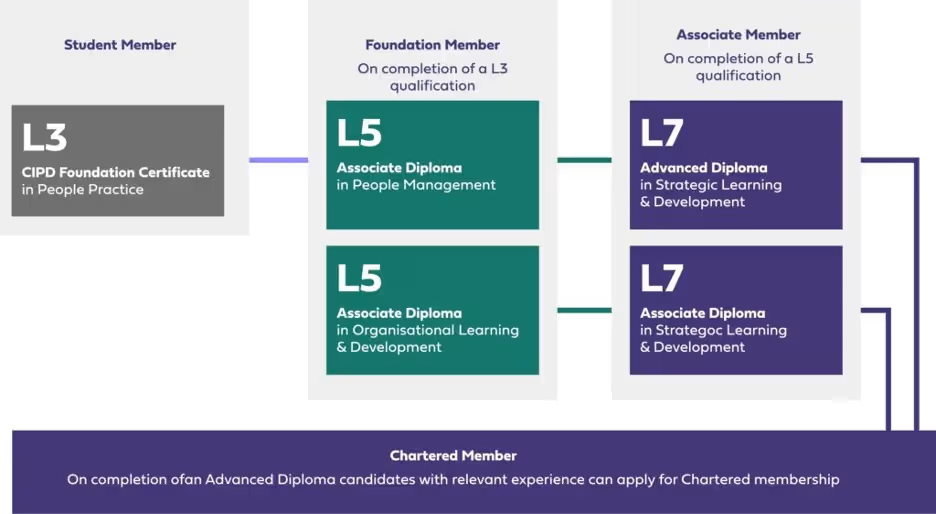
CIPD is the professional body for HR and people development. Its qualifications ladder fits the depth of responsibility, not simply years of service. The structural distinction in CIPD Level 3 vs Level 5 is deliberate. Level 3 sits at RQF Level 3 and targets those new to people practice or in HR support roles. Level 5 sits at RQF Level 5 and targets professionals with experience who are stepping into advisory or managerial impact.
Because we do not have head to head empirical studies comparing outcomes of CIPD Level 3 vs Level 5, the most reliable signal is the purpose each qualification serves. CIPD positions Level 3 as the firm foundation for people practice, with completion leading to Foundation Membership. The Level 5 diploma confers Associate Membership and focuses on applying evidence based practice to drive organisational change. When the awarding body itself clearly differentiates the two based on professional maturity, you can match candidates to the level by current responsibility and readiness with confidence.
Practical translation for a team environment
- Use Level 3 to standardise baseline capability across HR assistants, administrators, coordinators, and those moving in from adjacent functions. Target outcomes include improved process fluency, compliant documentation, and confident, consistent case handling.
- Deploy Level 5 for advisors, generalists, and specialists who need to partner with the business, design policy, and influence change. Target outcomes include stronger business partnering, talent and ER interventions, and measurable policy outcomes.
Two operational guardrails keep choices tight. First, treat Level 3 vs Level 5 as a capability to responsibility match, not a preference test. Second, time and cost must align with role criticality. If the business needs advisory level impact inside 12 months, fund Level 5 for those who already operate close to that bar.
CIPD Level 3: Ideal for Entry-Level HR Roles
CIPD frames Level 3 for people in HR support roles or those new to the profession. That context matters. The curriculum teaches the fundamentals. You cover core people practice, the employment relationship at a basic level, and the building blocks of HR operations. The focus is on doing the essentials well and consistently.
In practical terms, Level 3 works best when
- The role is task heavy and process centric such as onboarding, records, and first line queries.
- You have limited exposure to employment legislation, policy frameworks, or casework.
- The organisation needs reliable execution more than strategic input from this role.
You can expect learning and assessment through written work and applied tasks. Providers commonly use assignments and work based evidence. This gives you a safe runway to apply concepts in your day to day, which shortens the time to utility. Programmes typically run 8 to 12 months. That is a pragmatic cycle for entry level onboarding and capability building.
What HR leaders can implement
- Define day one and month six competencies for Level 3 learners. For example, accurate HRIS data maintenance, error free contract generation, timely right to work checks, and correct triage of ER queries.
- Build a supervisor scorecard aligned to Level 3 modules so feedback loops reinforce learning. Track accuracy rates, turnaround times, and first contact resolution on HR tickets. Review trends each month.
- Create a progression plan that explains the move from Level 3 to a junior advisor role once the learner shows consistent operational excellence and can support low risk ER or policy queries.
Role outcomes you can hire against after Level 3 include HR Assistant, HR Administrator, Learning Administrator, and Organisational Development Coordinator. For individuals, the value in CIPD Level 3 vs Level 5 is clarity. Level 3 is the most efficient path when you are entering the field and need breadth across the basics before depth in any one area.
CIPD Level 5: Advancing to HR Management
CIPD describes Level 5 as a step up for those with experience who want to drive change rather than simply support it. The diploma goes deeper into areas such as talent management, the employment relationship, and evidence based practice. The focus is on shaping policy, designing solutions, and influencing business outcomes. These are hallmarks of advisory and early managerial roles.
Use Level 5 when
- You already handle casework, stakeholder engagement, or project delivery and need to move from activity to impact.
- The role requires you to diagnose organisational issues, not simply administer processes.
- You expect measurable change in talent outcomes, engagement, or ER climate over the next 12 to 18 months.
Assessment at Level 5 commonly includes written assignments and work based projects. This mirrors the real work of advisory HR. You diagnose a problem, build a case using data and research, recommend an intervention, and evaluate outcomes. With a 12 to 16 month duration, the timeframe aligns with a typical business cycle for implementing and proving a policy or programme change.
Implementation blueprint for HR leaders
- Tie Level 5 projects to live business challenges. For example, redesign probation processes to reduce early attrition, overhaul ER case handling to cut cycle time, or build a succession plan for critical roles.
- Set a baseline and a target for each project. Commit to metrics such as time to fill, regretted attrition in pivotal roles, ER case closure time, or policy compliance rates. Set specific improvement goals such as a 20 percent reduction in case duration within two quarters.
- Pair learners with senior sponsors such as an HRBP or Head of People. The sponsor should unblock access to data, provide organisational context, and ensure interventions land.
Post qualification pathways include HR Advisor, People Analyst, ER Manager, Talent Manager, and HR Business Partner. In the calculus of CIPD Level 3 vs Level 5, the latter is not harder for the sake of it. It is built to embed advisory judgement and change capability.
Transitioning from CIPD Level 3 to Level 5
A recurring question in any CIPD Level 3 vs Level 5 discussion is how and when to upgrade. CIPD positions Level 5 for those with some HR experience or responsibilities at an advisory level. In practice, readiness looks like consistent success in a Level 3 type role plus exposure to problem diagnosis and stakeholder engagement.
A pragmatic transition plan
- Evidence your experience. Compile a mini portfolio. Include examples of casework you have supported, processes you have improved, or small projects you have run. Map each item to competencies expected at Level 5, such as analysing people data, advising managers, or improving policy outcomes.
- Speak to a provider about recognition of prior learning. Policies vary by centre. Many will evaluate your Level 3 achievement and work experience to shape a tailored learning plan. Treat this as a scoping conversation that focuses on outcomes, time, and assessment load.
- Align the upgrade with role stretch. Ask your manager to sponsor one or two live projects that need advisory input. These are ideal for Level 5 assessments. For example, run a targeted absence reduction initiative or design a line manager capability programme.
- Budget with care. Compared with Level 3, expect a longer duration and higher cost. Avoid splitting attention across too many deliverables in the same period.
Factors to weigh before upgrading
- Role requirements. Are you already expected to influence policy or lead change? If yes, upgrading closes a capability gap you already feel.
- Time commitment. Level 5’s workload must fit alongside cycles such as performance reviews, pay, and peak recruitment.
- Financial investment. Balance fees with the likelihood of role expansion or promotion in your organisation’s talent framework.
The best evidence we have, CIPD’s own positioning, is clear. The decision to move from Level 3 to Level 5 should rest on your current responsibility and near term career goals, not a desire for a higher credential.
A brief wrap up for decision makers. There are no published, peer reviewed head to head studies in the sources provided that quantify outcome differences between CIPD Level 3 vs Level 5. Instead, rely on the programme design and target audience CIPD sets out. Level 3 is the shortest route to reliable and compliant delivery in early HR roles. Level 5 is the structured path to advisory and managerial impact, with a clear focus on evidence based change. Match the level to the work, assign real projects, measure results, and the qualification will pay off in capability you can see in the business.
Frequently Asked Questions
Is a CIPD level 3 worth it?
Yes, if you are new to HR or moving from an adjacent role. In CIPD Level 3 vs Level 5 terms, Level 3 is the most efficient way to master the fundamentals, earn Foundation Membership, and prove reliability in HR operations. You should see quick wins in accuracy, turnaround times, and confidence handling standard queries within months.
Can you go from level 3 to level 5?
Absolutely. Many professionals complete Level 3 and then step up once their role expands. The cleanest path is to show success in Level 3 type responsibilities, then take on advisory style projects that can double as Level 5 assessments. In the logic of CIPD Level 3 vs Level 5, the upgrade is justified when your real work needs Level 5 capabilities.
What is a CIPD Level 5 degree equivalent to?
Level 5 sits at RQF Level 5 in England and Northern Ireland. It is not a university degree. It is positioned at an intermediate level of difficulty and depth, suitable for those moving into advisory and managerial roles. In practice, employers see it as strong evidence of capability that goes past the foundations.
Is it worth doing CIPD level 5?
It is worth it when your current or next role needs advisory judgement, policy design, or driving change. If you link the programme to live business projects, you will build a portfolio of impact while studying. Weigh the longer duration and higher fees against the likelihood of role expansion. Make sure you have sponsorship for project access.
What are the career prospects with a CIPD Level 5?
Typical outcomes include HR Advisor, HR Business Partner, ER or Talent Manager, and People Analyst roles. Compared with Level 3, the Level 5 endpoint offers greater autonomy, broader scope, and a clearer line of sight to HR management. If you are weighing CIPD Level 3 vs Level 5 for your next move, choose Level 5 when your responsibilities already require you to influence outcomes beyond your immediate tasks.